
Listen to this post: Africa’s New Strategic Importance in Great‑Power Competition (January 2026)
Great‑power competition is a polite phrase for a rough idea: the world’s strongest states are jostling for advantage, trying to lock in trade routes, supplies, allies, and influence before a rival does. It’s not just about tanks and treaties. It’s about who controls the parts inside phones, the metals inside batteries, the cables under the sea, and the ports where cargo has to pass.
In January 2026, that rivalry feels sharper. Supply chains are tighter, shipping routes are under pressure, and countries are treating minerals and data like security issues. In the middle of it sits Africa, not as a blank space on a map, but as a set of governments, markets, and voters with choices to make.
The headline isn’t simply “Africa is being competed over”. It’s also “Africa is setting terms”, sometimes confidently, sometimes under strain, often both at once.
What the big powers want from Africa, and why it matters now
Africa’s strategic importance comes from a simple fact: many of the world’s most wanted resources and routes run through, sit under, or connect to African states. That matters more when supply chains are brittle, and when governments in Washington, Beijing, Moscow, and the Gulf treat trade as a tool of power.
There are five big pulls.
First, critical minerals. The clean energy push needs copper for grids, cobalt and lithium for batteries, and manganese and rare earths for motors and electronics. When these inputs are scarce or politically risky, they stop being “commodities” and start being “national security”.
Second, energy and energy transit. Gas projects, offshore oil, and new power links can reshape who supplies whom, and on what terms. Even where the energy is produced elsewhere, African coastlines and sea lanes help decide whether it moves safely.
Third, food and fertiliser inputs. Weather shocks and wars have made fertiliser, grain, and shipping costs swing wildly. Countries that can grow more food, process it, or stabilise fertiliser supply can bargain harder.
Fourth, routes and infrastructure. Ports, rail corridors, and logistics hubs don’t just move goods. They create dependencies: preferred access, exclusive contracts, security agreements, and political influence that can last decades.
Fifth, votes and legitimacy. African states make up a large bloc in the UN and other bodies. When rival powers seek backing for resolutions, sanctions, or new rules, they court African capitals with visits, finance, and promises.
A useful way to picture it is a busy market square. Minerals are the stalls, ports are the gates, cables are the alleyways, and diplomacy is the bargaining. No single actor owns the square, but everyone wants the best position.
| What powers seek | What it looks like on the ground | Why it matters in 2026 |
|---|---|---|
| Critical minerals | Mining licences, processing plants, long-term offtake deals | Battery and defence supply chains are treated as security assets |
| Sea access | Port concessions, logistics parks, shipping agreements | Red Sea and Indian Ocean routes affect prices and delivery times |
| Data routes | Undersea cable landings, cloud contracts, data centres | Data control shapes commerce, policing, and political messaging |
| Political support | Summit diplomacy, debt relief offers, security assistance | Votes and alignment shape global rule-making |
For the wider context of how African leaders are thinking about 2026’s pressures, see Chatham House’s January 2026 analysis.
Minerals, batteries, and the new scramble for supply chains
Cobalt, lithium, rare earths, copper, and manganese have become the new strategic shopping list. They sit inside electric vehicles, wind turbines, drones, radars, and data centres. If a rival can choke supply, or corner processing capacity, it can shape prices and politics far from the mine itself.
That’s why some African governments are pushing back against the old pattern: export raw ore, import finished goods. The new mood is about local processing, tougher licensing, and clearer tax terms. Export controls or processing mandates are blunt tools, but the logic is easy to understand. Rock dug from African soil shouldn’t leave all the value behind.
This shift creates real opportunity. Processing plants and related manufacturing can bring better jobs than extraction alone. They can also build skills in engineering, logistics, and quality control, plus steadier tax revenue if contracts are written well.
The risks are just as real. Dirty processing can poison rivers and farmland. Weak oversight can lock countries into bad terms for decades. And when negotiations happen behind closed doors, elites can cash in while communities carry the costs.
A practical test is simple: does the deal leave behind capability, not just concrete? A mine that trains local technicians, supports supplier firms, and pays reliably into public budgets changes the future. A mine that only ships raw output changes the balance sheet for someone else.
For a deeper look at how conflict and competition can intersect around resources, RAND’s report on great‑power competition and conflict in Africa is a sobering read.
Ports, sea lanes, and the quiet contest over trade routes
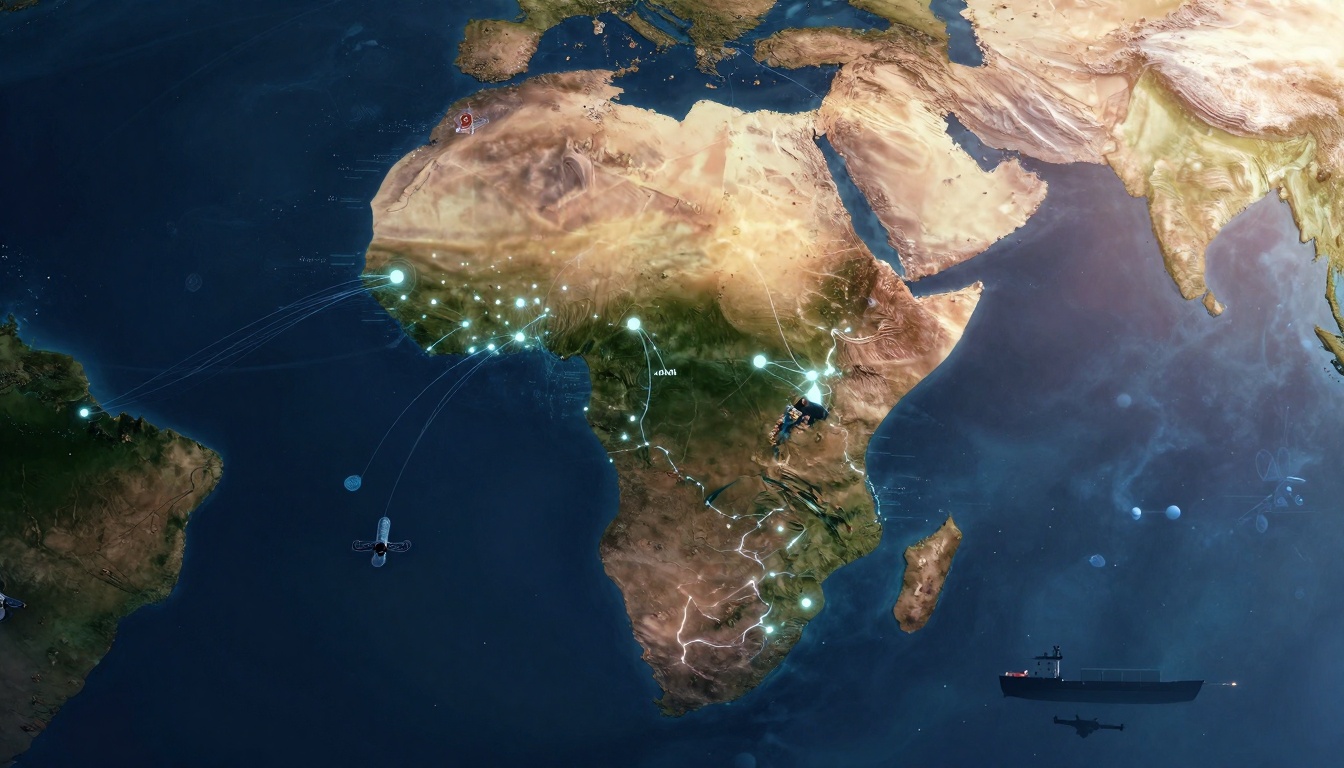
Look at a map and you’ll see why sea access matters. The Red Sea and Gulf of Aden connect to the Suez route, one of the world’s busiest trade corridors. The Indian Ocean links East Africa to the Gulf, India, and Southeast Asia. Around the Cape, Atlantic and Indian flows meet, with shipping lanes that carry fuel, food, and manufactured goods.
Ports are more than cranes and containers. A modern port is a bundle of contracts: land leases, security rules, customs systems, data networks, and financing terms. If a foreign partner runs terminals, builds the rail link inland, and provides the digital system that tracks cargo, influence can arrive quietly, then stay.
That’s why port concessions and “logistics hubs” often come with diplomatic warmth and military interest. Even without new permanent bases, naval visits, joint exercises, and maritime training signal presence. They also build relationships with local forces and ministries, which can shape future decisions when tensions rise.
For ordinary people, the port story lands in prices and jobs. Better logistics can cut the cost of imports and make exports more competitive. But a port that becomes a chess piece can also bring extra security pressure, tighter policing, and political friction, especially if communities feel excluded from the benefits.
How China, the US, Russia, and Gulf states are competing in different ways
The rivalry in Africa isn’t one single contest. It’s a set of overlapping plays, each with its own strengths, weaknesses, and blind spots. The same government might sign a mining deal with one partner, a security agreement with another, and a telecoms contract with a third. That’s not confusion, it’s bargaining.
In early 2026, China is signalling continued high-level attention, pairing diplomacy with industrial and infrastructure offers. The US is trying to balance strategic goals with domestic politics and trade pressure, while also responding to security risks. Russia leans into visible military signalling and security ties where Western partners have stepped back. Gulf states are moving capital into ports, farms, energy, and finance, often with a quicker commercial tempo than slower state bureaucracies.
It helps to think in everyday terms:
- China often offers scale and speed, with packages that combine finance, construction, and political ties.
- The US often offers market access, selective investment, and security partnerships, but with more rules and more domestic constraints.
- Russia often sells security relationships, weapons, and political support, especially in fragile settings.
- Gulf states often bring cash, logistics ambition, and a focus on food and energy security.
None of these approaches is automatically good or bad. Outcomes depend on contract details, oversight, and whether local priorities lead the deal.
For a broader frame of what major power rivalry can mean for African agency and sovereignty, the Council on Foreign Relations report sets out the tensions clearly.
China’s investment playbook is shifting from roads to factories and tech
For years, the most visible symbol of China’s role in Africa was big infrastructure: highways, rail, stadiums, and ports. That hasn’t disappeared, but the pitch is changing. In January 2026, Chinese diplomacy is again stressing production, industry, and supply chains, with deals that talk more about industrial parks, local processing, energy projects, and digital systems.
That change matters because it moves influence closer to the “command points” of an economy: standards, data, payments, and the location of manufacturing.
The appeal is obvious. When projects happen fast, and when partners can bundle finance, equipment, and contractors, governments can show results. Jobs in assembly, processing, and maintenance can also spread benefits beyond capital cities, if training and local procurement are enforced.
The worries are also familiar. Debt terms can be hard to judge when contracts aren’t public. Local job promises can fade if projects import most inputs and labour. And digital infrastructure raises a newer question: who controls data, and under what rules? A cloud contract or smart-port system can embed dependency just as much as a railway.
If you want to track 2026’s political and economic fault lines beyond any one partner, Africa Practice’s trends to watch in 2026 is a useful checklist.
Security deals, private forces, and military signalling are on the rise
Security partnerships are growing because insecurity is growing. Parts of the Sahel, the Horn, eastern DRC, and coastal West Africa face armed groups, smuggling networks, and political shocks. When violence spreads, the offer of training, kit, intelligence, and drones becomes tempting, especially for governments under pressure to restore order quickly.
These deals take many forms: military training missions, arms sales, intelligence sharing, joint drills at sea, and support for border control. They can help professionalise forces and protect civilians, but they can also tilt power toward hard men and secret budgets.
Private military actors and shadowy contractors add another layer. Where contracts are opaque, and where accountability is weak, security “help” can slide into predation: paying for protection, controlling routes, and profiting from instability.
For everyday life, the stakes are simple. Security can mean safer roads, open schools, and functioning markets. But security without rights can mean raids, fear, and grievance that recruits more fighters. When outside powers back different sides, local conflicts can start to look like proxy contests, with longer wars and fewer exits.
Africa’s leverage, and the hard choices leaders face
Africa’s new strategic importance brings bargaining power, but it also brings traps. Many governments now practise multi-partner diplomacy, taking meetings with everyone and signing targeted deals with different blocs. Regional bodies and trade frameworks can strengthen that position by setting shared standards and reducing “race to the bottom” bargaining.
The leverage is real for three reasons.
First, demand is rising for minerals, energy, and market access. Second, competition means partners fear being shut out. Third, African voters are younger and more connected, and leaders know legitimacy can turn on jobs and prices, not speeches.
But the hard choices don’t go away. Debt stress can force quick deals. Corruption and elite capture can hollow out good policy. Weak regulators can’t enforce safety or environmental rules. And gains often concentrate in capitals while rural communities near mines, ports, and pipelines see disruption first.
So what does “good” look like in practice?
- Transparency: publish key contract terms, including royalties, tax holidays, and ownership.
- Local value-add: require processing, local procurement, and training with measurable targets.
- Competitive bidding: avoid single-bidder projects unless there’s a clear public case.
- Community safeguards: protect land rights, water access, and health, with enforcement power.
- Real oversight: strengthen audit bodies, parliamentary review, and independent regulators.
For readers who want a wider view of what African priorities should be in 2026, including jobs, governance, and growth, Brookings’ Africa priorities discussion helps ground the debate beyond geopolitics.
How countries can bargain for better deals without picking one side
The strongest stance is often not “pro” or “anti” any power. It’s “pro-interest”, with clear national goals written down and defended.
Practical steps that improve bargaining outcomes tend to look boring, which is why they work:
Diversify partners: when a country has options, it can demand better terms. Even a credible alternative bidder can sharpen a deal.
Set priorities before meetings: decide what matters most (jobs, processing, grid power, export earnings), then test each proposal against it.
Publish contracts and beneficial ownership: secrecy is where bad terms breed. Public terms also help citizens judge leaders fairly.
Benchmark fiscal terms: royalty rates, tax take, and local content rules should be compared with peer countries, not negotiated in isolation.
Build negotiation teams: lawyers, geologists, engineers, and finance experts should sit at the table, not just politicians.
Use regional standards: common rules reduce the risk of neighbours undercutting each other. Trade rules and rules of origin can also raise local value by rewarding processing inside a region.
This is how small and mid-sized states punch above their weight: not by grand speeches, but by disciplined contracting.
What to watch next in 2026, signals that the rivalry is intensifying
If you want to follow great‑power competition in Africa month by month, focus on signals that are hard to fake and expensive to reverse:
- New port concessions and exclusive terminal deals, especially on the Red Sea, Gulf of Aden, and key Indian Ocean routes.
- Export bans or processing mandates for key minerals, plus sudden changes to licensing terms.
- Shifts in US trade policy, including tariffs, eligibility rules, and new market-access packages.
- Big tech infrastructure agreements, such as cloud hosting for government services, smart-port systems, and national data centre contracts.
- Defence agreements and joint drills, especially recurring naval exercises and long-term training missions.
- Summit diplomacy that comes with money attached: debt restructuring offers, industrial park announcements, or security packages tied to voting alignment.
A crowded field can be good for bargaining. It can also be a warning sign, like too many hands reaching for the same door handle at once.
Conclusion
Africa’s new strategic importance in great‑power competition comes down to three things: minerals that power modern life, routes that move global trade, and political choices that shape international rules. In January 2026, those pressures are rising, and so is Africa’s ability to negotiate.
The competition can fund roads, factories, skills, and cleaner energy if deals are fair, public, and enforced. It can also fuel debt, corruption, and instability when contracts are secret and security becomes a shortcut. The clearest takeaway is agency: Africa isn’t just the board, it’s also a player moving pieces.
Keep an eye on minerals policy, port contracts, and security pacts. They’re the smoke that often shows where the next fire might start.