

Listen to this post: How AI Overviews Choose Sources And How To Become One
When Google shows an AI Overview, it isn’t “answering from memory”. It’s building a short, confident summary and backing it up with links it trusts.
That creates a new kind of competition. You’re not only trying to rank. You’re trying to become one of the AI Overviews sources that Google feels safe citing.
This guide explains how those sources get picked, what signals matter most, and how to shape your content so it’s easy to cite and hard to ignore.
What AI Overviews are doing when they cite a page
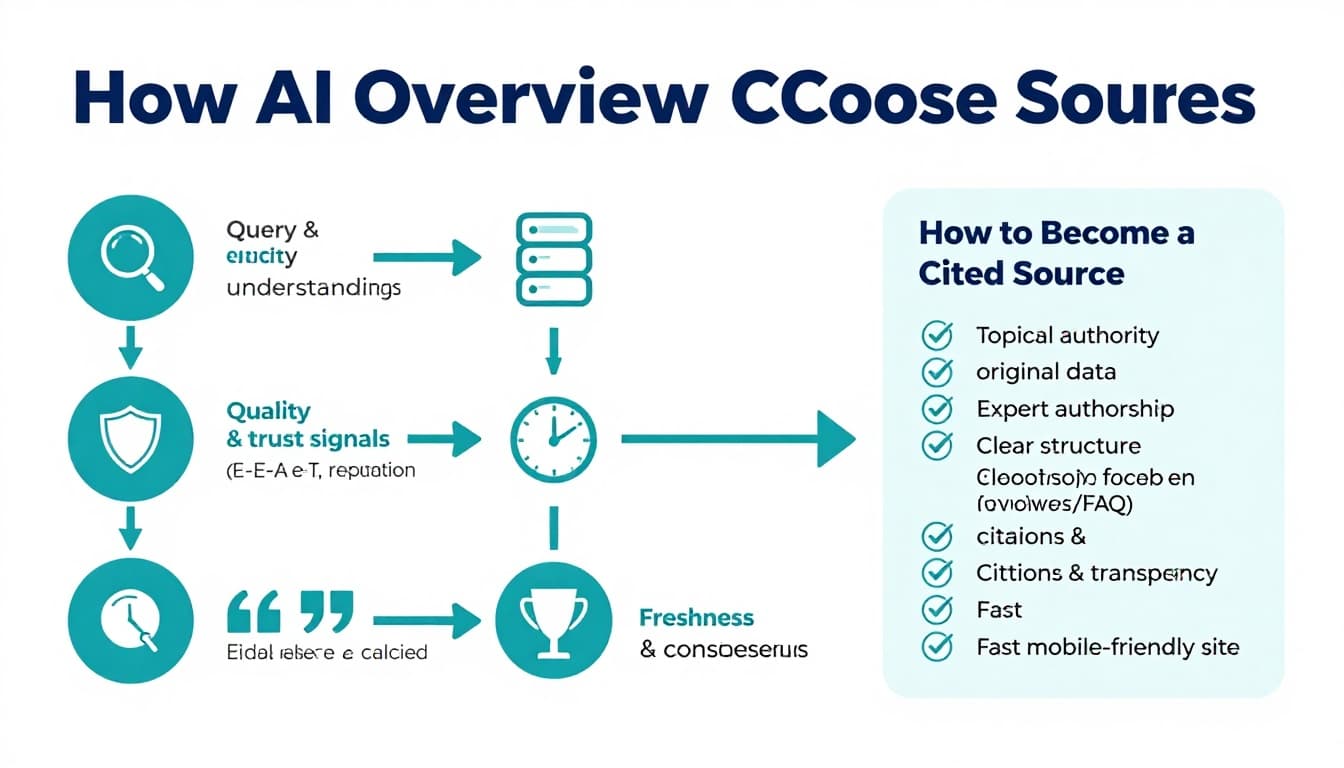
At a high level, AI Overviews work like a research assistant under time pressure. First, they interpret the query. Then, they gather candidates, cross-check claims, and cite pages that best support the final answer.
A key point: selection is not identical to classic ranking. For AI Overviews sources, Google can pull from deeper results if the page fits the question better, explains it more clearly, or looks more trustworthy. Some industry analyses in 2025 reported a meaningful share of citations coming from outside the top few organic results, which matches what many SEOs are seeing in the wild.
The system also seems to “fan out” the query. In practice, that means it behaves as if it ran several closely related searches (definitions, steps, comparisons, risks, costs), then stitched together the best-supported parts. If your page answers one of those sub-questions cleanly, you can win a citation even if you don’t cover everything.
If your page reads like a clear, referenced paragraph that could sit inside a handbook, it’s much easier to cite than a page that reads like a sales pitch.
This is why structure matters so much. AIO needs extractable chunks: short definitions, concise steps, scannable comparisons, and plain language. If your “best bit” is buried under a long story, you’ve made the model’s job harder.
For a helpful breakdown of the selection logic, see how Google’s AI Overviews choose sources.
The signals behind AI Overviews sources: trust, coverage, and extractability
AI Overviews sources usually share three traits: they look credible, they directly answer the intent, and they’re easy to quote.
Here’s a quick way to think about the major signals and what to do on your site.
| What Google needs | What it looks for | What you should publish |
|---|---|---|
| Confidence | Clear authorship, strong reputation, consistent facts | Named authors, bios, “how we test” notes, editorial standards |
| Relevance | Exact match to the sub-question | Pages built around one job-to-be-done, not five |
| Coverage | Enough context to avoid misleading answers | Pros/cons, edge cases, constraints, “when not to” sections |
| Freshness | Recent updates when the topic changes | Last updated dates, change logs for key pages |
| Extractability | Clean headings, short answers, definable claims | Tight H2s, TL;DR boxes, FAQs, tables where useful |
Trust is the big filter. Google has said for years that it rewards strong E-E-A-T, and our proof kit sets out exactly what to put on author, source and About pages to demonstrate it. In AI Overviews, that pressure increases because a wrong answer looks worse when it’s summarised at the top. Pages that cite primary sources (standards bodies, regulators, peer-reviewed work) and show real-world experience often feel safer to reference.
Consensus also matters. If ten pages repeat the same claim but only one shows evidence, the evidence-backed page has the best shot. That’s why original data, testing, or even a simple methodology section can punch above its weight.
Finally, don’t ignore basics. Slow pages, broken layouts, and intrusive ads can reduce the chance you’ll be used as a source — our Core Web Vitals fix list covers the specifics. If you’re rebuilding or tightening performance, reliable hosting helps. Options like WordPress hosting or Hostinger hosting plans make it easier to keep Core Web Vitals under control.
For more context on how source prioritisation is described in the SEO community, read Google AI Overviews source prioritisation.
How to become a cited source: a practical playbook for 2026

Becoming one of the AI Overviews sources isn’t about chasing one “secret” factor. It’s about making your site a dependable reference in a narrow area, then making your best information easy to extract.
Build “citation-ready” pages with this workflow
- Pick one topic cluster and commit
Choose a tight niche, then cover it with depth. A site with 30 excellent pages on one subject often beats a site with 300 mixed posts — see our guide to building topical authority with entity SEO. - Write the part that deserves the citation first
Put the clean definition, steps, or recommendation near the top. Then expand with examples, caveats, and references. - Add proof, not fluff
Include original mini-studies where you can. Even simple things help: a price snapshot with dates, a comparison table you maintain, or test results with photos. - Make authorship and experience obvious
Add an author box with credentials and relevant experience. If you have real hands-on work, say what you did and when. - Tighten internal connections
Even without internal links here, your site still needs strong pathways. Tools like Link Boss internal linking can help you spot orphan pages and build sensible clusters that support topical authority. - Publish, promote, and keep it fresh
AI Overviews favour up-to-date pages on fast-moving topics. Build a simple update routine. If you run a newsletter, you can also use it to gather feedback and repeat visits. Beehiiv newsletter platform is a solid option for that loop.
A simple example (so you can picture it)
Imagine you run a niche site on home air purifiers. Instead of a generic “best air purifier” post, create one page titled “HEPA vs carbon filters for smoke (what actually works)”. Add a short summary, a table of scenarios (wildfire smoke, cooking odours, allergies), and citations to public health guidance. Then add a testing note (room size, run time, PM2.5 meter used). That page becomes easy to quote because it’s specific, supported, and structured.
To speed up drafting while keeping a human tone, tools like RightBlogger can help with outlines and rewrites. If you’re testing AI-assisted content and you want stricter checks, SEOengine.ai can support quality control workflows.
Don’t overlook site foundations
If your site needs a refresh, a clean build often improves clarity and trust. Consider IONOS web design service if you want a done-for-you option, or strengthen your promotion with IONOS online marketing once your best pages are live.
For another view on selection factors and how citations appear, see how AI Overviews select the source.
The fastest way to earn citations is to publish the page you’d trust enough to send to a client, then make it easy for Google to quote.
Conclusion
AI Overviews sources tend to win because they’re clear, careful, and easy to reference. Build topical depth, show your experience, cite reliable material, and keep key pages updated. Once you are being cited, you need to see it: our guides to tracking AI Overviews in Search Console and spotting the CTR drops they cause cover the measurement side. The same work carries across surfaces — see our checklists for ChatGPT Search, Perplexity and Bing Copilot. Then structure answers so they can be lifted cleanly into a summary. If you treat every important page like a mini reference guide, citations start to feel less mysterious and much more earned.