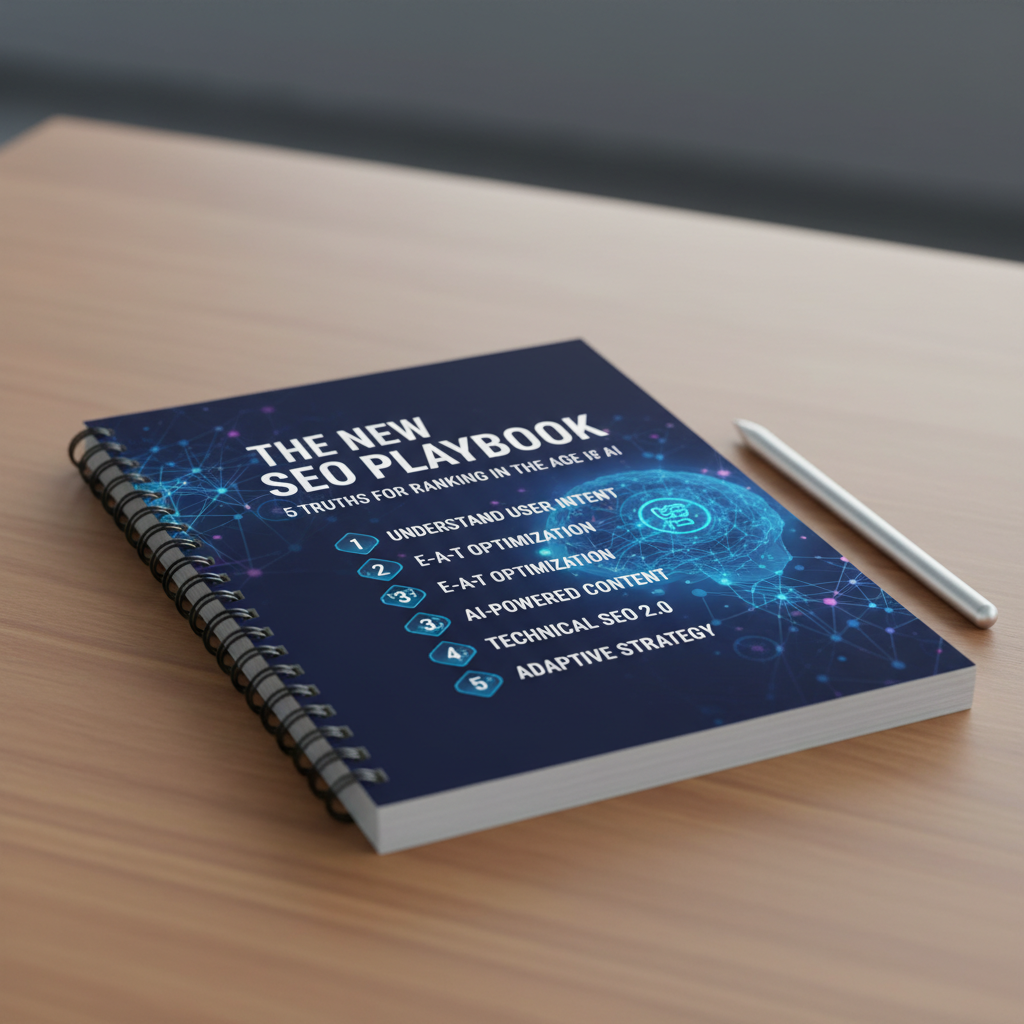

Listen to this post: The New SEO Playbook: 5 Truths for Ranking in the Age of AI
Introduction
The rise of AI-powered search tools like Google’s AI Overviews and ChatGPT has sent a wave of anxiety through the marketing world. With AI generating direct answers to user queries, a critical question has emerged: does traditional Search Engine Optimization (SEO) still matter? It’s a valid concern that leaves many professionals wondering if their established strategies are on the verge of obsolescence.
The answer, however, is not what you might expect. Far from being irrelevant, SEO has become the fundamental bedrock for discoverability in the age of AI. AI systems are not creating information out of thin air; they are discovering, interpreting, and synthesizing it from the vast index of the web. This means that the core principles of SEO are more critical than ever.
This article distills the new reality into a practical playbook for digital marketers. Here are five new rules for mastering discoverability in the generative age.
1. SEO Isn’t Dead—It’s the Foundation AI Is Built On
The single most important thing to understand is that AI search engines do not invent answers. They are sophisticated systems designed to find, process, and rank credible web content to generate a response. To do this, they rely heavily on the same classic SEO signals that have guided search for years to determine which content is discoverable, credible, and authoritative.
Key SEO signals that AI search engines rely on include:
- Structured content and metadata: Using schema.org markup provides AI with clear, machine-readable labels for your content. It tells an AI model precisely what a page is about, increasing the chance it will be featured in an AI-generated answer and making it the literal vocabulary you use to educate AI models about your business.
- Authoritative backlinks: Backlinks are still the “digital equivalent of a vote of confidence.” When trusted, reputable websites link to your content, it signals authority and reliability to the algorithms that feed AI search results; these votes of confidence are crucial data points that an LLM uses to gauge credibility and reduce its risk of surfacing misinformation.
- Topical relevance: To appear in results on platforms like ChatGPT, you still need a solid foundation. This means having a quality website with relevant content and authoritative backlinks to prove your expertise on a topic.
Instead of being a cause for panic, the rise of AI should be seen as a call to double down on getting the fundamentals right. SEO is the foundation that AI search is built on, making a strong and clean strategy more vital than ever.
2. Your New Job Is “Influence Optimization”
The game has changed from simply ranking your own website to strategically shaping how AI systems connect the dots about your brand across the entire internet. This evolution of SEO is known as Generative Engine Optimisation (GEO), or more broadly, “Influence Optimization.” It is the process of optimizing your complete online presence to be recommended by AI systems.
Your reputation is no longer confined to your own platforms; it is a cumulative record shaped by inputs you don’t directly control. Every article, review, forum discussion, and social media mention contributes to how AI perceives and presents your brand.
Your reputation now lives beyond your own platforms, shaped by inputs you don’t control. The goal of influence optimization is to guide how those dots connect across platforms, languages, and moments so they align with your intended narrative.
This represents a profound strategic shift. The job is no longer just about tactical keyword placement on a single webpage. It’s about building a coherent brand narrative everywhere your brand appears, ensuring that when an AI model assembles its understanding of you, the story it tells is the one you want told. This isn’t just about managing perception; it’s about actively training the AI models that will define your brand for years to come.
3. Human Storytelling Is Now Your Greatest Competitive Edge
In an industry where an estimated 42% of marketers use AI to produce content, the internet is becoming saturated with machine-generated text. This creates a significant “noise” problem, making it harder for any single piece of content to stand out. In this environment, your greatest competitive advantage is something AI cannot replicate: authentic human storytelling.
Storytelling is how you create an emotional connection and build brand recall, cutting through the endless stream of AI-generated content to connect with both humans and algorithms. As machines become more adept at producing factual content, the value of genuine experience, emotion, and transformation skyrockets.
To leverage this advantage, marketers should:
- Lead with story, then data: Frame a problem with a relatable anecdote before introducing a data-driven solution. This approach improves engagement and makes your content more memorable and quotable for AI Overviews and journalists alike.
- Share real stories: Engage directly on community platforms like Reddit. User-generated content heavily influences the responses of Large Language Models (LLMs), and participating in genuine, story-led interactions is a powerful way to earn brand visibility and organic citations at scale.
This is a powerful, counter-intuitive trend: as machines get better at writing, the value of genuine human experience and connection becomes paramount.
4. Win AI Overviews by Giving the Answer Away Immediately
A practical test from the digital marketing agency Exposure Ninja reveals a fundamental shift in content structure required for the AI era. When a blog post was updated to answer a specific question clearly and concisely within the first paragraph, it was quickly elevated to the first link cited in Google’s AI Overview result for that query.
The principle is simple: AI Overviews are designed to give users the information they need immediately. These systems favor content that helps them achieve this goal. The Exposure Ninja book notes that AI Overviews are often brief, favoring pages that provide concise content that helps the AI answer the user’s query immediately.
This finding fundamentally changes the old rules of content structure. The days of long, winding introductions designed to hold a reader’s attention are over. This tactical shift is a direct component of Influence Optimization; you are making your content the most efficient, authoritative, and useful building block for an AI to use in its answer construction.
5. You’re Building a Permanent Record for AI’s Brain
This brings us to the most profound implication of “Influence Optimization”: every action you take is not just for the present moment but is actively building a permanent record for AI’s brain. Every piece of content you publish, every brand mention you earn, and every user interaction you foster contributes to a cumulative digital footprint that educates AI models about your brand, your industry, and your reputation.
Think of it this way: traditional SEO is like trying to get to the top of a building, while GEO is like “trying to become part of the building’s foundation.” It’s not just about temporary visibility; it’s about embedding your expertise into the very fabric of the AI’s knowledge base.
Every piece of content, brand mention, and user interaction contributes to the cumulative record. Over time, that record becomes your reputation in data and discourse.
The implication of this is profound. Short-term tactics are less important than a long-term strategy focused on building a consistent, coherent, and authoritative online presence. This record becomes your brand’s permanent identity within the AI’s “brain,” shaping how you are perceived and recommended for years to come. Every asset you publish today becomes a permanent, unerasable part of your brand’s AI-interpreted identity.
Conclusion: The Future is Foundation
The rise of AI search does not signal the end of SEO. Instead, it elevates its core principles—authority, relevance, and quality—to a new level of importance. The mission is no longer simply about ranking for a list of keywords; it has evolved into a more holistic and strategic imperative.
Your new mandate is to build a brand narrative so comprehensive, credible, and coherent that it becomes a foundational source of truth for the AI-driven web. By focusing on a strong technical foundation, authentic human storytelling, and a consistent, long-term presence, you position your brand not just to be found, but to become a foundational source of truth for the next generation of search.
As AI continuously learns from the web, what is the single most important story you want it to tell about your brand?