

Listen to this post: Canonical Tag Setup for Syndicated News in 2026
Syndication can feel like free distribution, until your “copy” outranks your original. In 2026, news gets republished faster than ever across partner sites, newsletters, and aggregator feeds, so canonical tag setup has become the safety belt you can’t skip.
Get it right and Google consolidates signals (links, relevance, trust) on the page you actually want to rank. Get it wrong and you invite duplicate URLs, split authority, and a long, messy clean-up.
This guide focuses on practical setups for publishers, editors, and technical SEOs who manage syndicated articles, especially on WordPress.
Why syndicated news needs tighter canonicals in 2026
A canonical tag is meant to answer one simple question: “Which URL is the main version of this content?” When the same article appears on multiple domains, that question stops being simple.
Syndication in 2026 isn’t just “paste the story on a partner site”. It often includes tracking parameters, template changes, and content modules (related stories, ads, inline widgets). Those differences can be enough for search engines to treat pages as similar, but not identical. In that case, a canonical becomes a strong hint, not a guarantee.
The real risk is silent. Your original page can remain indexed, yet lose visibility because a partner URL becomes the chosen canonical, or because signals get split across multiple copies.
For background on how syndication models work (and why they create duplicate content by default), see the Newstex guide to content syndication. For a broader view of canonicals as part of site architecture, the framing in SeekLab’s 2026 canonical strategy is a useful read.
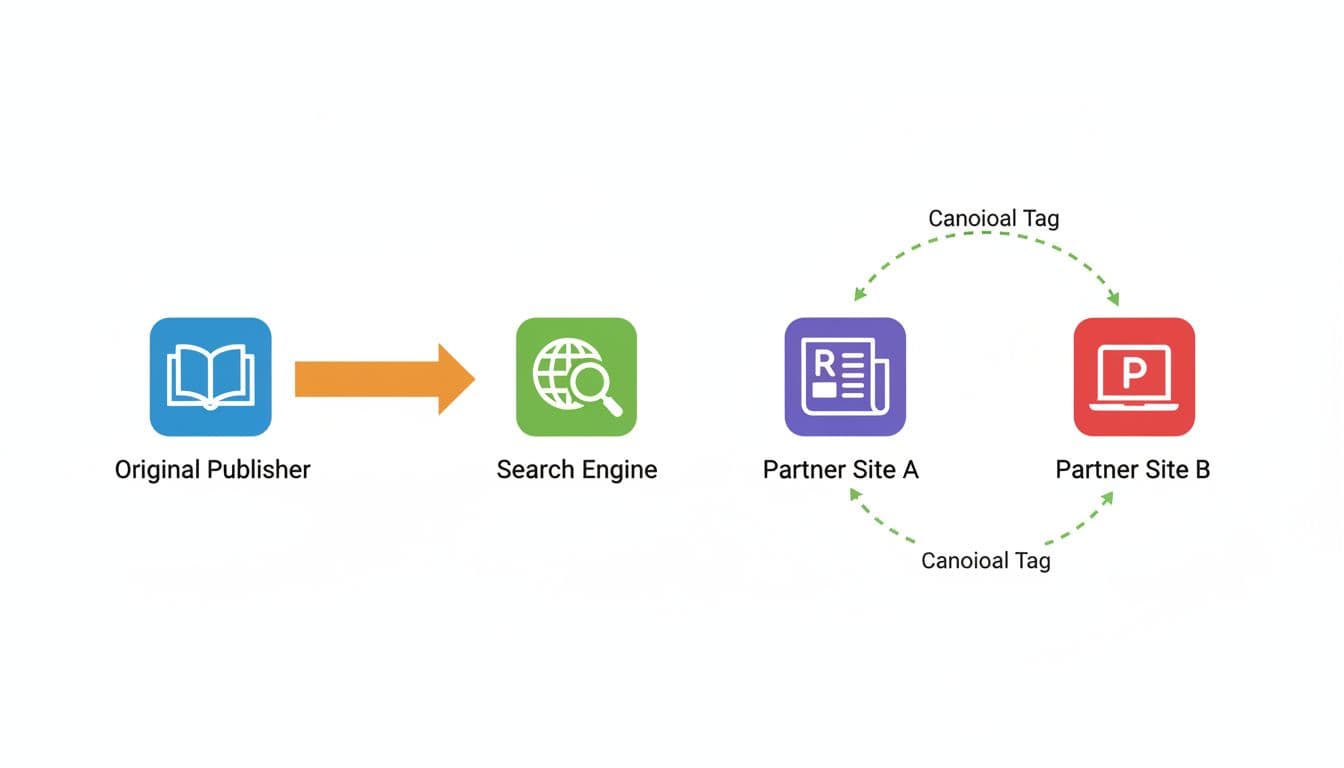
Here’s the guiding principle that holds up across most deals: the republisher should canonical back to the original URL, and the original should self-canonical to itself. When that’s true, syndication usually becomes a reach play, not a rankings gamble.
Canonical tag setup that works across syndication partners
Before you touch code, decide what “the original” means for each story. For most publishers it’s the first URL that went live on your domain, with a stable path and a 200 status code. Keep it clean, consistent, and permanent.
A solid canonical tag setup for syndicated news rests on three basics:
- One canonical per page, placed in the
<head>, not the body. - Absolute URL in the canonical (include
https://). - Canonical target returns 200 and isn’t blocked by robots or noindex.
The canonical tag itself should look like this (example only): <link rel="canonical" href="https://publisher.example/news/story-slug/" />.
Use this table to pick the right pattern for common syndication scenarios:
| Scenario | What the partner should do | What you should do | Best outcome |
|---|---|---|---|
| Full republish of your story | Canonical to your original URL | Self-canonical, keep URL stable | Your URL ranks, partner still gets readership |
| Partner adds heavy rewrites and unique reporting | Self-canonical on partner, link to your original as source | Publish your version as primary | Both can rank for different intent |
| Your own network sites cross-post the same story | Canonical to one chosen hub URL | Keep one “source of truth” URL | Signals consolidate across the network |
| Wire copy used by many outlets | Canonical should point to the licensed source (as agreed) | Avoid claiming canonicals you don’t own | Less duplication conflict, clearer ownership |
A practical implementation tip: if a partner can’t or won’t set canonicals reliably, ask for a noindex on their copy. Canonical plus noindex can be redundant, but in messy CMS environments it often reduces risk.
If a partner insists on keeping their version indexed, don’t let them canonical to themselves when the content is substantially the same as yours. That’s how originals get buried.

If your origin site runs WordPress, stability starts with hosting and caching you can trust. A reliable setup on WordPress hosting or Hostinger hosting reduces odd edge cases where canonicals differ by trailing slashes, HTTP vs HTTPS, or parameter handling after migrations.
Auditing syndicated canonicals (and fixing the problems that actually happen)
Even with the perfect plan, syndication breaks in predictable ways. Editors copy a template, partners inject their own canonical logic, or tracking parameters spread like glitter.
Start audits with reality, not assumptions. Check the live HTML source of both origin and partner pages, then confirm what search engines are choosing as canonical in their own reporting tools. When your chosen canonical doesn’t get selected, it’s usually because other signals disagree — our guide to crawl and index issues that hide good pages covers the “Google chose a different canonical” case in detail.
These checks catch most issues fast:
- Canonical points to a redirect: Update it to the final 200 URL.
- Multiple canonicals: Remove duplicates, keep one.
- Canonical target is blocked: Fix
noindex, robots rules, or paywall and auth walls that prevent crawling. - Canonicals mismatch between desktop and mobile: Align templates and headers.
- Partner page isn’t near-duplicate: If it’s substantially different, expect canonicals to be ignored.
Parameter control matters too. If your story URLs get published with UTM tags, keep the canonical on your own page pointing to the clean URL. That way, shares don’t become accidental duplicates.
For a plain-English refresher on common canonical mistakes and how to spot them, Canonical tags explained is a handy reference. If you want a more advanced, syndication-focused view, this advanced canonical strategy for content syndication adds useful nuance around when canonicals get ignored.
Finally, make the contract do some work. Add a syndication clause that requires (a) canonical to your URL, (b) noindex if canonical isn’t possible, and (c) a visible attribution link near the top.
When your team is moving fast, tools can reduce mistakes. IONOS web design service can help standardise templates across properties, while IONOS online marketing fits teams that want reporting tied to distribution. If partners require “unique” versions, an editor using RightBlogger or SEOEngine.ai can produce a differentiated rewrite faster, so you don’t rely on canonicals alone. For larger sites, Linkboss can help keep internal linking consistent so your original URL stays the clear centre of the topic cluster. If your syndication strategy includes pushing readers back to owned channels, a publication run on the beehiiv newsletter platform gives you a cleaner path to repeat traffic than endless reposts.
Conclusion
Syndication should expand your audience, not dilute your authority. The safest 2026 approach is simple: pick one “source of truth” URL, self-canonical on the original, and require partners to canonical back (or noindex their copies). Keep auditing, because templates drift and small changes add up.
Treat canonical tag setup like an editorial standard, not a one-off technical task, then your best stories can travel widely without costing you the rankings you earned.
Two related pieces worth reading alongside this: your structured data needs to point at the same canonical URL or you send conflicting signals, and if syndicated copies keep outranking you, the underlying cause is often a topical authority gap rather than a tagging one.