
Listen to this post: How to Build a Home Workout Routine With No Equipment (That You’ll Actually Stick To)
It’s a Tuesday night. The living room’s small, the floor space is barely “one yoga mat”, and the idea of a gym feels like a long walk in the rain. You’ve got no kit, no plan, and that familiar thought: “Can I even get fit like this?”
You can, and a home workout routine with no equipment can be simple, effective, and oddly calming. When it fits real life, it stops feeling like a project and starts feeling like brushing your teeth.
This guide shows you how to build a routine for strength, fitness, and mobility using bodyweight moves (a wall or sturdy chair is optional). The payoff is clear: more energy, better movement, and a repeatable session you can do in 20 to 30 minutes.
Start with your goal and schedule, then keep it simple
The best routine isn’t the fanciest one. It’s the one you’ll do on a messy week, when sleep’s short and motivation is thinner than your patience.
Pick one main goal for the next four weeks:
1) Get stronger
You’ll focus on controlled reps, harder variations, and steady progress.
2) Improve fitness
You’ll keep rest short, use full-body circuits, and add a “cardio punch” move.
3) Move better (mobility and joint comfort)
You’ll still work hard, but you’ll add more range of motion, slower tempo, and extra mobility work.
A realistic weekly plan helps you show up without bargaining with yourself:
- Beginner: 3 days a week, 20 to 25 minutes
- More advanced: 4 to 5 days a week, 25 to 35 minutes
Choose a set time and guard it. Early morning, lunch break, right before a shower, it doesn’t matter. What matters is that it’s predictable.
On rough days, use a 10-minute minimum session. That might be one warm-up plus one round of your circuit. You still “keep the chain unbroken”, and that habit pays you back later.
Pick a weekly plan you can repeat
Keep the plan boring enough to repeat and flexible enough to survive a busy week.
Example schedule A (simple and strong)
Mon, Wed, Fri: Full-body circuits
Tue, Thu, Sat, Sun: Walk, stretch, rest, or play a sport
Example schedule B (more variety, still doable)
Mon, Thu: Strength circuit
Tue, Sat: Mobility plus easy cardio (brisk walk, gentle jog, stair walking)
Wed, Fri, Sun: Rest or light movement
A simple rule at the start: leave at least one rest day between hard sessions. Your muscles rebuild when you recover, not while you grind.
Sleep and stress change what your body can handle. If you’ve had a bad night, keep the session easier and cleaner. Do the minimum session, nail your form, and move on with your day.
Set a baseline so you can see progress
Progress feels real when you can point at it. Do a five-minute check-in before week one, then repeat it every two to four weeks.
- Push-ups: max reps in good form (or knee push-ups)
- Plank: max hold up to 30 seconds (stop when hips sag)
- Bodyweight squats: 15 reps, note the time and how they feel
Write the numbers in your phone notes. Keep it honest. Form beats numbers, every time.
If you want extra structure and a beginner-friendly routine idea, Nerd Fitness has a clear reference point for bodyweight basics: Beginner bodyweight workout guidance.
Build your no-equipment workout using a simple template
You don’t need a new plan every week. You need a template you can reuse, then make slightly harder over time.
Use this structure:
1) Warm-up (5 minutes)
2) Main circuit (12 to 22 minutes)
3) Optional finisher (2 to 5 minutes)
4) Cool-down (2 to 5 minutes)
Each session should cover three movement patterns:
- Push: push-ups (or a variation)
- Legs: squats and lunges
- Core: plank and controlled core work
Then add a cardio option if your goal includes fitness.
Cardio punch options: burpees, fast squats, high knees, mountain climbers
Low-impact options: step-back burpee (no jump), marching high knees, squat to calf raise
Keep cues short. Your brain shouldn’t need a manual mid-workout.
Warm-up in 5 minutes to wake up joints and muscles
Think of the warm-up like switching the lights on in a dark room. You’re not trying to “smash it”. You’re trying to move well.
Aim for a light sweat, not heavy breathing:
- March on the spot (60 seconds)
- Arm circles (30 seconds each direction)
- Hip circles (30 seconds each direction)
- Bodyweight good-mornings (10 slow reps)
- Ankle rolls (20 seconds each side)
- 5 slow squats, smooth down and up
If your wrists often feel tight in push-ups, add 20 seconds of gentle wrist circles and palm presses before you start.
Choose the right exercises (with easy swaps)
A good no-equipment routine uses the classics because they work. You can make them easier, harder, slower, faster, or longer.
Push-ups (push)
- Easier: knee push-ups or incline push-ups with hands on a wall
- Harder: slow negatives (3 seconds down) or dolphin push-ups
- Cue: keep a straight line from head to heels, squeeze glutes
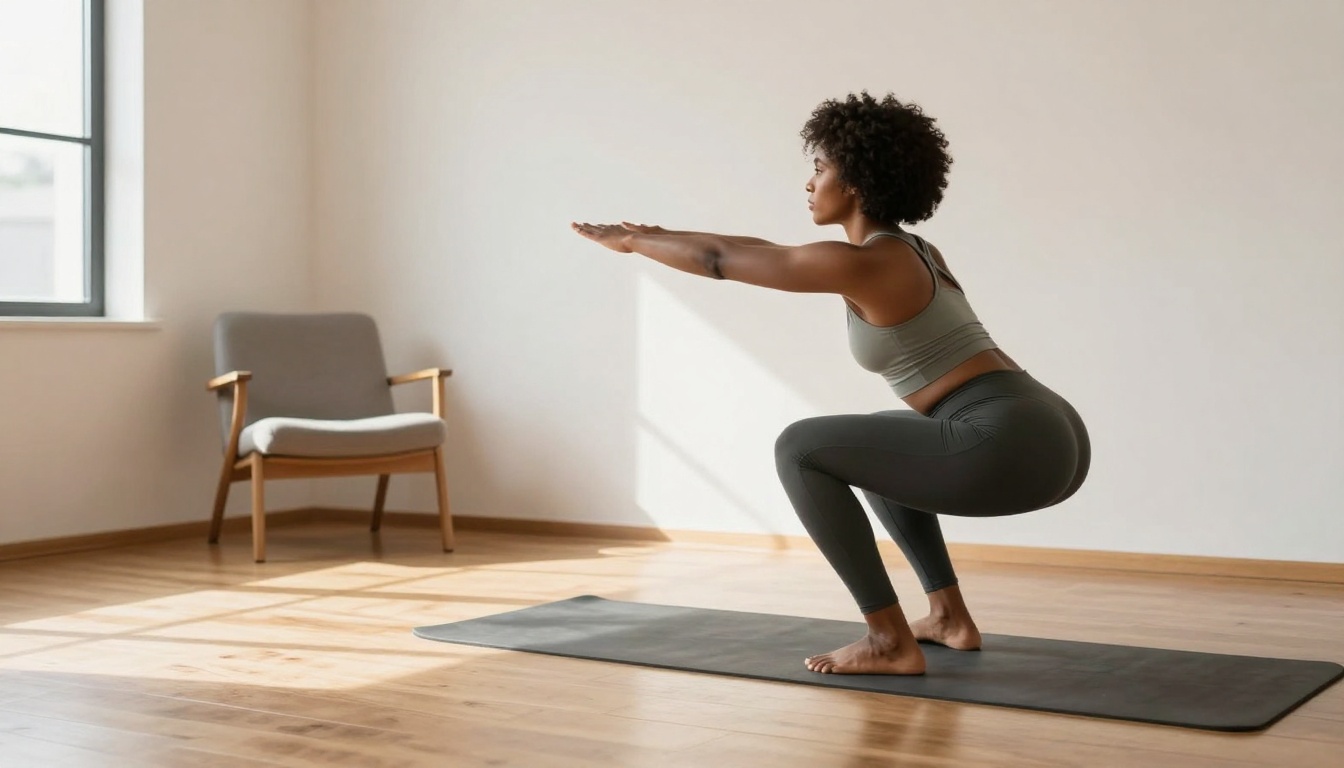
Squats (legs)
- Easier: reduce depth, sit back more, slow the tempo
- Harder: frog squats, pause squats (2-second hold at the bottom)
- Cue: knees track over toes, keep whole foot on the floor
Lunges (legs and balance)
- Easier: step-back lunge (often kinder on knees), hold a wall for balance
- Harder: jump lunges (only if joints feel good)
- Cue: stay tall, front knee stays roughly above the mid-foot
Planks (core)
- Easier: plank from knees
- Harder: plank with leg lifts or shoulder taps
- Cue: ribs down, don’t let hips sag or pike up
Burpees (full-body fitness)
- Easier: step-back burpee, remove the jump and do a gentle reach up
- Harder: add a strict push-up at the bottom
- Cue: move smooth, land soft, breathe out as you stand
Wall sit (leg burner)
- Easier: higher position, shorter time
- Harder: longer hold, lift one heel for 10 seconds at a time
- Cue: press lower back gently into the wall, knees stacked over ankles
For a broader list of bodyweight moves and variations, you can skim Men’s Health UK’s bodyweight exercise list and pick one swap per movement pattern.
Use beginner and advanced sample routines you can follow today
A timer app helps, but it’s optional. A kitchen timer works. So does counting breaths.
Two rules that protect your form and your joints:
- Move with control.
- Stop 1 to 2 reps before your form breaks.
Beginner full-body routine (20 to 25 minutes, 3 days a week)
Warm-up (5 minutes)
Use the warm-up flow above.
Main circuit (2 to 3 rounds)
Rest 30 to 60 seconds between moves. Rest 60 to 90 seconds between rounds.
- Push-ups: 8 to 10 (or knees)
- Squats: 10 to 12
- Forward lunges: 5 each leg (or step-back lunges)
- Plank: 20 to 30 seconds
- Chair tricep dips: 8 to 10 (optional, only if shoulders feel fine)
Cool-down (2 minutes)
Cat-cow for 5 slow breaths, then child’s pose for 5 slow breaths.
If you can’t finish a round, shorten reps and keep moving. The goal is to complete the session, not win it.
If you like having a printable reference for at-home strength sessions, this no-equipment PDF is a handy extra resource: No Equipment Home Workouts: strength workouts (PDF).
Advanced circuit (30 minutes, 4 to 5 days a week)
Warm-up (5 minutes)
Same warm-up, then add 10 slow walkouts to a plank if wrists and hamstrings feel ok.
Main circuit (20 minutes)
Work 45 seconds, rest 15 seconds. Repeat for 4 rounds. Rest 60 seconds between rounds if needed.
- Burpees (low-impact step-back option)
- Jump lunges (or step-back lunges)
- Dolphin push-ups
- Frog squats
- Plank with leg lifts
5-minute mobility finish
Cat-cow, hip flexor stretch, child’s pose. Slow breaths through the nose if you can.
Pacing tip: smooth and steady beats frantic. When you rush, you get sloppy. When you get sloppy, you lose the point.
For extra form ideas and strength-focused bodyweight options, Berg Movement’s bodyweight strength exercise guide is a useful browse.
Progress, stay safe, and make it stick for months
In January 2026, a lot of home training trends lean towards short sessions that build strength and mobility, with effort scaled to the day. That’s not just a trend, it’s common sense. The routine that respects your joints and your schedule is the routine you’ll still be doing in six months.
How to level up each week without equipment
You can apply progressive overload without dumbbells. You just change the challenge in small steps:
- Add reps (8 to 10 becomes 10 to 12)
- Add seconds (plank 20 becomes 30)
- Add rounds (2 becomes 3)
- Reduce rest (60 seconds becomes 45)
- Choose a harder variation (knee push-up to full)
Here’s a simple four-week plan that doesn’t feel dramatic, but works:
| Week | Main change | What it looks like |
|---|---|---|
| 1 | Build consistency | 2 rounds, full rest, tidy form |
| 2 | Add volume | 3 rounds, same rest |
| 3 | Add density | Same rounds, rest down by 10 seconds |
| 4 | Upgrade one move | One harder variation or longer holds |
Keep changes small. Big leaps often end in sore joints and missed sessions.
Safety basics matter, even at home:
Pain vs effort: burning muscles and heavy breathing are normal, sharp pain isn’t.
Knees and wrists: step-back lunges are often kinder than forward lunges, fists or push-up position on handles (if you have them) can ease wrists, or switch to wall push-ups.
Warm-up and cool-down: five minutes each can save you days of stiffness.
Rest when you need it: if your performance drops hard across the week, pull back.
If you have an injury, are pregnant, or get new pain that doesn’t settle, speak to a clinician or physio before pushing on.
Motivation systems don’t need pep talks. They need friction removed:
Track sessions: a simple tick in your notes app is enough.
Keep a streak: aim for three sessions a week for two weeks.
Pair the workout with a habit: after brushing teeth, before a shower, straight after you shut your laptop.
Home training also dodges a common barrier: gym nerves. No mirrors, no waiting for equipment, no feeling watched. Just you, the floor, and a plan.
If you want a bigger menu of bodyweight workouts to rotate in later, Muscle & Strength’s bodyweight workout collection can help you add variety without changing the basics.
Common mistakes that stall results (and easy fixes)
Doing too much too soon: Going from zero to daily HIIT sounds brave, then your legs rebel.
Fix: start with three days a week and leave recovery days.
Skipping the warm-up: Your first set shouldn’t be the warm-up.
Fix: five minutes of simple movement, every time.
Rushing reps: Fast reps hide weak positions.
Fix: slow the lowering phase and pause for one second at the bottom.
Training hard every day: Your body can’t rebuild on fumes.
Fix: keep 1 to 2 hard days, add easy walks or mobility on the others.
Ignoring mobility: Tight hips and stiff ankles make squats and lunges feel worse.
Fix: finish with 3 to 5 minutes of stretching and joint circles.
Conclusion
Start today, while it’s simple. Pick a schedule, run the beginner circuit once, and write down your baseline numbers. No equipment isn’t a limitation, it’s a clean start with fewer distractions.
Try it for two weeks, then add one small upgrade, one extra round, ten fewer seconds of rest, or a harder push-up. Your living room will look the same, but you won’t.