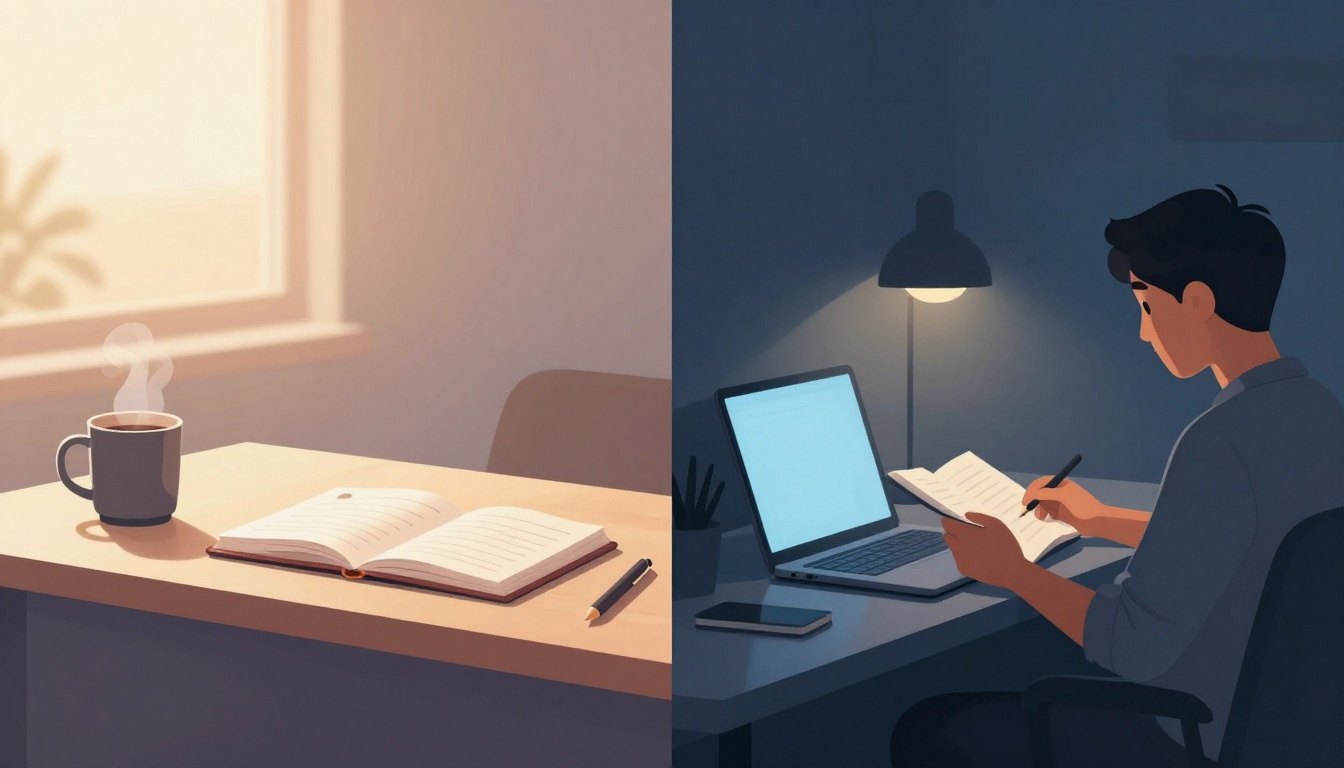

Listen to this post: Morning vs Night Routines: Which One Matters More for Success?
The early morning has its own sound, kettles clicking, streets still half-asleep, a quiet that makes your thoughts feel louder. Late night has a different calm, lights low, messages slowing down, the day finally letting go.
So which routine matters more for success, morning or night? In this article, “success” isn’t fame or a perfect diary. It’s steady progress, good health, reliable energy, clear thinking, and actually hitting the goals you set.
Recent research keeps pointing to a simple truth: mornings often suit planning and focused work for most people, because society runs on early schedules. But your chronotype (your built-in body clock) can flip the script. If you’re wired as a night owl, forcing a 5am life can make you worse at everything you’re trying to improve.
This guide will help you choose a routine that fits your biology, your responsibilities, and the kind of success you want, then build it in a way that sticks.
What science says about mornings, nights, and your body clock
Chronotype is a plain idea with a big impact: it’s your natural preference for when you feel awake and when you feel sleepy. Some people are “larks” who wake early without drama. Some are “owls” who come alive later. Most sit in the middle and can flex a bit.
The mistake is thinking routines are a moral choice, like waking early makes you disciplined, and working late makes you lazy. Your chronotype is largely genetic, with some wiggle room. You can nudge it, but you can’t willpower your way into becoming a different animal.
This matters because the world rewards early timing. School starts early. Many jobs start early. If you’re naturally aligned with that, you get a smoother run at life. If you aren’t, you can still succeed, but you need a smarter set-up.
There’s also growing evidence that night owls can score strongly on certain thinking tests, especially when they’re allowed to work at their best hours. For a recent UK research angle, see Imperial College London’s report on night owls and cognitive scores. The headline isn’t “stay up late to get smarter”. It’s “timing changes how your brain shows up”.
A good routine isn’t a copy of someone else’s day. It’s a match between your biology and your real life. When that match is off, you pay for it in small ways first: groggy mornings, late caffeine, short temper, scrolling to stay awake. Then it compounds. To find that harmony, consider ways to create a sustainable morning routine that aligns with your personal needs and energy levels. This could involve setting a consistent wake-up time, incorporating movement or mindfulness practices, and prioritizing a nutritious breakfast. By thoughtfully designing your mornings, you can enhance your overall well-being and set a positive tone for the rest of the day. Consider how evening routines for better mornings can play a crucial role in achieving this harmony. By winding down with calming activities, you signal to your body that it’s time to rest, which can lead to more restorative sleep. Creating a deliberate space for relaxation in the evening sets the stage for a smoother transition into your day.
Chronotype, social jet lag, and why willpower runs out
“Social jet lag” is what happens when your sleep schedule on workdays clashes with your natural rhythm, so you feel like you’re constantly travelling time zones. You may sleep late on weekends to catch up, then feel rough again on Monday. That swing is a signal, not a personal flaw.
The cost isn’t only tiredness. A mismatch can drain mood, focus, and patience. It also steals your willpower. Self-control isn’t endless; it’s more like a phone battery that drops faster when you’re stressed, under-slept, or doing hard tasks at the wrong time.
A quick self-check (no long quiz):
- When do you feel sharpest without caffeine: early morning, mid-day, or late evening?
- When do you naturally get sleepy if you stop pushing through?
- Do you “drift” on weekends by more than 1 to 2 hours compared with workdays?
If your weekend sleep is a full reset, your routine may be fighting your body. For a readable explanation of chronotypes and how to work with them, this chronotype guide from Ness Labs is a useful starting point.
Morning focus vs night creativity, different hours for different wins
Many people get their best “thinking fuel” in the morning. The day hasn’t filled up yet. Fewer messages, fewer opinions, fewer demands. That makes mornings strong for:
- planning and prioritising
- deep work that needs concentration
- decisions that shape the rest of the day
Nights can be different. As the world goes quiet, the pressure to respond drops. That can help with:
- creative work, writing, and idea-making
- problem-solving that needs play, not pressure
- learning for pleasure, when you’re not rushing
Neither is “better” by default. The real question is: what kind of work are you doing, and when does your mind co-operate? It’s also worth remembering that “night owl wins” often disappear if your sleep gets chopped up by an early alarm. That’s where routines stop being a vibe and start being a system.
Morning routines, the success upside, and the traps that make them fail
Morning routines are linked to steady progress because mornings are a narrow doorway. If you walk through it well, your day opens up. If you stumble, everything feels heavier.
The biggest upside is momentum. A good morning routine can reduce decision fatigue. You don’t wake up and bargain with yourself for an hour. You follow a simple script, and your brain saves energy for what matters.
Mornings also have fewer distractions. Even if you live with family, there’s often a small window where the world hasn’t fully started. That window is gold for habits that need calm, like planning, reading, or a short workout.
But morning routines fail for predictable reasons. These are the traps that turn “I’ll be a new person” into “why am I tired all the time?”:
- Overpacked routines: if your morning plan needs 90 minutes, it won’t survive a normal week.
- Snooze loops: they feel kind, but they fragment sleep and steal time.
- Doomscrolling: it pulls your attention into other people’s emergencies.
- Skipping sleep to wake early: you can’t borrow hours forever.
If you’ve ever tried to copy an early-riser routine and felt like you were walking through mud, you’re not alone. BBC Worklife’s piece on why you shouldn’t force yourself to be a morning person captures the problem well: personality and biology don’t respond to slogans.
The morning sweet spot, pick two anchors and keep them small
Think in “anchors”, not a perfect checklist. Anchors are two repeatable actions that tell your brain, “Day has started, we’re steering.”
Good morning anchors are small, boring, and easy to repeat:
- a glass of water
- 5 minutes of stretching
- a short walk in daylight
- a simple protein breakfast
- 10 minutes of planning (top 3 tasks, no more)
The rule is simple: consistency beats intensity. Your routine should still work on a bad day, when the baby was up, when the train is cancelled, when your mood is flat. If it only works on your best days, it isn’t a routine, it’s a performance.
Also, don’t confuse a morning routine with “doing more”. A strong routine often means doing fewer things, on purpose, so your attention stays intact.
When copying early-riser culture backfires
For night owls, forcing a very early wake-up time can be like starting a car in winter without warming the engine. You might get moving, but the strain shows up later: poor sleep, worse mood, slower thinking, more cravings, more caffeine.
A gentle test helps: if you can’t keep a wake time for two weeks without feeling wrecked, it’s not a routine, it’s a stress plan.
The fix is not “try harder”. It’s a slower shift:
- move wake time in 15-minute steps
- protect bedtime first, because sleep is the base
- get morning light exposure when you can, it helps nudge your clock earlier
If you’re curious about the “night owl” side without the drama, BBC Science Focus on how night owls can thrive offers a balanced view. It’s a reminder that success doesn’t belong to one schedule.
Night routines, the quiet power behind tomorrow’s best work
Night routines don’t get the same hype, but they’re often the hidden driver of performance. Think of the evening as the set-up crew. If they do their job, the main act (you, tomorrow morning) walks onto a clear stage.
A night routine is less about productivity theatre and more about sleep quality and stress release. When evenings are chaotic, mornings become damage control. When evenings are steady, mornings feel lighter without extra effort. An effective evening routine for better sleep can create a peaceful atmosphere that encourages relaxation. Simple practices like dimming the lights and disconnecting from screens help signal to the body that it’s time to wind down. By prioritizing these calming rituals, individuals can improve their overall well-being and approach the next day with renewed energy.
This matters because sleep isn’t just rest. It affects attention, emotion, appetite, and how well you learn. If your sleep is unstable, your “success habits” become harder to repeat, even if your motivation is high.
Chronotype links to stress too. Studies have found relationships between chronotype, stress levels, and performance in demanding settings. For one example in an academic context, see this research summary on chronotype and perceived stress. You don’t need to be a student for the lesson to land: when your schedule fights your biology, pressure rises faster.
A good evening routine is really a sleep and stress routine
Evening routines work best when they send clear signals: lights are softer, food is lighter, noise is lower, the day is closing.
You don’t need a rigid checklist. You need a “wind-down window”, even 20 to 40 minutes, where you stop feeding your brain new problems.
Calming options that don’t feel precious:
- reading a few pages of something easy
- a warm shower
- journalling for five minutes
- a light tidy of one area
- stretching or slow breathing
The most important habit is often boring: keep sleep and wake times reasonably consistent. Perfection isn’t required. Regularity is what your body understands.
Night routine for high performers, close loops and clear the runway
A practical structure is to close loops so your brain stops rehearsing tomorrow in bed.
Try this flow:
- 5-minute reset: tidy one zone (desk, kitchen counter, or sofa).
- 5-minute plan: write the top 3 tasks for tomorrow.
- Prepare one thing: clothes ready, bag packed, or breakfast basics set out.
- Unwind: do one calming activity, then lights down.
Add one tech boundary if possible: charge your phone away from the bed, or at least face-down and out of reach. The goal isn’t purity. It’s reducing the chance that a single notification steals your sleep.
So which matters more for success? Use this simple decision framework
If you want the honest answer: for many people, night routines matter more because they protect sleep, and sleep controls almost everything else. A brilliant morning routine can’t out-run a broken night.
But mornings often matter more for execution. If your day needs direction, mornings are where you set it. Nights are where you protect it.
So the best question isn’t “morning vs night”. It’s “where is my bottleneck?”
Use this decision framework:
- If you’re tired most days, wake up groggy, or rely on caffeine to feel normal, start with a night routine. Fixing sleep gives you the biggest return.
- If you sleep well but drift through the day, start with a morning routine. Add a planning anchor that tells you what “a good day” means before messages arrive.
- If you have early meetings, school runs, or shift work, build around the constraint. Your routine should support your real life, not shame you for having one.
When your schedule is fixed, you can still choose the order of effort. Put your hardest work where you naturally have the most mental fuel.
Match the routine to the goal: focus, fitness, learning, or calm
Different goals fit different hours:
- Focus and hard thinking: often best in the morning, especially for larks and most intermediates.
- Creative output: often works well in the evening, when it’s quiet and you’re not being watched.
- Fitness: either morning or evening can work, the key is the time you’ll repeat.
- Calm and recovery: belongs at night, because it protects sleep.
If you only fix one thing, fix sleep timing and morning light exposure. Morning light helps anchor your body clock, even on grey UK days.
A 7-day starter plan that doesn’t wreck your life
For one week, keep it small. Choose one morning anchor and one night anchor, each under 10 minutes. That’s it.
A simple plan:
- Days 1 to 2: pick anchors that feel almost too easy.
- Days 3 to 5: keep the same anchors, don’t add more.
- Days 6 to 7: adjust only if something is clearly failing.
Track one signal, not ten:
- energy at 10am, or
- mood at 3pm, or
- time it takes to fall asleep
At the end of the week, decide based on results, not opinions. If your energy lifted, keep going. If it didn’t, shift one part by 15 minutes, or swap the anchor for something simpler.
Conclusion
Success isn’t built from perfect mornings or perfect nights. It comes from repeatable rhythms that your body and your life can keep up with. Night routines often do the heavy lifting because they protect sleep, and sleep sets the ceiling for your focus, mood, and drive. Morning routines add direction, so your best hours don’t get spent on other people’s priorities.
Let your chronotype decide where the hardest work sits, then make the routine fit the person you actually are. Pick two anchors, one for night and one for morning, and try them for seven days. If you can repeat it, you can grow it. That’s success in real life.