
Listen to this post: Can Europe stay united on Russia, China and Trump at the same time?
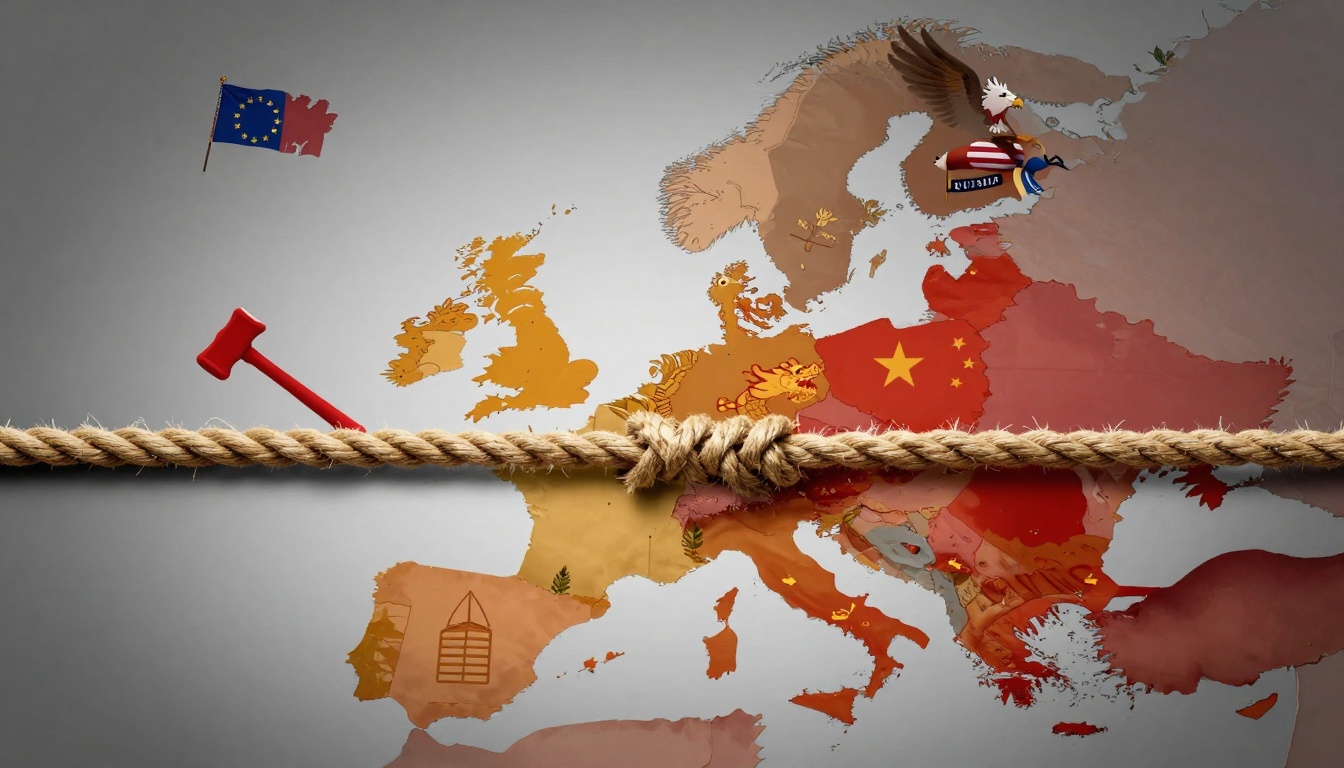
Europe looks like a thick rope in a three-way tug of war. One pull comes from Russia and a hot war on the EU’s border. Another comes from China, quieter but constant, tied to money, supply chains, and the cost of daily life. The third comes from Donald Trump and the question hanging over Europe’s security umbrella: what if Washington turns support into a price tag?
In press statements, Europe often sounds solid. The trouble starts when unity needs cash, energy choices, and real military kit. Then the rope frays, strand by strand, as governments answer to different voters, different maps, and different fears.
Why staying united is harder now than at any point since the war began
“European unity” isn’t one switch you flip on. It’s a stack of choices made every month, sometimes every week: sanctions, weapons deliveries, defence budgets, rules on trade, and what leaders tell their publics to expect.
Since 2022, the EU has held a firmer line than many predicted. But holding a line is not the same as deep agreement. A policy can pass, and still leave behind bruises and resentment.
The stakes in early 2026 look even sharper because the bills are bigger. On 14 January 2026, the European Commission proposed a €90 billion loan to support Ukraine’s budget and military needs across 2026 to 2027, with borrowing at EU level and talk of repayment linked to frozen Russian assets. That signals commitment, but it also forces every capital to answer the same awkward question: how much risk, how much money, and for how long?
For a sense of what European strategists think is being missed as this year starts, see Carnegie’s 2026 pulse-check on Europe’s risks.
Russia and Ukraine: the split between “stay tough” and “start talking”
A real split runs through Europe: those who think the only safe path is staying hard on Moscow, and those who want to keep the door open for talks, even if the terms look ugly.
Geography shapes this. Countries closer to Russia, especially in the east and north, hear the war as a nearby storm. They fear a “pause” that’s really just time for Russia to reload. Others, farther away, feel the war mainly through prices, headlines, and voter fatigue. When households are stretched, “keep paying” becomes a harder message to sell.
Politics matters too. Some leaders face loud parties that argue for softer sanctions or slower aid. Others can’t afford any softness at all, because their voters see the threat as personal.
This is where the EU’s single voice can weaken. Smaller groups sometimes act first, either to push faster support or to slow it down. That can be practical, but it also signals that the shared line is negotiable.
One fact cuts through it: if Europe is left out of peace talks, it risks living with a security deal written by others, and that can lock in danger for a generation.
The money problem: defence spending, tight budgets, and uneven risk
Unity cracks fastest when the same plan feels cheap to one country and painful to another.
Some states already spend more on defence and have room to scale. Others carry high debt, fragile coalitions, or publics that want hospitals and schools funded first. The argument isn’t only about values, it’s about who pays now and who pays later.
Risk is uneven too. A Baltic state sees a higher chance of direct pressure from Russia than a country on the Atlantic edge. That changes how leaders talk about urgency. It also changes what they buy, air defence, artillery shells, drones, or basic ammunition.
Every new Ukraine package, every sanctions step, and every defence purchase creates winners and losers inside Europe. Defence firms gain contracts, but energy-heavy industries take hits. Ports and logistics hubs can benefit from re-routed trade, while exporters lose markets. People sense these trade-offs even when politicians dress them up.
Analysts warning of a tougher Russian posture in 2026 often point to a mix of military pressure and hybrid tactics. A useful read is RUSI’s note on Putin’s 2026 hybrid escalation risks.
China adds a quieter pressure that still splits Europe
China rarely creates the same street-level fear as Russia. It’s more like damp in the walls. It spreads slowly, then shows up everywhere: in supply chains, investment, and the price of key inputs.
Europe’s big challenge is discipline. Many countries want open trade with China, because it keeps costs down and helps big exporters. At the same time, governments worry about security, unfair subsidies, and dependence on a supplier that can turn the tap off.
“De-risking” is a simple idea: don’t let one country control the parts you can’t do without.
China can test EU unity by working country by country. A deal offered to one capital can undercut a common stance agreed in Brussels. It can also create a quiet pecking order, where states that speak tougher get less access, and states that stay soft get the rewards.
For a snapshot of how these pressures have been playing out, see GMF’s January 2026 “Watching China in Europe” briefing.
Trade fights and supply chains: cheap imports, rare earths, and who pays the price
Trade rows with China turn political fast because they hit jobs and prices.
Europe wants factories, especially for cars, batteries, and clean tech. But it also wants affordable goods. When EU trade defences tighten, some shoppers pay more, and some firms get relief. When defences don’t tighten, factories fear being undercut.
Supply chains add another layer. China has weight in materials used for electronics and green energy. Even the hint of restrictions can make businesses nervous, because replacement sources take time.
These disputes can spill into unity on Russia too. Many European officials worry about “dual-use” goods, items that look civilian but can support a war effort. If China is seen as helping Russia keep its system running, it becomes harder for Europe to treat China as only a trade issue.
Security and values: when “partner” and “rival” both feel true
The EU’s own language on China fits the confusion: China can be a partner, a competitor, and a systemic rival at the same time.
That sounds tidy on paper, but it’s messy in practice. Security choices often sit with national capitals, not Brussels. Intelligence, defence ties, and sensitive infrastructure rules vary widely. One country may block a risky tech supplier, another may wave it through for cost reasons.
China’s strongest tool is not a tank. It’s attention and access: investment offers, market entry, and bilateral visits that make a small state feel singled out. If those deals soften one government’s stance, others feel exposed and isolated. A “one voice” Europe becomes a choir where some singers stop following the conductor.
Trump is the stress test that can turn cracks into breaks
A Trump-led America changes behaviour quickly because it’s direct, public, and transactional. Tariff threats can land overnight. Security promises can come with conditions. Leaders who thought in four-year plans start thinking in weeks.
The result is a strange mix of panic and pragmatism. Some governments push faster for European self-reliance. Others focus on staying close to Washington at almost any cost, fearing that distance means danger.
For a sharp take on how Trump reshapes Europe’s China choices, read ECFR’s January 2026 policy brief.
Tariffs and coercion: unity is easiest when the threat is clear and sudden
Europe can rally fast when the threat is obvious. A blunt tariff warning tends to produce quick meetings, shared messaging, and talk of retaliation. In the short term, it’s easier to stand together because no one wants to look like the weak link.
The hard part comes when pressure becomes a grind. Carve-outs appear. Side deals tempt individual states. A targeted exemption for one sector can turn unity into quiet bargaining, where each capital asks, “What do we get?”
That’s how a shared front turns into a queue of separate negotiations.
NATO, Ukraine, and mixed signals: what happens if Washington steps back
The fear is simple: if US support wobbles, Europe must fill gaps in weapons, money, and deterrence.
That strains unity because countries start choosing different speeds. Some want rapid rearmament, joint procurement, and bigger stockpiles. Others worry about cost, escalation, or losing American protection by annoying Washington.
It also loops back to Russia. If Europeans doubt US backing, calls to “start talking” with Moscow get louder, even if the terms look unsafe. The argument becomes less about justice, and more about avoiding being left alone.
Conclusion
Europe probably won’t get a clean yes or no answer in 2026. A more useful question is what unity means when pressures pull in different directions. It may mean agreeing a small set of non-negotiables: Ukraine’s security, protection from coercive trade pressure, and shared defence commitments, while allowing controlled differences elsewhere.
Watch three signals in the next months: defence spending decisions, sanctions discipline, and any shift in US posture. If those hold, the rope can stay tight enough to work. Europe may move like a convoy, with vehicles at different speeds, but it still needs the same direction.