
Listen to this post: The economic cost of long-term conflict and displacement: the bill that keeps growing
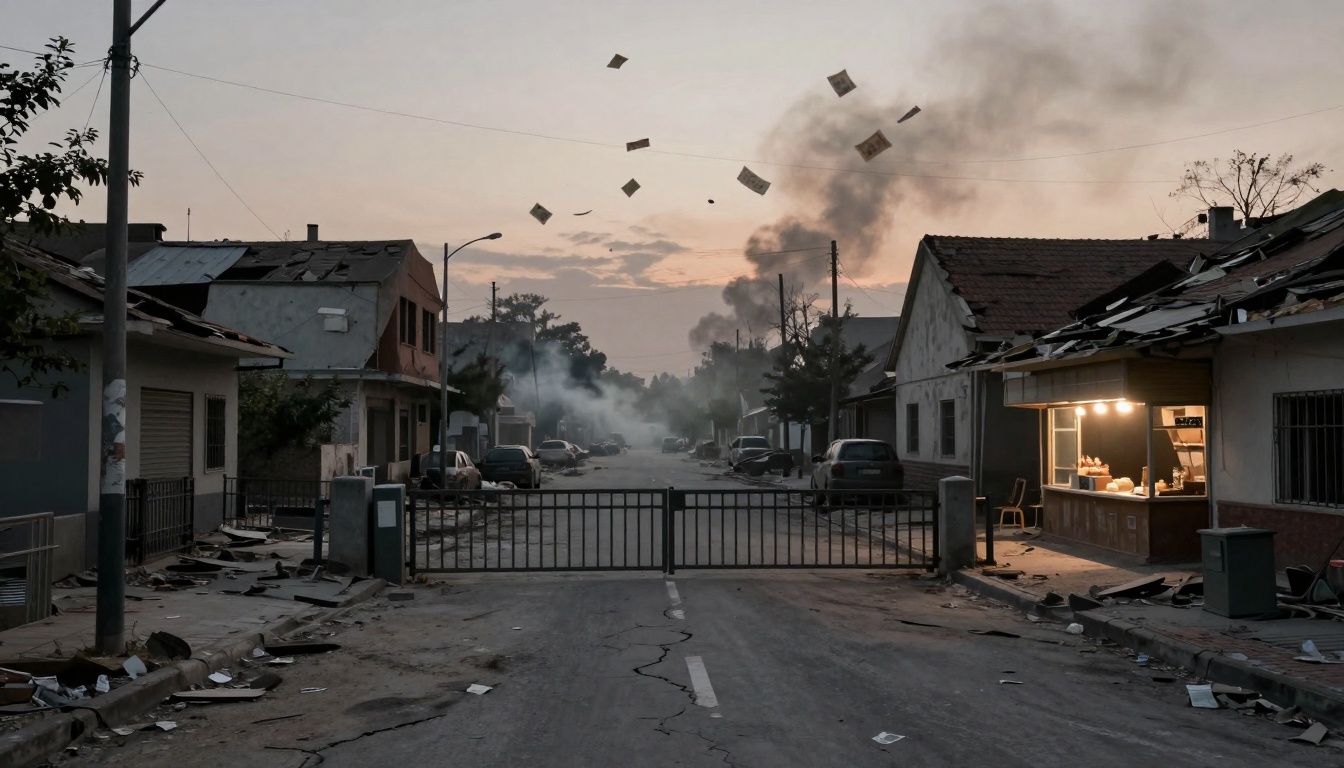
A town can look “alive” on a map while it’s quietly shutting down in real life. A checkpoint splits the high street in two. The school gates are locked because the teachers left months ago. The baker still opens, but only when the electricity holds.
This is what the economic cost of long-term conflict and displacement looks like at ground level. It isn’t just the price of tanks and aid convoys. It’s a slow, compounding shock that eats wages, skills, savings, public services, and trust.
In simple terms, conflict is organised violence that disrupts daily life. Displacement is when people are forced to leave home, either across a border as refugees or within their own country as internally displaced people (IDPs). The costs land on families, governments, host towns, and far-away shoppers who suddenly pay more for food and fuel. This guide walks through the chain reaction, step by step.
The hidden price tag inside war zones: what breaks first and what costs most
In long wars, the first losses are obvious: buildings collapse, roads crater, factories stop. The deeper losses take longer to notice, because they show up as “missing normal life”. Missing pay packets. Missing lessons. Missing repairs. Missing trust that tomorrow will be better than today.
Economists often talk about “direct damage” (what gets destroyed) and “indirect damage” (what the destruction stops you from doing). A mined farm doesn’t just lose one harvest. It can lose years of work, seed money, and skilled workers who move away for safety.
Recent World Bank-linked estimates put Ukraine’s reconstruction and recovery needs at $524 billion over the next decade, with direct damages assessed around $176 billion, and housing a major share of the need (about $84 billion). Those are big numbers, but the more important point is what they represent: a country trying to run schools, hospitals, and businesses while also replacing the basics that make an economy function. For context on how conflict reshapes development outcomes, the World Bank’s summary of fragility, conflict and violence priorities is a useful starting point.
Here’s a simple snapshot of how these costs stack up in practice:
| Cost channel | What it looks like on the ground | Why it keeps compounding |
|---|---|---|
| Infrastructure damage | Broken bridges, unreliable power, damaged water systems | Repairs get pricier, outages push firms to close or relocate |
| Lost output | Closed workshops, stalled exports, empty hotels | Supply chains break, customers disappear, capital flees |
| Human capital loss | Missed schooling, trauma, injuries, migration of skilled workers | Productivity drops, tax base shrinks, recovery slows |
Destroyed roads, power, and homes: why rebuilding gets harder every year
A road isn’t just a strip of tarmac. It’s the route to work, to markets, to medicine. When it’s cut, the cost shows up everywhere: delivery vans burn more fuel on detours, food spoils before it arrives, ambulances take longer, construction firms can’t move materials.
In long conflicts, infrastructure damage isn’t a one-off event. It’s repeated hits plus slow decay. A power station that’s patched up in a hurry often runs at lower capacity. A water network might work, but leak so badly that whole neighbourhoods get only hours of supply. Businesses can’t plan around that. A small manufacturer might want to reopen, but a single day without power can ruin stock and break contracts.
Rebuilding also gets harder because the “market” for rebuilding changes. Fewer skilled tradespeople stay. Insurance becomes expensive or unavailable. Materials have to travel further, under tighter security. Even if donors or the state have funds, the real-world capacity to turn money into working roads and safe housing can be the bottleneck.
When housing is damaged at scale, the ripple effects widen. Families crowd into fewer homes, rents rise, and workers become more mobile in the worst way, moving because they must, not because a better job is calling.
Lost work and lost skills: the human capital drain that can last a generation
War doesn’t only destroy things, it interrupts people. It steals time, attention, sleep, and concentration. That matters because modern economies run on skills, reliability, and routine.
In a long conflict, jobs vanish in layers. First, businesses shut because demand collapses. Then, suppliers stop delivering. Then, workers leave. Later, even when conditions improve, the old networks are gone. A mechanic who fled might be driving taxis abroad. A nurse might be caring for her own family full-time. A young person who lost two years of schooling can’t easily “catch up” while also trying to earn.
The result is lower productivity and weaker public finances. If fewer people work in formal jobs, the state collects less tax. That means less money for teachers, health workers, and repairs, which pushes more people to leave, which reduces the tax base again. It’s a feedback loop.
Ukraine’s economy, for example, took an enormous hit in the first year of full-scale invasion, with output falling sharply and many industries disrupted. Even when growth returns, labour shortages and repeated attacks can keep the recovery slow. This is why protecting schooling and basic healthcare during conflict is not charity. It’s economic self-defence.
Displacement costs more than shelter: the long bill for services, jobs, and stability
When people flee, the costs don’t vanish. They move. A destroyed home becomes a rent payment in another town. A lost job becomes an aid request. A missing document becomes a legal problem that blocks work and bank accounts.
Displaced families often lose the small things that make a household stable: tools, school records, property deeds, medicines, contacts. They can’t sell assets at a fair price because they left in a hurry. They may arrive with skills but no way to prove them. Even simple tasks, like registering a child for school, can become months of forms, fees, and waiting.
Host communities carry costs too. The first response is usually generosity. The longer it lasts, the more it turns into pressure on rents, clinics, transport, and local politics. If funding is unpredictable, councils and charities are forced into short-term fixes, which often cost more than planned systems.
A World Bank report on refugee economic participation estimates that meeting basic subsistence needs for refugees in low and middle-income host countries can reach nearly $62 billion a year, falling to around $22 billion after counting refugees’ current earnings, and potentially down to $5.7 billion if barriers to work were eased. The argument is plain: keeping people idle is expensive, for everyone. For the underlying analysis, see World Bank research on economic participation and global costs.
Housing, schools, and clinics under strain, and the budget trade-offs that follow
Displacement quickly becomes a local issue. A sudden increase in population can push rents up, even in places far from the front line. Landlords convert long lets into short lets, or raise prices, because demand is urgent and constant. That squeezes both newcomers and long-term residents.
Schools feel it next. More children arrive than there are desks, books, or trained staff. If classes become crowded, learning suffers across the board. Health services see the same pattern: longer waiting lists, more pressure on vaccinations, maternity care, and mental health support.
One benchmark estimate puts the annual cost to educate all refugee children in low and middle-income host countries at about $4.85 billion. That’s not just a humanitarian line item. Education is the pipeline for future work, productivity, and social stability. When it breaks, the bill shows up later as higher welfare needs, higher crime risk, and lower growth.
Local leaders then face brutal trade-offs. Fix the road, or hire more teaching assistants? Expand a clinic, or top up housing support? If national funding falls short, the gap can become higher local taxes, service cuts, or rising resentment. None of those options is good for social cohesion.
For context on current humanitarian planning and funding pressures, UNHCR’s Global Appeal 2026 shows how needs scale across crises.
Work rules and legal status: how policy choices change the cost curve
The right to work sounds like a moral question. It’s also a budget question.
If displaced people can’t work legally, they often end up in the shadow economy, underpaid and unprotected. That reduces tax revenue, increases exploitation, and keeps families dependent on cash aid. It can also depress wages in the informal sector, which harms the poorest locals too.
When work is allowed, the equation changes. People can pay rent, buy food without vouchers, and contribute to local demand. They can start repaying debts. They can plan.
That doesn’t happen automatically. A work permit that takes six months to process is a barrier. Qualifications that aren’t recognised trap doctors and engineers in low-paid jobs, which wastes skills. Language classes and job matching sound “soft”, but they remove friction that keeps people out of the labour market.
Practical steps that tend to pay for themselves include:
Fast, clear legal status so employers know what’s allowed.
Recognition pathways for qualifications, with bridging courses where needed.
Language support linked to work, not endless classroom loops.
Simple small business registration so market stalls can become proper firms.
That World Bank estimate of a potential drop to $5.7 billion in annual subsistence costs if work barriers eased isn’t a magic trick. It’s the maths of letting people earn, rather than forcing long-term dependency.
The knock-on effects the rest of the world feels: food, energy, trade, and risk
Long-term wars don’t stay “over there”. They get into shipping routes, energy markets, insurance contracts, and government budgets. The costs travel like smoke.
The Russia-Ukraine war offers a clear example because it hit several arteries at once: grain exports, fertiliser supply, natural gas flows, and investor confidence. Some estimates put the total cost for a group of affected countries at $2.4 trillion, roughly 45 percent of their 2021 GDP combined. In 2022, oil prices spiked to around $118 per barrel, feeding inflation in places far from the fighting.
These aren’t abstract numbers when you’re paying for heating or a weekly shop. Inflation is often described like a rising tide, but it feels more like a tightening belt. You notice it when you skip an item you used to buy without thinking.
Why prices rise far away from the fighting
Prices rise when supply drops, transport gets harder, or buyers panic.
If a major exporting region can’t ship grain safely, global buyers bid for what’s left. If fertiliser prices rise, farmers elsewhere plant less, or pay more to keep yields stable. If shipping insurance premiums jump in a conflict-adjacent sea route, the cost gets added to the final product, whether that’s cooking oil or animal feed.
Poorer households get hit first because essentials take up more of their budget. A small jump in bread prices can mean cutting back on fresh food. Higher heating costs can mean damp homes, more illness, and lost workdays. The economic cost of conflict becomes a health cost, a school cost, a productivity cost, all at once.
To track how one war has forced millions to move and rely on support, the Ukraine refugee crisis statistics and updates page gives a regularly refreshed picture.
Long wars raise risk premiums: how uncertainty changes investment and debt
A “risk premium” is just the extra price paid for uncertainty. When lenders fear a country might default, or a firm might lose its assets, they charge more interest. When investors think a region might be unstable for years, they stay away.
That has two big effects.
First, governments in conflict zones borrow at worse rates, if they can borrow at all. That makes it harder to fund basic services and repair projects. Second, nearby countries can also get punished by proximity, even if they aren’t fighting. Currencies come under pressure, credit ratings can wobble, and debt becomes more expensive to roll over.
This is how long wars trap whole regions in slower growth. Not because people lack talent, but because uncertainty becomes a tax on every decision. The longer it lasts, the more normal it feels, and the harder it is to reverse.
Conclusion: the cost isn’t one number, it’s a chain reaction
The economic cost of long-term conflict and displacement isn’t a single headline figure. It’s a chain reaction that grows over time: damaged infrastructure limits work, lost work shrinks tax revenue, shrinking revenue weakens services, weaker services push more people to leave, and the cycle tightens.
There are practical levers that reduce the bill while protecting people:
- Protect schools and basic healthcare, even under strain.
- Keep electricity, water, and key roads running, even with temporary fixes.
- Open safe, legal routes to work for displaced people, and recognise skills.
- Fund host towns so rent pressure and waiting lists don’t boil over.
- Plan reconstruction early, so money turns into results faster.
- Reduce corruption in aid and rebuilding, so trust doesn’t collapse.
A hopeful point sits underneath all of this. Most people want the same thing: a steady job, a safe home, and a future for their kids. When policy supports that, recovery stops being a slogan and starts being a schedule. Keep following conflict and displacement stories with an economics lens, the hidden costs become easier to see, and harder to ignore.