
Listen to this post: 5 Data-Backed SEO Truths for 2026 That Flip the Old Playbook on Its Head
You’ve done everything right. “You’re ranking on page one for 20 keywords. Traffic is up 40% year over year… And your revenue from organic search hasn’t moved.”
If this scenario feels familiar, you’re not alone. Many marketing teams feel like they are running on an SEO treadmill—working hard to increase rankings and traffic, only to find that business growth remains stubbornly flat. This frustration is common because the old playbook—built on clicks, keywords, and content volume—is no longer enough. The fundamental rules of search are changing, demanding a transformation from a model that chases algorithm signals to one that diagnoses and solves core business problems in an AI-driven ecosystem.
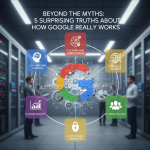
This article reveals five surprising, data-backed takeaways that challenge traditional SEO wisdom. These truths offer a clearer, more effective path forward for driving real business results.
1. Your Obsession with Clicks Is Becoming Obsolete
For years, the primary goal of SEO has been to earn the click. In today’s AI-driven search landscape, that is a dangerously outdated objective. The game has shifted from getting users to your page to becoming the source within the search result itself.
The data paints a stark picture of this new reality:
- When a generative AI summary appears on the search results page, users click traditional blue links only about 8% of the time.
- Across all searches, only about 36% result in a click to a website.
This means that in the best-case scenario, nearly two-thirds of all searches end without a visit to your website. In the emerging AI-driven landscape, that number climbs to over 90%. Your marketing surface is no longer your website; it’s the search results page itself. The implication is profound: visibility is now about having your content “excerpted, and cited in environments where clicks are optional.” Your content must be so clear and authoritative that it can be directly quoted by an AI assistant, positioning your brand as the answer, not just another link.
If visibility now means being the cited source, the most efficient way to achieve this isn’t by creating more content, but by perfecting the content you already own.
2. Your Best “New” Content Is Already on Your Website
Your content team’s obsession with ‘net new’ articles is likely your biggest wasted expense. Data shows that the highest ROI comes not from the blank page, but from what’s already on your website—a strategy known as “historical optimization.”
Consider these powerful statistics from HubSpot’s extensive content efforts:
- 76% of monthly blog views come from existing posts.
- 92% of blog-generated leads come from existing posts.
- Optimizing older content drives an average 106% increase in organic traffic.
This isn’t an isolated finding. A Rankalyzer study on a highly competitive keyword found that top-ranked articles made an average of 14 changes per month, while lower-ranked articles made only 5. This high-frequency update cycle isn’t just about tweaking keywords; it’s a signal of reliability and currency to AI systems. While new content starts with zero authority, an optimized existing post leverages years of accumulated trust, backlinks, and user signals, delivering supercharged ROI for a fraction of the effort.
But optimizing content without a clear business objective is just another form of running in place. This leads to the most critical strategic shift of all.
3. Stop Chasing Keywords and Start Solving Bottlenecks
The most effective SEO strategies in 2026 no longer begin with keyword research. They start with a clear diagnosis of the business’s primary constraint. Are you struggling with awareness, or are you failing to convert the traffic you already have? The answer changes everything.
As the strategy team at The Digital Ring explains:
“The most effective SEO strategies in 2026 don’t start with keywords or content plans. They start with diagnosis. Where does your funnel break down? Are qualified visitors not finding you, or are they bouncing after they arrive? The answer determines everything that follows.”
This strategic shift forces a more focused approach. An awareness problem (low traffic) requires creating new top-of-funnel blog posts. A conversion problem (high traffic, low leads) requires A/B testing the call-to-action on existing, high-traffic landing pages. Same SEO team, radically different work. By identifying the real bottleneck, you can apply the right tactics to the part of the funnel that will actually drive business growth.
This diagnostic approach also clarifies what kind of authority you need to build—and how AI systems are now programmed to measure it.
4. AI Cares More About Where You’re Mentioned Than How You’re Linked
While backlinks still matter, the nature of authority is evolving rapidly for AI-powered search engines. This new landscape, called Generative Engine Optimization (GEO), prioritizes holistic brand credibility over simple link volume.
A foundational academic paper on GEO published on arXiv revealed a critical insight: AI Search exhibits an “overwhelming bias towards Earned media (third-party, authoritative sources) over Brand-owned and Social content.”
This academic finding provides empirical proof for a strategic shift experts have identified: Topical Authority is the New Link Building. Your focus must shift from simply acquiring links to earning genuine citations, quotes, and mentions in authoritative third-party media—the very ‘Earned media’ that AI models are now overwhelmingly biased towards.
Building this kind of authority isn’t a one-time project; it requires a fundamental change in your operational rhythm.
5. SEO Isn’t a Project, It’s a High-Frequency Rhythm
The idea of SEO as a one-time project or a semi-annual task is a relic of the past. The digital environment is too dynamic for a “set it and forget it” approach. Data shows a clear correlation between the frequency of updates and sustained performance. For competitive keywords, data from Rankalyzer shows that top-ranking articles average 3 body content changes per month, while lower-ranked articles average only one.
This high-frequency rhythm isn’t just about changing dates for freshness signals; it’s about the continuous refinement required to meet AI’s relentless demand for clarity. As one guide notes, the bar for conciseness is higher than ever:
“If your content can’t answer a question clearly in 30 seconds, it’s unlikely to be selected for AI-generated answers.”
Constant optimization is the mechanism for achieving and maintaining that level of conciseness. This rhythm of monitoring, analyzing, and refining is what separates teams that consistently win from those that fall behind.
Conclusion: From Checklist to Operating System
In an AI-first world, SEO is no longer a static checklist of tactics. It has evolved into a dynamic operating system for aligning your content with your most important business goals. Unlike a checklist, where tasks are independent, an operating system requires all components to work in concert to function effectively. Neglecting one truth undermines the others.
The five truths outlined here represent a fundamental pivot in strategy:
- From chasing clicks to earning citations.
- From creating new content to renewing existing assets.
- From targeting keywords to solving business bottlenecks.
- From accumulating links to building earned media authority.
- From treating SEO as a project to embracing a constant rhythm of optimization.
By adopting this mindset, you can move off the SEO treadmill and start building a system that generates predictable, sustainable growth. If you ignored traffic metrics for one quarter and focused only on solving your biggest business bottleneck, what would you do differently?
The answer will be the foundation of an SEO strategy that doesn’t just earn traffic—it builds the business.