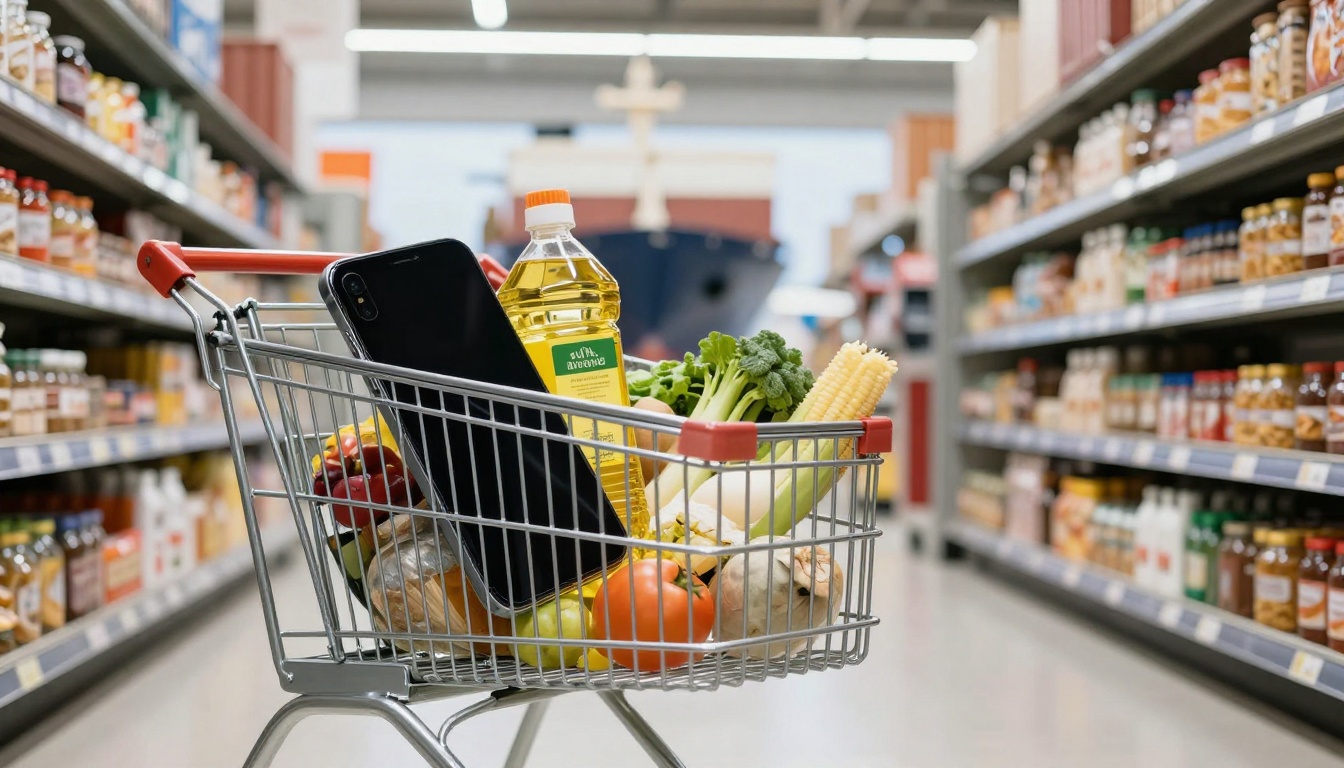

Listen to this post: How trade tensions show up in the price of your phone and groceries
You’re in the supermarket aisle, doing that small mental maths you never asked for. The same bottle of cooking oil looks pricier, the “offer” isn’t much of an offer, and the total climbs faster than the trolley fills.
Later, you check the price of a phone upgrade. The monthly deal has a bigger upfront cost, and last year’s model suddenly feels like the sensible choice.
That’s trade tensions at work in everyday life. When countries argue through tariffs, bans, and payback measures, the extra costs don’t stay in meeting rooms. They travel through ports, warehouses, factories, and lorries, then land on shelves and in checkout totals. This guide breaks down the chain in plain language, uses January 2026 examples from recent reporting, and ends with a practical checklist for what to watch next.
From political headlines to price tags: how trade tensions turn into higher costs
Trade rows can feel distant, like weather somewhere else. But prices are like puddles, they show you where the water’s flowing.
Here’s the usual chain, stripped of jargon:
- A government announces a new tariff, a restriction, or a ban.
- A business moving goods across borders faces higher costs, more paperwork, or delays.
- Those costs spread through the system, shipping, insurance, warehousing, packaging, and finance.
- Brands and retailers choose who “eats” the extra cost, and how much gets passed on.
- Shoppers see higher prices, fewer discounts, or smaller packs for the same price.
Three terms appear in the news a lot:
- Tariff: a tax charged at the border on imported goods (or sometimes on parts, not just finished products).
- Export controls: rules that limit what a country will let leave, often aimed at technology or strategic materials.
- Retaliation: the other side answers back, adding its own tariffs or restrictions, which can hit different products.
Early 2026 reporting has kept tariffs in the spotlight, with warnings that price pressures could build as policies harden and supply chains adjust. Pieces from outlets like CNN’s January 2026 look at tariffs and prices and the BBC’s January 2026 reporting on tariffs reshaping trade both point to a familiar theme: once businesses expect policy risk, they plan for it, and that planning often costs money.
Tariffs are like a border tax that usually lands on the buyer
A tariff sounds like it hits “foreign companies”. In practice, the first payer is usually the importer, the firm bringing the item into the country. That importer might be a brand, a distributor, or a big retailer.
What happens next depends on margins and competition:
- The brand may absorb some of the cost to keep the sticker price stable.
- Retailers may push back and demand a lower wholesale price.
- Costs may still flow through to you, just more slowly, or hidden in fewer promotions.
A simple example helps. Imagine a phone with a wholesale import value of £500. A 10% tariff adds £50 at the border. That’s before extra admin, shipping changes, or currency swings. If the brand only has £30 of “wiggle room”, the remaining £20 tends to show up in the price you pay, or in a weaker deal.
In early 2026, the broader backdrop has been repeated talk of wider tariff rises, especially around US and China trade. Even if you’re buying in the UK, big tech supply chains often price globally, and global uncertainty can lift costs in more than one market. The Consumer Technology Association has argued that tariffs can feed directly into higher prices for devices, including smartphones, in its research on tariffs and consumer technology prices.
Retaliation and export limits can pinch supply, not just raise taxes
Not every price rise comes from a neat percentage at the border. Sometimes the bigger shock is supply.
If one country limits exports of a key material, or if firms stop shipping because rules got messy, the market can tighten overnight. Less supply, same demand, higher prices. No new tariff required.
This matters for modern products because many rely on “small but essential” inputs: battery minerals, chipmaking equipment, speciality chemicals, even basic packaging materials. When trade ties fray, businesses also hold more stock “just in case”. That ties up cash and warehouse space, and those costs don’t stay secret.
Retaliation works the same way. One side targets a different set of goods to cause pain, and the knock-on effects can feel random to shoppers. A tariff on industrial metals can raise the cost of food tins. A restriction on a component can slow the assembly of a whole device.
A Reuters report on the 2025 tariff moves that kicked off wider tensions shows how fast payback measures can escalate and how quickly markets start pricing in higher costs and disruption (Reuters coverage of tariff escalation).
Why phones get pricier fast when trade friction hits chips, batteries, and assembly
A smartphone looks like one object. In reality, it’s a travelling circus of parts.
Inside a typical phone you’ve got:
- A processor and memory chips, made using specialist tools and materials.
- A screen, often from a different country than the chip.
- Camera modules with multiple suppliers.
- A battery that depends on mined minerals and chemical processing.
- Tiny connectors, sensors, and radio parts sourced globally.
- Packaging, manuals, and accessories that may be produced elsewhere again.
Each step can cross borders. Each border can add a cost or a delay. That’s why phones often react quickly when trade rules change, even when the tariff headline is about “imports” in a general sense.
January 2026 reporting and commentary has frequently linked trade friction to noticeable price pressure on consumer electronics. The numbers vary by model and market, but the range that keeps coming up in early 2026 analysis is roughly 5% to 15% on newer models once tariffs and supply chain costs filter through. You won’t always see it as a clean markup. It can show up as fewer freebies, higher storage tier prices, or smaller discounts at launch.
A smartphone is a passport book of parts, and each border can add a fee
Picture a phone’s journey like a passport with lots of stamps.
Minerals might be mined in one country, refined in another, turned into battery chemicals somewhere else, then shipped to an assembly plant. Chips may be designed in one place, manufactured in another, then packaged and tested elsewhere again. Those parts meet at a factory, and the finished phone is shipped across oceans, trucked to a depot, then sent to shops.
Now add trade tension:
- Tariffs on components raise costs even if finished phones are spared.
- Extra inspections and paperwork slow down movement.
- Firms reroute shipments to avoid certain tariffs, which can mean longer journeys and higher freight costs.
- Delays force factories to reorder parts at short notice, often at worse prices.
Time becomes money. If a launch slips, planned marketing spend is wasted, older stock sits longer, and retailers protect their margins by trimming discounts. For shoppers, that can feel like prices “sticking” at the top for longer.
What price rises can look like in 2026, and why deals may dry up
The early 2026 “5% to 15%” idea is useful because it matches how consumers experience it: not a catastrophe, but a nagging rise that changes decisions.
- Entry-level phones: Makers fight harder on price, but they may cut features, drop included chargers, or limit storage options. You might not pay much more upfront, but you get less phone for the money.
- Flagships: High-end models have more expensive components and tighter supply. A 10% bump on a premium handset is felt immediately, and the “free upgrade” vibe fades.
Retail promotions are often the first casualty. When costs rise, retailers have less room for “£0 upfront” deals, and carriers may shift value into bundles instead of price cuts.
Second-hand markets also react. When new prices move up, refurbished and used phones look better, demand rises, and resale prices can firm up. If you were hoping for a cheap last-year model, you may find it’s not falling as fast as it used to.
How trade fights land in your food basket, even if your apples are local
Food feels local because you can see it: British milk, local potatoes, a bakery down the road. But a modern food bill is built from inputs that travel.
Even “local” items can depend on:
- Fertiliser and farm chemicals.
- Animal feed and imported ingredients.
- Fuel for tractors, processing plants, and lorries.
- Packaging, from glass and aluminium to labels and cardboard.
- Cooking oils and food additives tied to global crop markets.
So trade tension doesn’t need to target apples to raise the price of apples. It just needs to make farming and processing more expensive, or interrupt the steady flow of inputs.
In January 2026 coverage, food industry analysis has highlighted tariffs and trade disruption as a source of pressure across categories. For a Europe-focused view, FoodNavigator has discussed likely effects in its analysis of tariffs and food in 2026. The story is familiar: once costs rise in the supply chain, they spread.
Early 2026 reporting has also kept inflation and food costs in the public eye, with Reuters noting that food remained a meaningful driver in recent inflation data (Reuters on consumer inflation and food costs).
Food prices move when inputs get hit, packaging, fuel, and fertiliser matter
A loaf of bread isn’t just wheat. It’s also energy for ovens, fuel for deliveries, and packaging to keep it fresh. When trade friction lifts the price of industrial goods, food feels it.
Think of common items:
- Tinned tomatoes depend on metal for tins, and energy for canning.
- Yoghurt and ready meals rely on plastic pots, film lids, and printed sleeves.
- Eggs depend on feed prices and transport costs.
- Cooking oil depends on crop supply and processing, plus bottles, caps, and labels.
If tariffs raise the cost of metals, plastics, or chemicals, food producers pay more. Even when the rise is small per item, it adds up across millions of units. Producers then face a choice: raise prices, shrink pack sizes, or reformulate recipes. Shoppers often see the result as a “quiet” price rise, the kind that arrives without a headline.
Retaliation can reshuffle farm trade, and shoppers notice in oils, seafood, and fruit
Retaliation can shift trade routes like a river changing course after a storm. A producer that used to sell to one market may divert goods elsewhere, leaving a gap that’s filled at a higher price.
Oils are a good early warning sign because they sit at the crossroads of farming, global commodities, and packaging. Early 2026 notes and industry commentary have cited canola oil as a category under strain, with reported moves in the 10% to 20% range in some contexts when supply tightens and costs rise. Even if you don’t buy canola oil directly, it turns up in processed foods, frying oil, and packaged snacks.
Seasonal imports can also jump. Fruit in winter, seafood with complex cold chains, and speciality ingredients can swing in price when routes change, paperwork increases, or shipping schedules get disrupted. When the same price bump appears across many shops at once, it’s often a supply story, not one retailer being greedy.
How to spot trade-driven price changes, and what you can do about them
Trade-driven price shifts often arrive in waves. The first wave is headlines and uncertainty. The second is “weird” availability, fewer deals, longer delivery times. The third is the new normal price.
You can’t control trade policy, but you can read the signals and plan around them. That matters most for big purchases like phones, and for repeat buys like food staples.
A quick checklist: signs a tariff or supply shock is about to hit the checkout
- New tariff announcements on major trade partners, especially covering electronics, metals, or agriculture.
- Export limits on minerals, chemicals, or tech components.
- Shipping delays and rising freight costs reported by carriers and logistics firms.
- Fewer promotions on phones, less generous trade-in values, or higher upfront costs on contracts.
- Sudden jumps in cooking oil prices, often a fast-moving category.
- Price rises across multiple supermarkets in the same fortnight, a clue that the cost moved upstream.
Smart ways to save without panic buying
Phones: If you’re not desperate, wait. Buying last year’s model can dodge the first wave of higher costs. Refurbished devices from reputable sellers can offer better value, and SIM-only plans keep you flexible if handset prices rise.
Groceries: Swap ingredients rather than chasing exact recipes. If one oil spikes, use another where it works. Store brands often adjust more slowly than premium labels. When prices are stable, it can help to buy a little extra of non-perishables you already use, pasta, tinned goods, toiletries, but keep it calm and sensible. Unit prices are your friend because they reveal shrinkflation quickly.
The goal isn’t to “beat” the system. It’s to avoid paying the peak price out of habit.
Conclusion
Trade tensions push prices up in three main ways: tariffs that act like border taxes, supply limits that make key inputs scarcer, and uncertainty that adds delay and cost at every step. That’s why phones can jump quickly when chips, batteries, or assembly routes get squeezed, and why groceries rise even when some produce is local.
Early 2026 reporting has linked new phone pricing pressure to roughly 5% to 15% increases on certain models, while food categories like cooking oils have seen sharper moves, with canola oil cited in the 10% to 20% range in some contexts. Broader food bills can also feel persistent pressure, often discussed in the 2% to 5% range when costs spread across inputs.
Keep an eye on policy headlines, shipping signals, and discount patterns, and stay flexible. The most useful habit is simple: buy with your eyes open, not on autopilot.