
Listen to this post: How Technology Is Helping People in Crisis Zones Right Now
When a crisis hits, the first things to break are often the basics: roads, power, clinics, and the normal ways people find help. In that gap, technology has become a kind of emergency bridge. Not a magic fix, not a replacement for trained responders, but a fast way to spot danger, share information, and get support to people who can’t wait.
Right now (January 2026), aid teams are using satellites to predict floods and droughts, mobile tools to register families on the move, and simple messaging systems to learn what communities actually need. For people living through conflict or disaster, a charged phone and a signal can be as important as a blanket.
Technology in crisis zones works best when it’s quiet and practical: tools that help people get water today, find a safe route tonight, or speak to a doctor before an infection turns serious.
The first 72 hours: satellites, AI, and faster warnings
In emergencies, time behaves strangely. A day can feel like a month, and a missed hour can cost lives. That’s why early warning is one of the biggest technology wins in crisis response.
In early 2026 reporting, teams supporting the International Rescue Committee’s work have used satellite imagery, climate models, and AI-driven risk mapping to forecast floods and droughts in places such as Somalia and Nigeria. The point isn’t to predict the future perfectly. It’s to see risk forming early enough to move supplies, pre-position staff, and send alerts before roads wash out or wells run dry. When that works, response becomes less like sprinting after a fire and more like clearing brush before the spark.
Satellites also help when on-the-ground access is blocked. If a bridge collapses, if a front line shifts, if a region is too dangerous for assessment teams, remote sensing can show where water has spread, where vegetation is failing, and where settlements are expanding because people have fled.
What’s changed is the speed. Data that once took weeks to gather and clean can now be processed in hours. That means:
- Faster targeting of food, water, and shelter supplies.
- Better routing for convoys, including safer alternatives when main roads are cut.
- Stronger evidence for funding decisions, because needs can be shown clearly.
For a broader view on why humanitarian response is leaning harder on shared data and new tools, see the World Economic Forum’s overview of technology for humanitarian crisis response.
Still, early warning only helps if the warning reaches the right people in time. That takes us to the next problem: staying connected when everything around you is breaking.
Staying connected when networks fail (and when silence is dangerous)
In many crisis zones, the network doesn’t disappear completely. It becomes unreliable, patchy, and expensive. That’s often worse than a clean outage, because people can’t plan around it. A message might send at 2am but fail at noon. A phone might show signal, but calls won’t connect.
Aid groups and local responders use a mix of tools to keep communication alive:
Low-bandwidth messaging: Systems built to work on weak signals can still send key updates, safety advice, and service locations. In conflict settings, that can include basic SMS-style messaging, or lightweight apps used by community volunteers.
Rapid information collection: Mobile data collection lets field teams record needs quickly, even offline, then upload when they regain a signal. In 2026, this matters in places where movement is fast and dangerous, including conflict zones referenced in recent reporting such as Syria, Gaza, Sudan, and Haiti.
Community hotlines and feedback loops: Technology isn’t only about broadcasting. It’s also about listening. A hotline, a short survey, or structured community reporting can highlight a cholera spike, a missing supply, or an unsafe distribution point before it turns into a wider harm.
Digital inclusion for displaced people: For refugees and internally displaced people, connectivity is tied to protection. It affects how people contact family, access services, and reduce exploitation risks. UNHCR’s work on digital inclusion and safer services is outlined in its Digital Innovation Programme, which focuses on digital protection and practical field-level experimentation.
There’s a human side too. When someone can send a message that says “I’m alive”, it changes the weight of the day. Connectivity doesn’t stop a crisis, but it can stop isolation from becoming another injury.
Getting aid to the right hands: digital cash, smarter logistics, fewer blind spots
In the public mind, aid is often pictured as boxes and sacks. In reality, one of the fastest forms of help is cash assistance, because it lets families buy what they need locally, while supporting surviving markets. Technology has made cash programmes easier to run at scale, and in many settings, safer.
Digital cash and e-vouchers can reduce long waits and lower the risk that people have to travel far through unsafe areas. They can also cut down on duplication, where one person is registered twice while another is missed entirely. When people are displaced quickly, those details matter.
Behind the scenes, technology also strengthens logistics:
- Inventory tracking can show what’s in a warehouse and what’s already on the road.
- Route planning can help avoid known hazards and bottlenecks.
- Needs mapping can link distribution planning to real-time feedback from communities.
Some organisations and suppliers also experiment with stronger audit trails for procurement and distribution, especially when funding pressure is high and scrutiny is rising. A useful, balanced summary of the upsides and risks of digitised humanitarian operations can be found in Technology in Humanitarian Aid: Benefits and Risks.
To keep this grounded, it helps to name the trade-offs plainly. Digital systems can reduce fraud and speed up support, but they can also fail in messy, real conditions. Batteries die. SIM cards get stolen. Databases don’t match local reality. The best programmes plan for workarounds, including paper backups and in-person verification where needed.
Here’s a quick snapshot of common tools, their impact, and their risk:
| Tool in crisis response | What it does | On-the-ground impact | Key risk to manage |
|---|---|---|---|
| Mobile cash or vouchers | Transfers value to households | Faster choice and dignity | Exclusion if phones or IDs are missing |
| Satellite and risk maps | Forecasts floods, droughts, damage | Earlier action, better targeting | Wrong assumptions from weak local context |
| Digital registration | Records needs and eligibility | Fewer duplicates, better follow-up | Data misuse if security is weak |
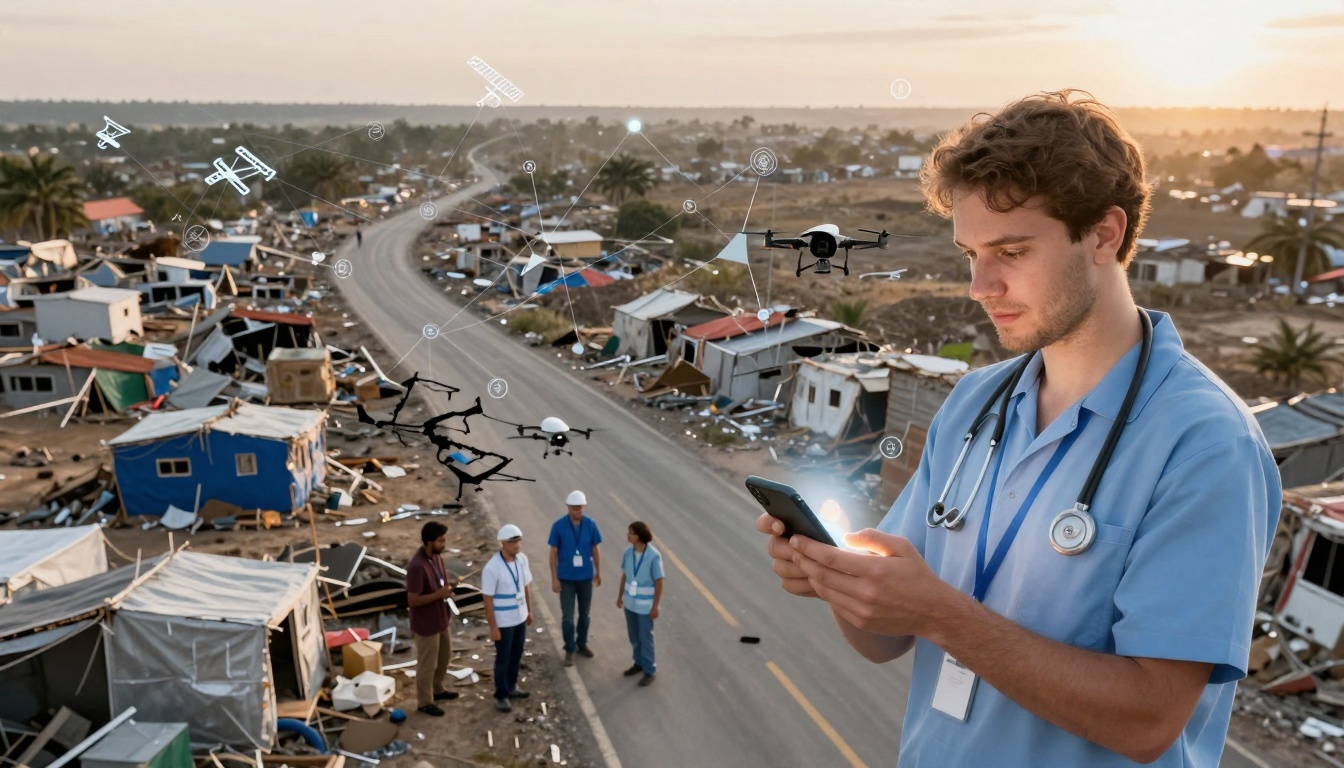
| Drones for assessment | Checks routes, damage, hazards | Access without risking staff | Perception issues, possible targeting concerns |
Health and protection tools people can actually use
In a crisis zone, health risks stack up fast. A small cut can turn into an infection when water is scarce. Pregnancy becomes more dangerous when clinics are overwhelmed. Stress can sit in the body like a locked jaw.
Technology supports health in practical ways, especially when staff and supplies are stretched:
Remote clinical support: Telemedicine and remote consultation can help frontline health workers get advice on triage and treatment. This doesn’t replace hospitals, but it can improve decisions when the nearest specialist is hundreds of miles away.
Disease surveillance and alerts: Mobile reporting can flag unusual clusters of symptoms. Even basic, consistent reporting can show where diarrhoeal disease is spreading, or where malaria cases are rising after flooding.
Digital tools for continuity of care: When people are displaced, medical records often vanish. Secure systems that allow safe, minimal sharing (for example, key vaccination information) can prevent gaps in treatment. The key word is minimal. Collect only what’s needed, store it safely, and don’t keep it longer than required.
Mental health support: In conflict and disaster, people often need short, practical support that fits into hard days. That might be a hotline, a trusted local volunteer using structured guidance, or simple phone-based check-ins. The goal is stability, not a perfect therapy setting.
For a wider look at where humanitarian technology is headed, including health-related applications and coordination tools, Diplomatic Courier provides a useful overview in tech trends transforming humanitarian aid.
One point matters more than any app: people use tools they trust. In places where fear is daily life, privacy and safety aren’t extras. They are part of care.
The hard part: safety, privacy, and tools that can be used against people
Every technology that helps can also harm. In crisis zones, that risk is sharper because power is uneven and consequences are immediate.
Take drones. Recent reporting notes a grim reality: drones are used heavily in conflicts, adding threats and deaths. Aid organisations also use drones for safer assessment and, in some cases, to reach cut-off areas with supplies or to spot hazards in places such as Mali and Ethiopia. Both truths can exist at once. A tool can save lives on Tuesday and be feared on Wednesday.
The same tension runs through data systems. Collecting data can help deliver support fairly. It can also create a list of vulnerable people. If that list leaks or is seized, it can put people in danger. That’s why responsible organisations stress:
Data minimisation: don’t collect what you don’t need.
Strong security: protect devices, connections, and storage.
Clear consent: explain risks in plain language, not legal jargon.
Exit plans: know how data will be deleted or handed over safely.
There’s also a quieter issue: misinformation. In emergencies, rumour spreads like smoke. A fake message about a “new registration point” can pull people into danger. A false claim about a vaccine can undo months of health work. That’s why community-based verification, trusted local communicators, and consistent messaging matter as much as any software.
Policy choices in 2026 are shaping which technologies get funded and which risks are tolerated, including the pressure of shrinking budgets and new partnerships. The New Humanitarian captures that shifting terrain in What’s shaping aid policy in 2026.
The best rule is simple: if a tool makes people easier to find, it must also make them harder to harm.
Conclusion: the most useful tech is often the simplest
If you strip away the headlines, crisis technology is mostly about small wins that add up: earlier warnings, clearer needs, faster cash, safer routes, and a message that gets through when silence would be dangerous. In 2026, with tens of millions displaced and around 240 million people needing assistance, those wins matter.
The next time a phone buzzes with an alert, it’s worth remembering what that sound can mean in a crisis zone: a route to higher ground, a clinic location, a payment that buys food, a reminder that someone hasn’t been forgotten. The challenge now is keeping the benefits while protecting people from the risks, because trust is the one resource no system can manufacture.