



Listen to this post: Why You Can Never Quite Bring Yourself to Throw Out That Receipt
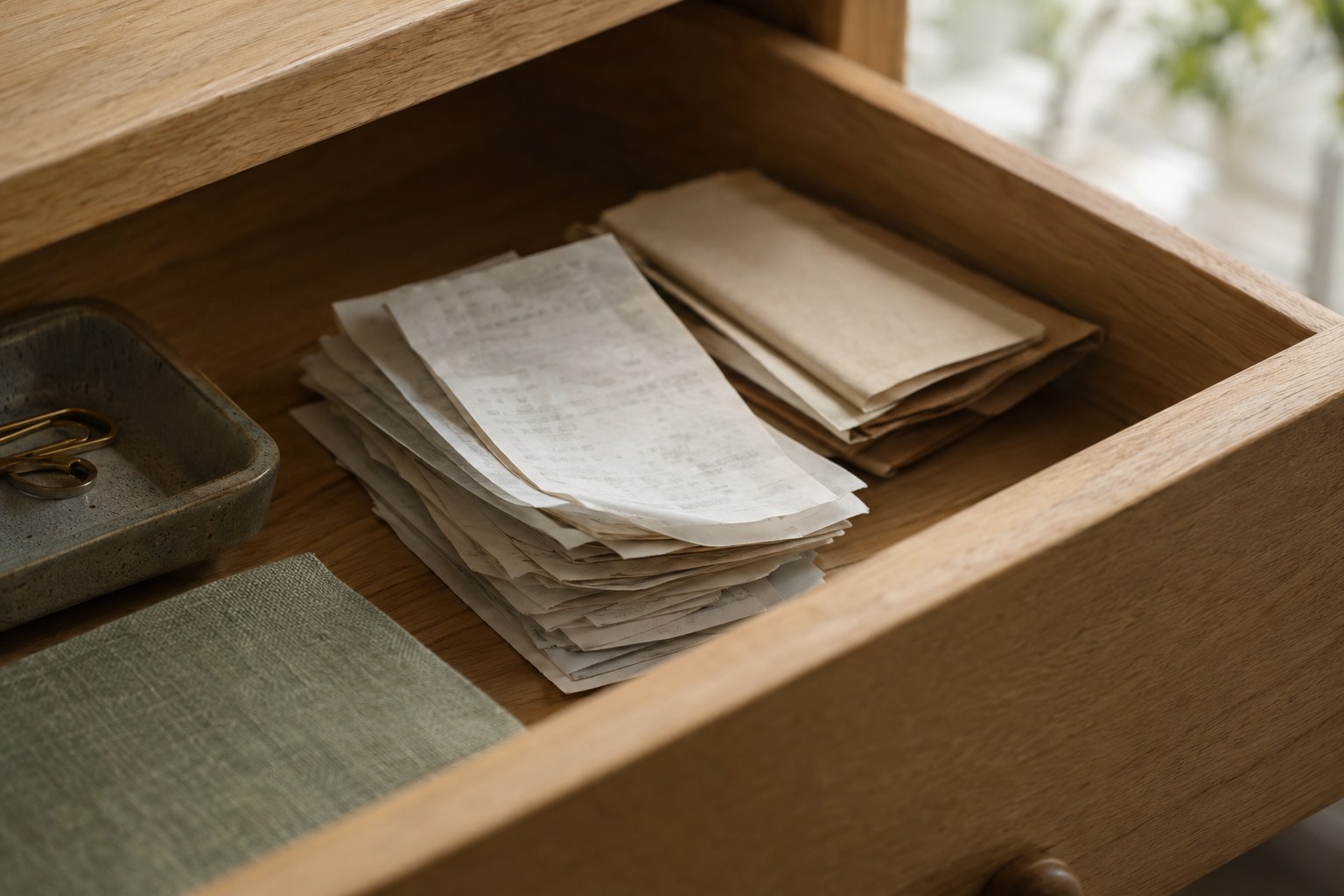
There is a drawer somewhere in most houses — a kitchen one, a desk one, sometimes just a shoebox on a closet shelf — that exists purely to hold receipts nobody has looked at in months. Every so often you open it meaning to clear it out, and every so often you close it again having sorted almost nothing, because some small, stubborn part of you isn’t sure which of these slips of paper you’re allowed to let go of. The electronics one, maybe. The one for the mattress, almost certainly not. The rest sit in a kind of administrative limbo: probably fine to toss, possibly the one thing you’ll need in March.
That hesitation isn’t disorganisation. It’s a fairly well-understood piece of human wiring, and once you see what it actually is, the drawer gets a lot easier to deal with.
The math says toss it. The feeling says not yet
Behavioural economists have a name for why a receipt feels harder to throw away than its actual usefulness would justify: loss aversion, the finding, first documented by Daniel Kahneman and Amos Tversky, that losing something registers roughly twice as painfully as gaining the equivalent amount feels good. A receipt isn’t money, but it represents access to money — a refund, a replacement, a warranty claim — and the brain treats the small chance of needing that access as a much bigger deal than the odds actually warrant. Throwing the receipt away doesn’t feel like discarding a scrap of thermal paper. It feels like closing a door you might still need to walk back through.
Professional organisers run into this constantly, which is why most decluttering guides for paperwork spend less time on folding technique and more on permission: a framework for deciding, item by item, what a given piece of paper can actually still do for you. Without that framework, the drawer doesn’t get sorted. It gets reorganised, which is a different thing, and about once a year it gets quietly replaced by a slightly bigger drawer.
Almost none of it is doing anything for you anymore
Here’s the part that makes the anxiety mostly unnecessary: the overwhelming majority of receipts stop being useful on a predictable, fairly short timeline. A grocery receipt has nothing left to protect after you’ve checked the bill. A clothing receipt is dead weight the day after the return window closes, typically somewhere between thirty and ninety days depending on the shop. Even tax-relevant receipts, for people who keep those, generally only need to survive three to seven years before the IRS’s own audit window closes, not forever. The paper that’s actually worth protecting is a much smaller pile than the drawer suggests: big-ticket purchases with a multi-year warranty, anything you might want to insure or claim against, and anything you’d genuinely struggle to prove you paid for if a product failed next year instead of next week.
Once you separate those two piles — the stuff with a short, already-expired shelf life, and the small handful of purchases that could matter for years — the drawer stops being one undifferentiated anxiety and becomes two much smaller, much more manageable problems. One of them you can solve this afternoon with a bin bag. The other one needs an actual system, because it’s the pile where losing the receipt really would cost you something.
The part worth keeping works better logged than saved
The mistake most people make with that second, smaller pile is still treating it like paper to be filed rather than information to be recorded. A faded thermal receipt for a laptop you bought four years ago is already most of the way to useless — the ink fades long before the warranty does — which is the opposite of what you actually need from it. A few people have quietly switched the habit around: the moment something expensive enough to matter comes into the house, they photograph the receipt and log the purchase date right then, using something like Warranty Watch, so the record exists in a form that doesn’t fade, isn’t tied to one physical drawer, and is actually searchable the day it’s needed. The paper original can then go wherever paper goes, because the thing that was actually valuable about it — the date, the proof, the amount — was never the paper. It was the information printed on it.
That reframing is really the whole trick. The drawer isn’t a filing problem and it was never really about willpower either. It’s what happens when a system built for paper is asked to hold onto information for years at a time. Paper is good at very little past the first few weeks of owning something. The information inside it can last as long as you need it to, if it’s kept somewhere other than a drawer that one day, inevitably, gets cleared out all at once, good receipts and dead ones together.
None of this requires becoming the kind of person who logs every purchase on principle. Most of what comes through the door really is disposable the moment the return window shuts, and treating it that way is accurate, not careless. The only shift worth making is noticing, right at the register, which few things this month actually belong to that second pile — and giving those a home that isn’t a drawer counting on you to remember where you put them.