

Listen to this post: How Nigerian Food, Slang and Music Are Taking Over Streets and Studios in the UK
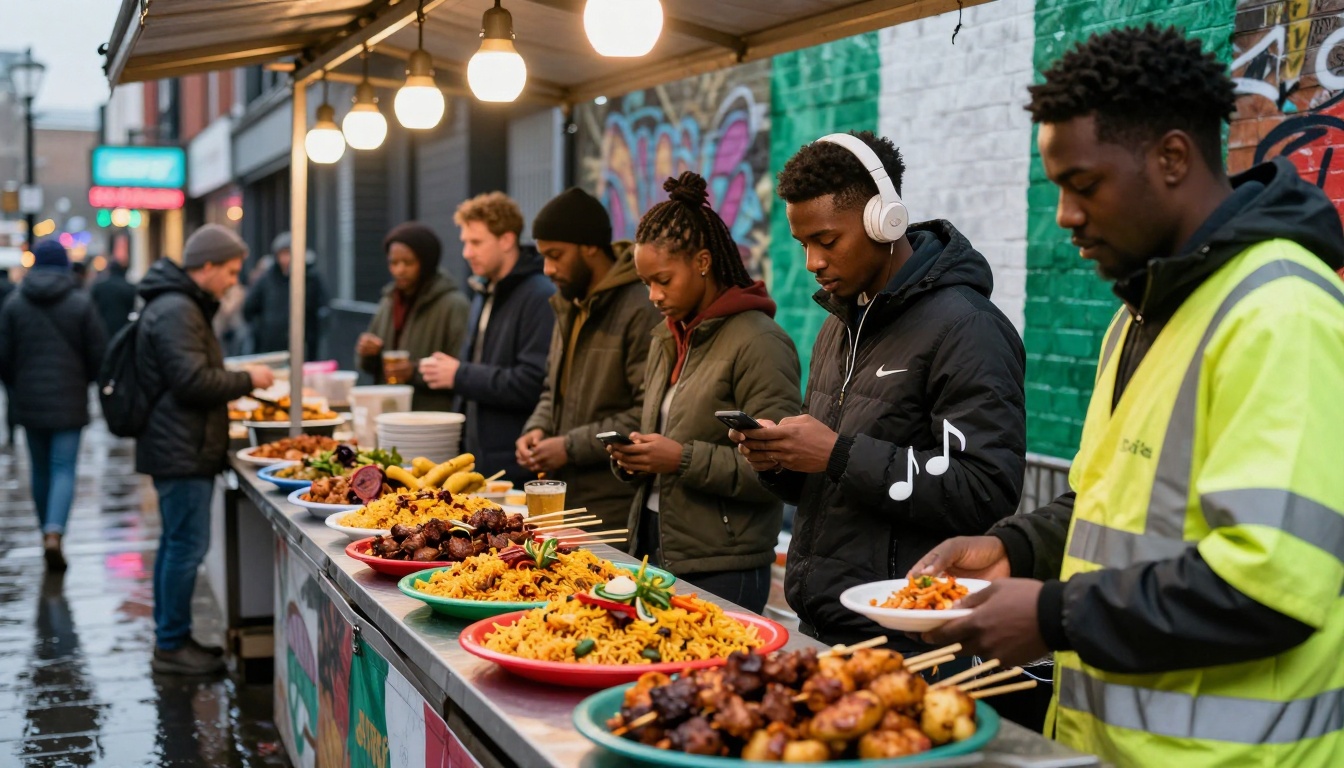
It’s a weekday lunch rush in South London. The queue spills out of a small shop front, and you can tell what’s waiting inside before you even see the menu. The air has that peppery warmth that sticks to your coat. Someone at the back is already arguing, half-joking, about whose jollof is “correct”. Two school kids scroll TikTok, humming an Afrobeats hook they only know from clips, while a man in a high-vis jacket says, “Abeg, make it extra spicy,” like it’s the most normal thing in the world.
This is Nigerian culture in the UK in January 2026. It isn’t just at carnivals or family parties anymore. It’s in lunch breaks, barber shops, gym playlists, and group chats.
Nigerian food, Nigerian slang, and Nigerian music are shaping what people eat, say, and play across UK cities, and the speed of it can feel unreal. One minute you’re hearing a phrase in a song, the next it’s in a bus stop conversation. One minute you’re “just trying suya”, the next you’re craving it at midnight.

From jollof to suya, how Nigerian food became a UK craving
Nigerian food doesn’t whisper. It arrives loud, hot, and confident, and that’s part of why it travels well in the UK. It fits how people actually eat now, quick lunches, shareable dinners, late-night bites after a link-up, and plates that look good on camera.
There’s also a simple truth: the flavours are bold, and bold flavours create loyal people. Once someone finds a dish that hits, they’ll go back for it the way they go back for their “usual” coffee order.
A recent BBC piece captured how Nigerian cooking has moved from community staple to high street and supermarket demand, with more mainstream visibility for dishes many people in Britain hadn’t tried before (BBC: The Nigerian food boom). That matters because it signals something bigger than a trend. It shows Nigerian food has become part of everyday choice.
The dishes people can’t stop ordering (and why they hit so hard)
Jollof rice is the headline act, and it earns it. Tomato-rich, smoky, and spiced, it’s the kind of rice that doesn’t taste like a side. It tastes like the point. In the UK, it’s become a regular lunch pick, often with grilled chicken, fried plantain, or a pepper sauce that wakes you up better than an espresso.
Suya is the late-night favourite. Think grilled skewers, thinly sliced beef, and a dry spice mix that sits somewhere between heat and savoury crunch. It’s snackable, but it also feels like a meal. The smell alone can pull people off a high street and into a queue.
Puff puff plays a different role. It’s soft, sweet fried dough, warm in the centre, with that light chew that makes you reach for “just one more”. In the UK, it’s a perfect add-on when you’re ordering for a group, or when you want something that calms down the heat.
Then there are the comfort plates that people grow into after the “first try” stage:
- Egusi soup: rich, thick, and nutty (made with ground melon seeds), often eaten with swallow like pounded yam or eba.
- Fried plantain: sweet edges, caramel notes, and the kind of side that can steal attention from the main.
If you’re new to it, ordering doesn’t have to be a test of bravery. Ask for medium heat first, then move up. Many spots will happily adjust pepper level, and your taste buds will thank you.
Restaurants, street stalls, and supper clubs putting Nigerian flavours on the map
Part of the UK’s Nigerian food surge is about range. There are long-standing community restaurants where the portions come heavy and nobody’s pretending. Then there are modern dining rooms where the plating is sharp and the menu reads like a story.
In London, places often mentioned in conversations about Nigerian food include Aso Rock Restaurant, Alhaji Suya (Peckham), and Chishuru (Fitzrovia). They don’t attract only Nigerians. They pull in mixed crowds, first-timers on dates, colleagues on lunch, and food lovers who’ve chased the taste from a clip to a real plate.
Manchester is on the same wave, with well-known options like Enish, Yetti’s Kitchen, and La Buka African Restaurant. That spread matters because it shows demand isn’t locked to one postcode. It moves where people live, study, and go out.
What’s also changing is format. Nigerian food in the UK now shows up as:
Street food energy: suya stands, grills, late-night counters.
Dinner destination: birthdays, anniversaries, and “let’s dress up a bit” meals.
Supper club culture: intimate menus, playlist-driven nights, and communal tables that turn strangers into friends.
And once people connect the taste to the feeling of the night, it becomes a memory they want again.
Slang that travels fast: how Nigerian words slip into UK chats
Language spreads the way music does. It sticks when it’s short, expressive, and easy to repeat. In big UK cities, speech already mixes Jamaican patois, Somali, Arabic, Punjabi, and a dozen local dialects. Nigerian English and Pidgin slide into that mix because they fit the rhythm of how people talk online and in person.
There’s also a cultural loop at work. People hear words in songs, comedy clips, and group chats, then try them out with friends. If it lands, it stays.
This isn’t about claiming everyone in Britain speaks Nigerian Pidgin. They don’t. It’s about how a few words travel far because they’re useful. Some have even gained wider recognition in English dictionaries, which signals how common they’ve become in global usage (the real-time data referenced recent Oxford English Dictionary additions for Nigerian-origin terms).
Why UK youth speech borrows from Nigerian English and Pidgin
The main channels are ordinary places, and that’s why it moves fast:
School corridors and friend groups: diaspora kids bring home speech patterns that friends pick up naturally.
Social media: short videos reward catchphrases, punchlines, and fast reactions.
Music lyrics: Afrobeats and UK rap often share slang and cadence, which helps words jump genres.
Comedy and skits: timing matters, and Nigerian slang often carries a whole mood in one word.
If you want background on heritage language learning in the diaspora, including Yoruba lessons among young British Nigerians, this piece gives a useful view of why language matters beyond “slang” (Lacuna: Yoruba lessons in the diaspora).
Using the words right: meaning, tone, and respect
A lot of people pick up Nigerian words because they like the sound, or because it makes them feel close to the culture. That can be fine, but only if it’s done with respect.
A few rules keep it simple:
Don’t force it: if it’s not your normal voice, it’ll sound like acting.
Ask what it means: friends usually don’t mind explaining when you’re genuine.
Watch context: what’s fine in a group chat might feel rude in public.
Don’t mock accents: repeating words in a “funny voice” is where it turns ugly.
Know when to keep it standard: work settings, formal events, and speaking with elders often call for plain English.
A quick example shows the difference.
Respectful:
- “I keep hearing ‘abeg’ in songs, what does it mean?”
- “It means ‘please’.”
- “Cool, abeg can you pass the sauce, please?”
Awkward:
- “Abeggggg!” (dragged out, exaggerated, put on)
- “Why are you talking like that?”
The goal isn’t to perform someone else’s identity. It’s to understand, and if you use a word, use it properly.
For a wider look at how music and youth culture shape language in Britain, this Guardian piece on rap and slang gives strong context (The Guardian: UK rap and language change).
Afrobeats in the UK: the sound moving clubs, charts, and studio sessions
Afrobeats in the UK now feels less like a “guest genre” and more like part of the furniture. It sits comfortably next to UK rap, R&B, dancehall, and amapiano. DJs blend it into sets without announcing it like a special feature. You hear it at weddings, at freshers’ parties, in nail shops, and through car windows at red lights.
The rise isn’t just about what fans stream. It’s also about what producers build. Once a rhythm becomes normal in clubs, it starts shaping how songs are written. Hooks get simpler and chant-ready. Percussion becomes more playful. Tempos sit in that sweet spot where people can dance without thinking too hard.
Mainstream visibility has also been reflected in major festival slots and big stages, as covered in this BBC explainer on Afrobeats and Glastonbury (BBC: Afrobeats at Glastonbury).
How Nigerian rhythms changed UK nightlife and festival line-ups
Walk into an Afrobeats-friendly UK club night and you’ll feel the difference in minutes. The rhythm has bounce. The drums feel like they’re talking. The crowd sings parts of songs they don’t fully “know”, because the hook is designed for call-and-response.
It works because it matches real life. People don’t go out to analyse. They go out to move, to flirt, to shout lyrics into their mate’s ear.
Afrobeats also suits UK event culture:
- Summer day parties: bright, open-air sound, good for long sets.
- Freshers’ week: easy singalongs, low barrier to join in.
- Weddings and birthdays: music that makes aunties dance and cousins scream at the same time.
- Gym playlists: steady bounce that keeps you going, even when you’re tired.
And when the genre blends with amapiano, you get that deeper swing, the kind of groove that turns a club into one big shoulder-roll.
For a broader view of Afrobeats as a global export shaped by diaspora, The Economist has covered how the music travels and shifts as audiences grow (The Economist: Afrobeats’ new groove).
Inside the studio: collabs, hooks, and the new rules of a hit
In UK studios, Afrobeats influence often shows up in practical choices, not grand statements. Producers borrow patterns that feel good on the body. Artists write hooks that work in clips and in crowds. Engineers leave space for percussion to breathe.
Common building blocks include:
Percussion that talks: busy, syncopated drums that push the song forward.
Guitar riffs: bright, looping lines that feel sunny, even in a grey month.
Chant-style hooks: short phrases that people can repeat after one listen.
Bilingual lines: switching between English and Nigerian languages or Pidgin for flavour and rhythm.
Collaboration is a big part of it too. UK artists feature Nigerian artists, Nigerian artists feature UK artists, and both sides win because the audience expands without losing the local feel.
Streaming rewards that crossover. A track can build in London, catch in Lagos, then return to Birmingham with twice the energy. It’s the same song, but it arrives back with a new story attached.
If you’re trying to spot what makes an Afrobeats-leaning track feel right, here’s a quick checklist:
- A steady bounce you can move to without thinking
- A hook that works in a room, not just in headphones
- Percussion detail, even when the melody is simple
- Space for call-outs, ad-libs, and crowd moments
Conclusion
That lunch queue for jollof, the quick “abeg” in a group chat, the Afrobeats hook drifting out of a barber shop, it’s all connected. Food, slang, and music travel together because people carry them, and because phones make sharing instant. In 2026, Nigerian culture in the UK isn’t a side note. It’s part of the sound, taste, and talk of everyday life.
Next, expect the wave to spread harder into more regional towns, more fusion menus, and more cross-genre tracks that blur borders without losing identity. Try one dish you’ve never ordered, learn one phrase properly, and put on a new mix for your commute. The best way to understand the culture is to meet it where it lives, on your street.