
Listen to this post: How AI Helps Map Content to Each Stage of the Funnel (TOFU to Retention)
Picture a busy road with too many signposts. Some point to a cafe that’s miles away, others warn of a sharp bend that’s already behind you. That’s what a lot of content feels like. Teams publish plenty, but the message lands in the wrong place, too salesy too soon, too fluffy too late.
Mapping content to the funnel is simply putting the right message in front of the right person at the right moment. Not by guesswork, but by reading intent signals and matching topics, formats, and proof to where someone is in their journey.
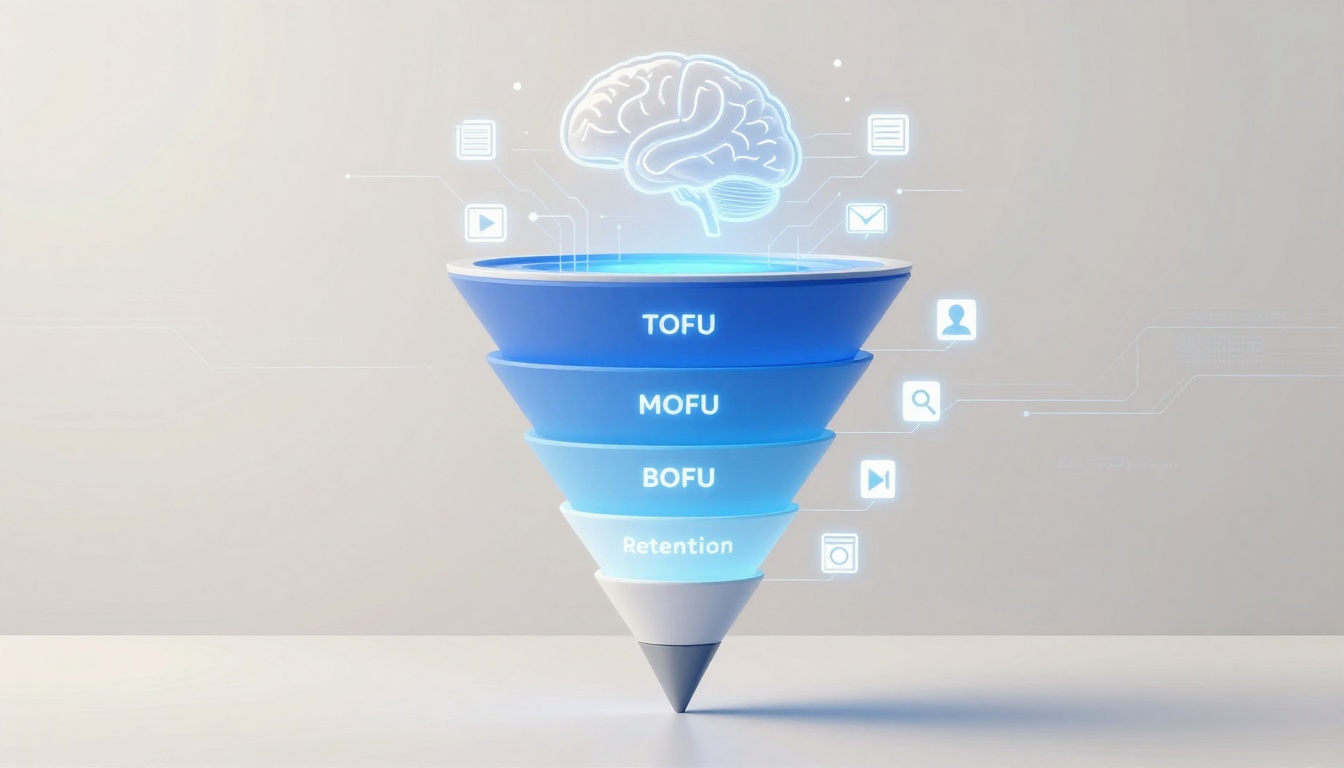
This guide shows how AI can help you do that without turning your marketing into noise. You’ll see what to create for TOFU, MOFU, BOFU, and retention, how AI decides what to serve next, and what to track so your funnel stays honest.
What “content to funnel mapping” means, and why it breaks in real life
A funnel is a tidy model for a messy truth. People don’t walk in a straight line. They loop back, compare, ask a mate, open ten tabs, then vanish for a week.
Still, the stages are useful when you keep them plain:
- Awareness (TOFU): They’ve got a problem, not a shortlist. They want clear answers.
- Consideration (MOFU): They’re weighing options. They want proof, comparisons, and a sense of fit.
- Decision (BOFU): They’re close. They want pricing clarity, risk reduction, and a simple next step.
- Retention: They’ve bought. They want to succeed quickly, then keep succeeding.
Content mapping breaks when teams treat the funnel like a label maker, not a behaviour map. Common failure points show up fast:
- Guessing intent from a single page view.
- Copying competitors and ending up with the same bland content.
- Measuring the wrong thing, like traffic instead of progress.
- Treating every visitor the same, even when their actions shout otherwise.
A quick example makes it real. Someone searching “how to reduce manual workflows” is hunting for a way out of a daily pain. Someone searching “best workflow automation tool pricing” is already comparing vendors. Same theme, different stage, different job for your content.
If you want a sharper take on why the classic funnel can mislead, the critique in Forget Everything You Know About TOFU, MOFU, And BOFU is worth your time. The punchline isn’t “ditch the funnel”, it’s “stop pretending it’s linear”.
The signals that show what stage a reader is in
AI doesn’t read minds. It reads patterns. The useful kind are simple and observable:
- Search terms and on-site queries
- How deep they go (one page or five)
- Time on page and scroll depth
- Return visits over days or weeks
- Email clicks and which links they choose
- Pricing page views and repeat visits
- Demo requests, trial starts, contact forms
- Support tickets, help-centre searches, feature questions
Early-stage signals look like curiosity. Late-stage signals look like intent.
A visitor who reads an explainer and bounces might still be a strong TOFU win. A visitor who revisits pricing twice and opens an integration page is waving a BOFU flag.
One warning: consent and clean tracking matter. If your data is patchy, AI will “fill in” with probabilities, and you’ll end up pushing the wrong content at the wrong time.
How AI maps the right content to TOFU, MOFU, BOFU, and retention
AI helps because it can do two hard jobs at once: it can spot patterns across thousands of sessions, and it can react quickly without your team hand-stitching every journey. however, there are complexities that arise with this technology, such as hallucinations in generative ai explained. these can lead to unexpected outputs that may confuse users and diminish trust in the system. understanding how these phenomena occur is crucial for improving the reliability and effectiveness of ai applications.
In January 2026, the strongest approaches tend to combine:
- Predictive topic discovery for SEO (finding what’s rising before it peaks)
- Content structured for AI citation (clean summaries, Q and A, schema markup)
- Predictive audiences for ads and distribution
- Lead scoring and behaviour-based triggers
- Dynamic content blocks that change based on behaviour
- Automated A/B testing on landing pages and emails
- Churn prediction and proactive support content
If you want extra background on the “AI content funnel” idea, this overview from Copy.ai is a solid reference point: Optimizing Each Funnel Stage with an AI Content Funnel.
TOFU (Awareness): AI finds questions people ask, then helps you answer first
What the reader wants: relief and clarity. They’re naming the problem, not buying a product.
What content works best: plain-language explainers, checklists, beginner guides, short videos, glossaries, and “how it works” pages. Keep it helpful and specific. When considering what content works best for your audience, think about starting a blog for beginners that covers practical tips and straightforward advice. Incorporating engaging visuals can also enhance the learning experience, making complex topics easier to grasp. Additionally, offering downloadable resources, like templates or eBooks, can provide extra value to your readers.
What AI does behind the scenes:
- Spots rising topics and clusters keywords by theme, so you build around real questions, not random blog ideas.
- Suggests outlines that match beginner intent (simple headings, definitions, common pitfalls).
- Helps you write content that’s easy for AI search tools to quote by nudging you to add short summaries and clear Q and A sections.
- Supports structured data (such as FAQ, HowTo, and Product schema) so search systems can understand your page.
A practical tactic here is “answer-first” writing. Put the direct answer near the top in 40 to 60 words, then expand. That format tends to work well for both humans and AI-driven search summaries. Understanding how tokens influence language generation is critical for developing AI models that can accurately predict and produce text. By examining the structure and significance of each token, developers can enhance the coherence and relevance of generated content. This approach not only improves user engagement but also aligns AI outputs closer to human-like communication.
Concrete example: someone searches “reduce manual workflows”. AI flags this as early intent and recommends:
- A simple explainer: “What manual workflows cost you (time, errors, stress)”
- A short video: “3 signs your process is too manual”
- A glossary box: “workflow automation, approval flow, handoffs”
The goal is trust, not a hard sell. If you want more on how SEO changes when AI tools sit between search and click, this piece gives a useful angle: How AI is Reshaping the Modern Marketing Funnel, And What That Means for SEO.
MOFU (Consideration): AI nurtures interest with the next best piece, not a random drip
What the reader wants: confidence. They’re asking, “Will this work for someone like me?”
What content works best: case studies, comparison guides, webinars, ROI calculators, implementation notes, and “how we’re different” pages that don’t insult their intelligence.
What AI does behind the scenes:
- Uses predictive lead scoring to estimate who’s warming up, based on behaviour across pages, emails, and sessions.
- Triggers the “next best” content when someone does something meaningful (not on a fixed calendar).
- Personalises recommendations on-site (related content modules, chat prompts) and in email (role-based angles, relevant proof).
- Runs small tests on subject lines and call-to-action text to learn what each segment responds to.
Tools and platforms change, but the pattern is consistent. Systems like HubSpot AI and Salesforce Einstein are often used for scoring and routing, while analytics and CDP tools help segment behaviour. The point isn’t the brand name, it’s the loop: observe, predict, respond, measure.
Dynamic content is the plain version of personalisation. The page stays the same, but certain blocks swap out. A finance lead sees cost control and risk. An ops lead sees time saved and fewer handoffs. Same product, different “why”.
Concrete example: after someone watches a webinar on workflow automation, AI can:
- Email a case study in their industry
- Offer an ROI calculator that uses their team size
- Suggest a comparison guide: “automation platforms vs. internal builds”
That feels like help. It doesn’t feel like being chased.
BOFU (Decision): AI tightens the last mile with intent-based personalisation and testing
What the reader wants: certainty and low risk. They’re checking details, not dreaming.
What content works best: pricing pages that answer real questions, security and compliance notes, integration docs, buyer FAQs, proof sections, short demo videos, and clear CTAs.
What AI does behind the scenes:
- Watches for high-intent signals: repeat pricing visits, demo-page views, “best X for Y” buyer keywords, return sessions from email, and visits to contract or policy pages.
- Personalises the final mile based on intent, not just persona. Someone worried about cost needs different proof than someone worried about adoption.
- Automates A/B testing on landing pages (headlines, page order, CTA wording, form length), so you learn faster than quarterly “big redesigns”.
- Helps optimise spend by shifting budget towards ads and creatives that produce late-stage actions, not just clicks.
This is where teams often go wrong. They see “pricing page visit” and send five sales emails. AI makes it tempting to press harder. Resist that urge. Use it to remove friction, not add pressure.
Concrete example: a visitor returns to pricing twice, and views “integrations” and “security” in the same week. AI triggers:
- A role-specific demo page that highlights security and setup time
- A short proof section with relevant logos and one tight case study
- A CTA that matches readiness (“Book a 15-minute fit check”, not “Talk to sales for 60 minutes”)
If you want a broader view on AI across the full funnel, Single Grain’s guide is a useful skim: AI-Driven Full-Funnel Optimization for Enterprise Growth.
Retention: AI keeps customers by predicting churn and serving help before complaints
Post-buy content isn’t “nice to have”. It’s part of the funnel. If customers don’t get value fast, you’re back to selling, just in a different outfit.
What the customer wants: quick wins, then steady progress. They want to feel smart for choosing you.
What content works best: onboarding emails, in-app checklists, feature tips, training hubs, troubleshooting guides, renewal reminders, and upgrade education that’s linked to real use cases.
What AI does behind the scenes:
- Looks for churn signals (drop in usage, fewer logins, repeated help-centre visits, failed actions, long gaps between sessions).
- Predicts which accounts need help, then prompts support content before frustration turns into a ticket.
- Personalises onboarding based on what a customer has not done yet, not just what they clicked once.
Churn prediction tools vary, but the idea is stable. Systems such as Pecan AI are often discussed in this context, alongside product analytics platforms that spot drop-offs early.
Concrete example: a customer’s logins drop for ten days, and they keep searching the help centre for “approvals”. AI triggers:
- A three-email “quick wins” series focused on approvals
- A short in-app checklist: “Set your first approval flow in 7 minutes”
- A support prompt offering a short screen-share session
That’s retention content doing its job. It arrives like a lifebuoy, not a lecture.
A simple AI workflow to build a funnel content map your team will actually use
The best funnel map isn’t a pretty spreadsheet. It’s a system people trust, because it matches what customers do.
Keep it tool-agnostic. Most teams can do this with a CMS, analytics, email platform, and a CRM.
Start with one audience, one goal, and one funnel path
Pick a single persona and one conversion goal. Keep it tight:
- Newsletter sign-up
- Demo request
- Trial start
- Purchase
Write down their top pains and the objections that block action. Not twenty of each, just the ones you hear every week.
AI works best when the job is narrow. A fuzzy brief produces fuzzy output, no matter how smart the model is.
Use AI to tag every content piece by stage, intent, and format
You need a tagging system that a human can understand in five seconds:
- Stage tag: TOFU, MOFU, BOFU, Retention
- Intent tag: learn, compare, buy, use
- Format tag: article, video, checklist, case study
AI can help classify older content by reading it and matching patterns, then flagging gaps. You might find you’ve got 40 TOFU blogs, three MOFU pieces, and a single BOFU landing page. That isn’t a content strategy, it’s a pile.
A good map also shows “next steps” for each piece. A TOFU explainer shouldn’t point straight to “Book a demo” unless the page truly earns it.
Connect content to triggers, then measure what matters at each stage
Set simple trigger rules that reflect behaviour:
- If they read X, recommend Y on-site
- If they watch a webinar, send a relevant case study
- If they revisit pricing, show the right FAQ and offer a short demo
- If usage drops, send a quick-start guide
Then measure stage-based outcomes, not vanity totals:
| Funnel stage | What to measure | What “good” looks like |
|---|---|---|
| TOFU | Reach, engaged time, new visitors, AI search impressions where available | More qualified attention, not just more clicks |
| MOFU | Return visits, email clicks, webinar sign-ups, guide downloads | More people moving from curiosity to evaluation |
| BOFU | Demo requests, trial-to-paid rate, conversion rate, sales cycle length | Fewer stalled deals, clearer decisions |
| Retention | Activation, feature adoption, renewals, churn | Customers succeed sooner and stay longer |
Watch for last-click bias. BOFU often gets the credit, but TOFU and MOFU do the heavy lifting.
Guardrails, mistakes, and ethics, so AI doesn’t wreck trust
AI can make your funnel feel helpful, or creepy. The difference is your rules.
Common mistakes: wrong labels, thin content, and pushing for a sale too soon
- Misreading intent: pricing curiosity isn’t always buying intent. Some people are just checking range.
- Thin AI text: if it says little, it earns little. Add real examples, clear steps, and honest limits.
- Ignoring mobile UX: the best content fails if the page is slow or hard to scan.
- Trigger spam: too many emails and pop-ups turn interest into avoidance.
- Treating the funnel as a straight line: people loop, compare, and share links internally.
Quick fixes that don’t require a rebrand:
- Review tags monthly, and sample sessions to check reality.
- Write for one question per page, then link out for depth.
- Add proof only when the reader is ready for it.
Privacy and consent: collect less, explain more
First-party data is powerful, but it comes with responsibility. Track what you need, and be clear about why. Consent banners are only the start. People also need plain language that explains what improves their experience.
Trust is part of conversion. A simple privacy note and a preference centre can do more for long-term results than another personalisation layer.
Conclusion
Content is still a set of signposts, but AI helps you place them where the traffic actually flows. When you use it well, AI spots intent, matches content to TOFU, MOFU, BOFU, and retention, then delivers it at the right moment without shouting.
Treat the funnel map as a living system, not a one-off exercise. Pick one persona, tag 20 pieces, fill one gap per stage, then test one trigger each week. Done with care, AI doesn’t replace judgement, it backs it up with pattern and pace.