
Listen to this post: BRICS+ vs G7: Is the Balance of Global Power Really Shifting?
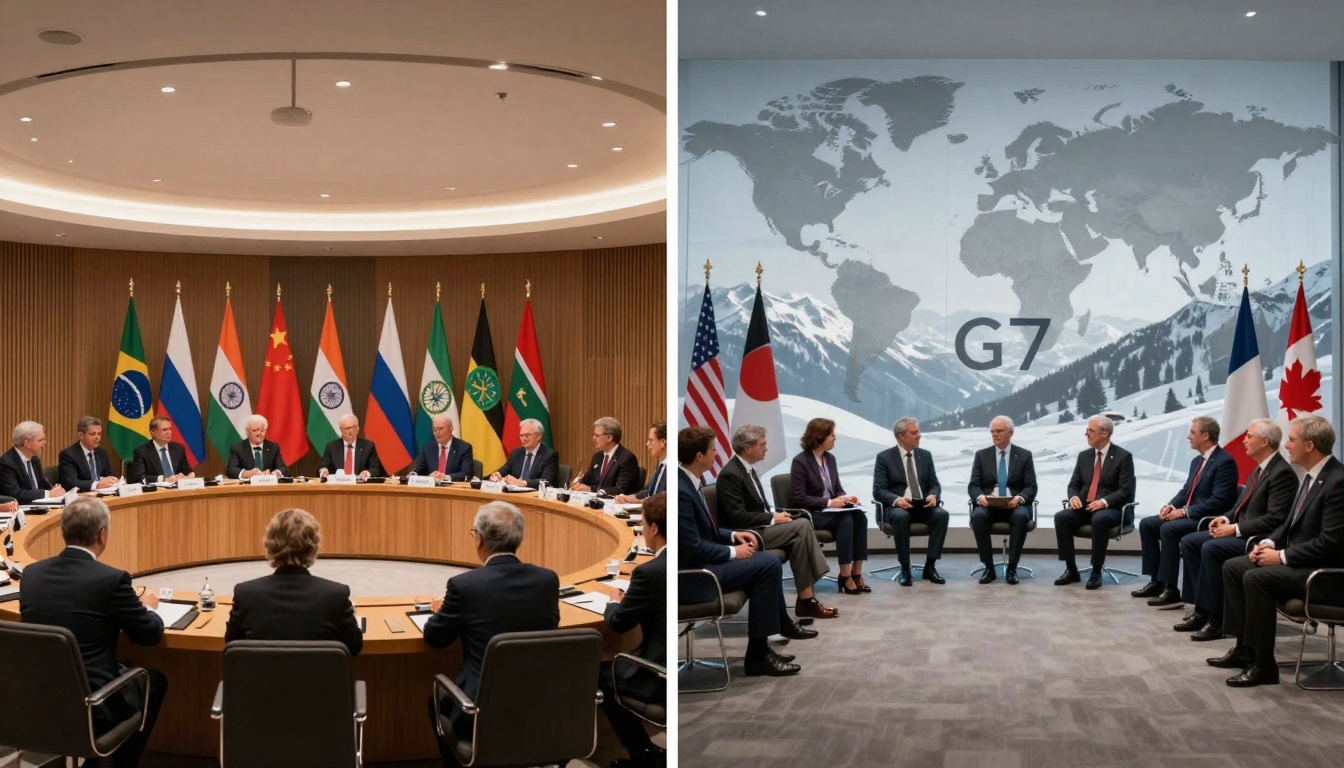
Picture world leaders gathered at tense summits. Brazilian hosts cheer new allies in Rio, while Canadian mountains echo G7 debates on trade wars. BRICS+, now with ten full members, boasts Brazil, Russia, India, China, South Africa, plus Egypt, Ethiopia, Iran, UAE, and Indonesia. The G7 sticks to its seven rich democracies: US, Japan, Germany, UK, France, Italy, Canada.
Does BRICS+ expansion mark a real power shift? Or does G7 unity keep control? This post breaks down members, crunches economic numbers from IMF projections, weighs military clout, and scans recent summits. Numbers surprise: BRICS+ grabs economic leads in some measures. Stay tuned for what it means for global order.
Who makes up these powerhouse groups today?
BRICS+ draws from vast lands and billions of people. It started in 2009 with Brazil, Russia, India, China. South Africa joined in 2010. Now it covers 3.5 billion people, or 45% of the world. That dwarfs G7’s 770 million. BRICS+ controls key resources too, like oil from Russia, UAE, Iran, and China’s factories.
G7 formed in 1975 amid oil shocks. Its members top global wealth lists. They set rules through bodies like the IMF. Recent joins boost BRICS+ reach, but G7 stays tight-knit.
| Group | Members | Population | Key Strengths |
|---|---|---|---|
| BRICS+ | 10 nations | 3.5 billion | Resources, manufacturing |
| G7 | 7 nations | 770 million | Finance, tech |
BRICS+ partners like Algeria and Nigeria add weight without full ties.
BRICS+ growth spurt: New faces on board
Expansions speed up. Egypt, Ethiopia, Iran, UAE joined in 2024. Indonesia signed on in 2025 at the Rio summit, first from Southeast Asia. Partner countries join drills and talks. Naval exercises ‘Will for Peace 2026’ show muscle. Diverse faces unite over trade gripes. Ships cut waves together, eyes on Western seas.
G7’s steady core amid tensions
G7 lists no changes. US leads, Japan and Germany follow. At 2025 Canada summit, cracks show. Trump left early; no Ukraine statement emerged. Still, they court India and South Africa. Ties to BRICS+ strain outreach. Unity holds on core goals.
The numbers game: Economic strength head-to-head
IMF 2026 projections paint a split picture. On purchasing power parity (PPP), BRICS+ hits $69.1 trillion, tops G7’s $55.4 trillion by 25%. China drives it at $39.4 trillion. Nominal GDP flips: G7 at $47.1 trillion beats BRICS+ $29.8 trillion by 58%. Growth rates favour BRICS+ too, 3.7% against G7’s 1.2%.
PPP measures real buying power, like what locals afford. Nominal tracks trade dollars. BRICS+ exports claim 23% of world share, close to G7’s 27%. Huge populations mean big markets. Visual Capitalist charts 2026 GDP forecasts show BRICS+ average 3.7% growth.
Does size mean power? Not always. G7 steers finance flows.
| Metric | BRICS+ | G7 | Leader |
|---|---|---|---|
| PPP GDP (2026) | $69.1T | $55.4T | BRICS+ |
| Nominal GDP | $29.8T | $47.1T | G7 |
| Growth Rate | 3.7% | 1.2% | BRICS+ |
PPP power: BRICS+ pulls ahead in real terms
PPP adjusts for costs. BRICS+ wins big. Developing nations shine here. China alone nears half the total. It buys more roads, homes locally. Edge grows as populations boom.
Nominal reality: G7’s trade dominance holds
Nominal uses market rates. G7 leads deals, reserves. US dollar rules. Finance inflows hit 31% for G7, 15% for BRICS+. Medium analysis tips the balance on trade power.
Beyond the economy: Military might and real-world clout
Economy tells part. Military and tech fill gaps. G7 spends big on defence. US and NATO allies hold nukes, bases worldwide. BRICS+ lacks a joint force. India-China borders simmer.
Summits spotlight rifts. Rio BRICS 2025 pushed AI, climate via Rio Declaration. No bold dollar drop. G7 Canada meet skipped full statement. Six notes covered minerals, AI, quantum. Trump exit blocked Ukraine push. Middle East talks stalled sanctions.
Resources aid BRICS+, but unity lags. G7 grips high-tech exports. Rebalance brews, takeover waits.
| Factor | G7 Edge | BRICS+ Edge |
|---|---|---|
| Military Spend | High (US leads) | Resources |
| Tech Control | Patents, chips | Growth potential |
| Unity | Strong core | Internal strains |
G7’s unbeatable military and tech edge
G7 pours cash into arms. US tops charts; NATO backs it. Global bases project force. Tech exports like chips stay ahead. Allies train as one.
BRICS+ hurdles: Unity and influence gaps
No shared army binds them. India skips some meets over China rows. Soft power trails. Rivalries hobble bold moves.
What summits reveal about the rivalry
Rio welcomed Indonesia, eyed partners. G7 Kananaskis stressed minerals, AI amid fractures. No Ukraine deal; focus shifted. OMFIF notes thin BRICS plans. Rivals watch each other close.
BRICS+ swells in size, people, resources. G7 clings to military, finance, tech. Evidence points to slow rebalance, not a flip. Growth lifts BRICS+; fractures test G7.
Watch BRICS+ expand markets. G7 may adapt or harden lines. Multipolar world could ease tensions, share gains. Follow CurratedBrief for geopolitics updates. What shift do you see next? Share below.