
Listen to this post: From Owambe to London Nightclubs: How Party Life Changes After You Relocate
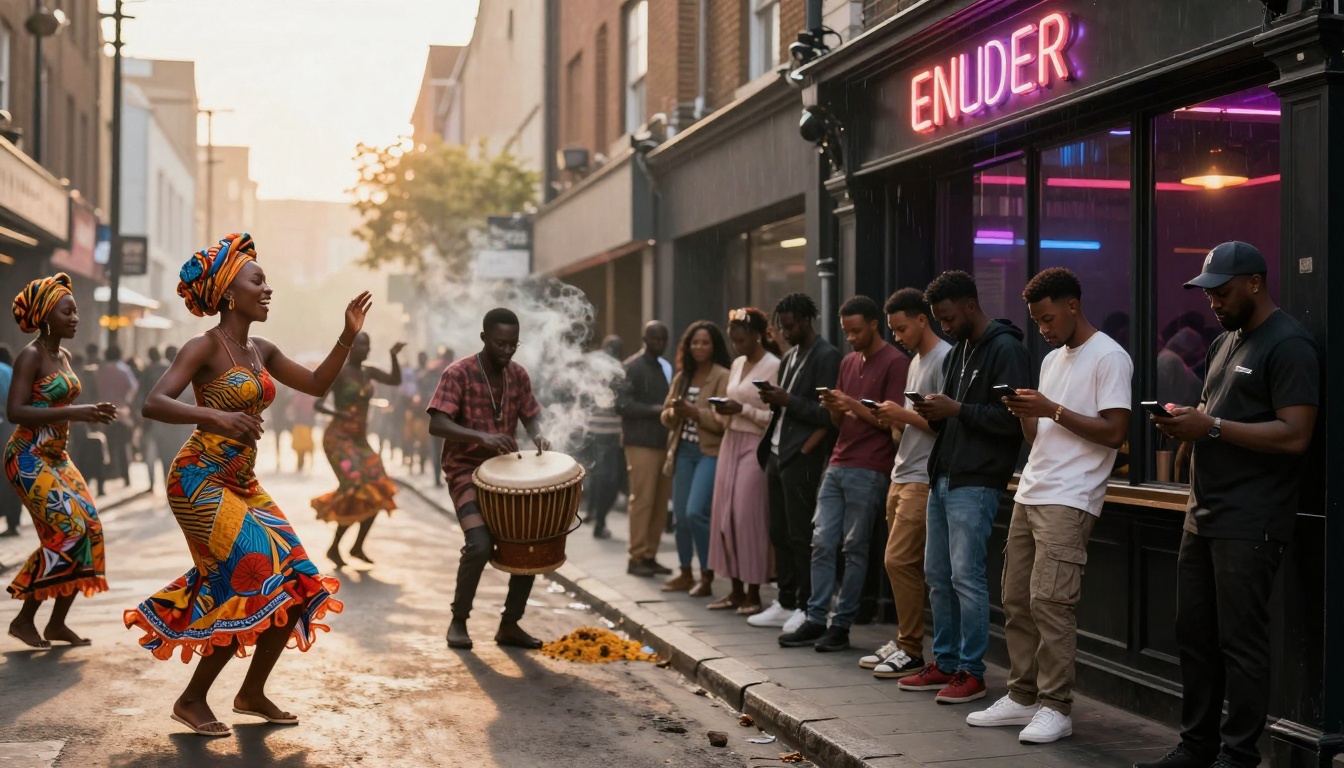
One Saturday in Lagos, the sun’s still up and the street is already alive. A canopy flaps in the harmattan breeze, gele catches the light like it’s made for cameras, and the smell of smoky jollof drifts past stacked coolers. Somebody’s auntie is dancing with her handbag tucked under her arm, the talking drum is gossiping in rhythm, and the hype man is calling names like he’s reading out blessings.
Now picture a Friday night in London. It’s cold enough to sting your ears. You’re in a queue outside a club, checking your phone battery like it’s a lifeline. The bouncer’s doing quick maths with faces and attitude, there’s an ID scan, a ticket QR code, and the quiet pressure to look like you belong.
That contrast is why relocating can make your social life feel like it’s been reset. An owambe (also spelt owanbe) is a big Nigerian party, often Yoruba in origin, where the point isn’t only fun, it’s community and shared pride. If you need a quick definition, this explainer on owambe gives the cultural gist, and the Wikipedia overview puts it in broader context. This guide breaks down what changes after you move, what stays with you, and how to keep joy in the mix.
What makes an owambe feel like home (and why it’s hard to replace)
Owambe isn’t only a party format, it’s a feeling. It’s the sense that the room has history, even if you arrived as a plus-one. It’s the way older women greet you like they’ve seen you grow up, and the way your friend’s mum insists you eat as if hunger is a personal insult.
The setting does a lot of work. Chairs in neat rows, coolers with drinks that don’t run out, a live band that knows how to stretch one song into a 12-minute moment. People don’t dance like they’re trying to look cool, they dance like they’re telling a story. Every circle has a narrator, every dancer has a cheer squad.
And there’s meaning under the noise. Many owambes mark life events, weddings, naming ceremonies, birthdays, even funerals for elders. That’s why it lands differently. You’re not just going out, you’re showing up.
If you’ve ever tried to explain it to a non-Nigerian friend, you know the problem. London has parties, great ones, but the “you belong here” energy can take time to rebuild.
The big five: food, music, fashion, spraying, and the “everyone is family” vibe
First, food. Not a bowl of chips at midnight, real feeding. Jollof with that party smoke, pounded yam that stretches like pride, small chops that disappear as soon as they land. It’s common to arrive hungry and leave “overfed”, and nobody asks you to pay at the point of service.
Second, music. Fuji, juju, Afrobeats, gospel turns, old-school highlife, then back to whatever’s hot. The sound is loud, yes, but it’s also familiar. It carries your language, your jokes, your aunties’ dance moves.
Third, fashion. Aso ebi, gele, agbada, lace, stones, the full “we came to represent” look. Dressing up isn’t only vanity, it’s respect for the hosts and the moment.
Fourth, spraying. It’s easy to reduce it to money flying, but in many circles it’s a visible way of supporting the celebrant and the musicians. (If you want a practical, modern checklist of what people expect, Pulse Nigeria’s owambe must-haves captures the current vibe.)
Fifth, the everyone-is-family spirit. A child can run between tables without anyone panicking. Elders sit near the front like living landmarks. People you’ve never met call you “my dear” and mean it.
Unspoken rules that make it work: greetings, respect, hype, and social proof
Owambe runs on soft rules. You greet. You greet properly. You greet again when you meet your friend’s mum for the third time because she’s changed seats and now you’re in her line of sight.
You also learn the social rhythm of hype. Friends don’t clap politely, they celebrate you out loud. Someone will adjust your gele mid-dance. Someone will shout your nickname like it’s a headline. The point is to make the celebrant feel seen.
And then there’s social proof, the quiet idea that looking good is part of the gift. You don’t have to be rich, but you try. You iron the outfit. You polish the shoes. You show up with effort.
A key detail: owambe is built for connection. Open invites, shared surnames, mutual friends, and family links mean you can arrive alone and still end up with a table, a plate, and new people calling you “sis”.
London nightlife after relocation: what changes in real life, not just on Instagram
London nightlife can feel like freedom at first. There’s choice in every direction, a night for every music taste, and a buzz that doesn’t need a wedding to exist. In January 2026, Afrobeats and Amapiano nights are strong, but they often sit alongside house, techno, DnB, and UK rap, depending on the venue and the crowd.
Still, the real shift isn’t only the playlist. It’s the structure. London is more transactional. You plan more, pay more, and read more rules. The same night can feel exciting and oddly lonely because people don’t automatically fold you into their group.
If you want a quick view of what’s on, listings help. DICE’s Afrobeats and Amapiano nights in London is useful for themed events, while Eventbrite’s Nigerian events in London can point you towards community nights that aren’t strictly clubs.
The night has a timetable: pre-drinks, last entry, peak time, and the trip home
London nights come with a clock you can’t ignore.
Pre-drinks often run from about 7 to 10 pm, usually at someone’s flat because it’s cheaper. Clubs tend to open around 10 or 11 pm. Peak time hits late, often 12:30 to 3 am, with many venues finishing between 4 and 6 am, depending on licensing and the night.
The planning part is the new muscle you build. Where’s the meeting point when the queue splits? What happens if someone’s phone dies? Who’s the sober-ish person that can still read a map?
Getting home matters too. Night Tube and night buses help in many areas, but your route might still include a long wait, a change, or a pricey ride if you leave with the crowd. If you’re used to hopping into a quick car and being home in 20 minutes, this can feel like the party has an extra chapter you didn’t ask for.
Money talks louder here: tickets, cloakrooms, pricey drinks, and why “free food” is rare
In Lagos, the host often carries the cost. In London, you carry your own. That’s the headline.
Entry varies, but it’s common to see tickets around £13 to £30 for a standard club night, with bigger nights going higher. Afrobeats and Amapiano events can be more affordable if you buy early, often around the £10 to £20 range for advance tickets. Once you add transport, a cloakroom, and drinks, the total can climb quickly.
And the food culture changes. Free plates don’t circulate just because you showed up. Some venues do street food nearby or sell snacks, but you’re usually expected to eat before you arrive.
Simple ways to keep it from turning into a money leak:
- Buy early-bird tickets when you can, and watch “last entry” times.
- Eat a proper meal at home first, not just crisps.
- Decide your spend before you leave, then stick to it.
- If you’re carrying a coat, budget for the cloakroom, or dress for the cold and accept the queue.
Different sounds, different energy: Afrobeats nights vs house, techno, drill, and DnB
Music can be the biggest culture shock and the biggest gift.
Many mainstream clubs in London lean into electronic music, house, techno, and DnB. UK rap and drill can dominate certain rooms and certain nights. The first time you step into a venue expecting Afrobeats and hear a long techno build-up, you might feel like you’ve walked into somebody else’s private joke.
The good news is that Afrobeats and Amapiano aren’t hidden away anymore, they’re promoted openly and regularly, often as themed nights and day parties. Some big venues even programme them directly, like the listings on Ministry of Sound’s Afrobeats page.
Taste often stretches after relocation. You might still want Asake at 1 am, but you may also learn to enjoy a house set because the crowd is happy and the bass is kind to your stress.
Door culture and safety: ID checks, searches, consent, and feeling “watched”
London door culture can feel strict if you’re used to more informal entry.
Photo ID is non-negotiable, and many venues scan it. Bags may be searched. CCTV is everywhere. If you argue with a bouncer, the night can end before it begins, even if you’re right.
There’s also a safety culture that’s more explicit. People talk more openly about consent, unwanted contact, and how to look out for your friends. That’s good, but it can also make newcomers feel “watched”, like one wrong move will be judged.
Basic habits keep you calmer:
Keep an eye on your drink, keep your phone secure, use licensed rides if you’re travelling alone, and share your location with a friend when you can.
Some people also report bias at doors, especially with dress codes and group dynamics. It helps to choose venues with a track record of welcoming diverse crowds, and to avoid turning up extremely drunk or in a large all-male group, which can trigger refusals.
The emotional shift: from community parties to independent nights out
Relocating doesn’t only change where you party, it changes what a “good night” means.
At home, the social script is shared. You can predict the flow, the jokes, the respect codes. In London, the script changes by venue, and sometimes by postcode. That uncertainty can feel like freedom one week and rejection the next.
You might also notice how much the weather affects mood. In winter, darkness comes early. The cold makes you rush, not linger. Even your body moves differently when you’re layered up and trying not to slip on wet pavements.
What you miss first: warmth, big dancing, aunties, and being “overfed”
The first thing many people miss is warmth, not only temperature, but social warmth.
In London, strangers often keep to their circle. You can dance next to someone for two hours and still not exchange names. Big group dances happen, but they’re less common unless you’re at a diaspora night or a birthday booking.
You may miss aunties and uncles who act like social glue. At an owambe, there’s always someone older who will pull you into the moment, even if you’re shy. In a London club, nobody’s assigned to make you feel included.
And yes, you miss being fed. Nobody forces you to eat. Nobody packs leftovers for your cousin. Love is shown differently.
What you gain over time: choice, privacy, new music, and a wider circle
Then, something shifts.
You start to enjoy the choice. A quiet bar with two friends becomes a valid night out, not a sign of loneliness. A mid-week comedy night becomes part of your social mix. You learn that you don’t need a canopy and 300 guests to feel alive.
You also gain privacy. Nights where nobody knows your family name can feel like breathing room. You can reinvent your style, your dance confidence, even your friendships, without constant commentary.
And your circle can get wider in a real way. London puts you in rooms with people from everywhere. You might find queer nights, niche music nights, or communities built around hobbies, not background. The best part is when you stop using Lagos as the only measuring stick. That’s when London starts to feel like yours.
How to build your “London owambe” without losing yourself
You don’t need to pick one world and reject the other. You can carry both.
Think of it like cooking. London gives you new ingredients, but you can still season your life the way you like it. The goal is not to copy Lagos. The goal is to rebuild the parts that make you feel held.
Find your people fast: Afrobeats nights, day parties, uni groups, and community links
Start with spaces that already share your rhythm.
Search for Afrobeats London and Amapiano nights on platforms like DICE, and scan Eventbrite’s Nigerian listings for community events that aren’t only about clubbing. If you like big cultural gatherings, keep an eye on things like the Yoruba Festival, which can feel closer to home than a random club night.
If you’re in uni, African and Caribbean societies can change your whole social life. If church is part of your routine, it can also be a bridge to friends, not only faith. The key is simple: go where the same songs get the same reaction.
Host “mini owambe” nights: food, playlist, dress theme, and a respectful money culture
London rents can make big hosting feel impossible, so go small and intentional.
Pick six to ten people. Cook jollof, or order from a Nigerian spot if time is tight. Build a playlist that moves from soft classics to high energy. Add a light dress touch, maybe a colour theme, not full pressure aso ebi. People want ease, not stress.
If you want to recreate gifting, keep it tasteful. A bottle, a small envelope for the host, a shared contribution for food, it’s enough. The goal is warmth, not performance.
One London-only rule to respect: neighbours. Noise complaints are real, and they can ruin your peace. Let guests know the vibe, keep the music sensible after late hours, and be the kind of host that people feel safe with.
If you want the full “Nigerian wedding party” experience in the UK, there are organisers that stage it, like London Blings. Even if you don’t attend, it’s proof that the culture travels.
A simple first-month plan: one London club night, one Afrobeats event, one cosy hangout
Your first month doesn’t need to be hectic. It needs to be steady.
Week 1: Do one mainstream London night once, just to learn the basics. Bring physical ID, plan your route home, and decide a spending limit before you step out.
Week 2: Pick one Afrobeats or Amapiano night. Buy tickets early, arrive on time, and go with at least one friend if possible.
Week 3: Do one cosy hangout, a house link-up, games night, food, music low enough to talk.
Week 4: Repeat whichever felt most like you, then add one new thing.
This is how you build a social life that lasts, not one that burns bright and disappears.
Conclusion
Party life changes after relocation, even when you’re the same person inside. The Lagos owambe gives you open arms, shared meaning, and a kind of joy that feeds the whole room. London nightlife gives you structure, rules, variety, and a chance to meet people far outside your usual circle.
You can be the person who once danced under canopies and still dance under strobe lights, carrying rhythm, pride, and your own pace. The key is belonging, and belonging can be built.
What do you miss most about home parties, and what have you discovered in London that surprised you? Share it with someone new, and watch what happens next.