
Listen to this post: Memory-Keeping Traditions with Your Children: Simple Rituals That Build a Family Story
A child laughs with their mouth full of toast, and you think, I’ll remember this forever. Then the day runs on. Shoes go missing, the school bag tips over, the washing machine beeps, and that bright little moment slips behind the rest.
Memory-keeping traditions are how you catch those moments on purpose. Not with perfect scrapbooks or big “special” days, but with small repeatable rituals that tell a child, “I see you, I know you, you belong here.”
In January 2026, more families are choosing quality time over buying more stuff, and memory-keeping fits that shift. It’s attention, shared stories, and a gentle way to mark time. By the end of this post, you’ll have easy traditions you can start this week, plus simple ways to keep them going when life gets loud.
Start small, make it yours: what a memory-keeping tradition really is
A one-off special day is lovely, but it’s like a firework. Bright, then gone. A tradition is more like a lamp in the window. It shows up again and again, even when the week hasn’t gone to plan.
The best memory-keeping traditions are:
- Low-effort, so you don’t dread them.
- Child-friendly, so your kids can join in.
- Tied to everyday life, so they don’t rely on spare time you don’t have.
To make one that sticks, choose two things:
1) One anchor time
Pick a moment that already exists in your week, like Sunday tea, the Friday evening wind-down, or the school-run walk.
2) One memory format
Decide how you’ll “save” the moment, such as a photo, a note, a voice clip, or one small object.
When you keep the anchor time and format simple, the tradition becomes a habit, not a project.
Pick an anchor moment your family already has
You don’t need to invent a new slot. Look for a moment that’s already repeating, even if it’s messy.
Good anchors across ages and schedules:
- After-school snack chat on the sofa
- Bath-time recap (what was fun, what was tricky)
- Saturday morning pancakes, even if they’re from a mix
- Bedtime book, plus one extra minute for “today’s highlight”
- A weekly walk to the shops, the park, or the library
A quick checklist helps you choose:
- Short: 5 to 20 minutes.
- Repeatable: same day or same time window most weeks.
- Realistic: works even when you’re tired.
- Enjoyable: at least neutral, ideally cosy.
A gentle prompt for your child: “Which moment would you protect each week, if we could only keep one?” Their answer is often surprising, and it tells you where connection already lives.
Choose a memory format that matches your energy
If you’re already stretched, pick the lowest-friction option. In 2026, many families are leaning into story-sharing (talking about the day) and saving tiny pieces of it, rather than writing long journals or making complicated albums.
Here are three formats that work well, even on busy weeks:
| Memory format | Time needed | What you capture | Best for |
|---|---|---|---|
| One-line note | 30 seconds | The essence of a moment | Parents who like simple |
| Photo + caption | 1 minute | A snapshot plus meaning | Visual kids, quick wins |
| 30-second voice note | 45 seconds | Tone of voice, funny phrasing | Kids who love to talk |
Consistency matters more than fancy tools. One sentence every Friday beats a beautiful album you never open.
If you want extra ideas for simple journalling and photo routines, this guide to journal ideas and photo traditions for childhood memories is a useful springboard.
Easy traditions that capture real life (weekly, monthly, and seasonal ideas)
The goal is not to record everything. The goal is to collect enough moments that your child can later look back and feel, “That was us.”
Think of it like making a stew. You don’t need every ingredient in the cupboard. You just need a few good things, added often, simmered over time.
Weekly rituals kids actually stick to
Choose one weekly ritual that fits your family’s shape. Keep it concrete: what you do, how long it takes, and what memory it creates.
Candle-lit dinner and “best part of today” (10 minutes): Light one candle at tea. Each person shares one best part and one “I survived it” moment. Write a single line afterwards.
Sunset walk and one photo (15 minutes): Pick one evening walk a week. Take one photo only, then add a caption: “Cold hands, warm chips.”
Sunday “memory minute” (5 minutes): Everyone shares one moment they want to keep. You save it as a note, photo, or voice clip.
Theme craft night (20 minutes): One theme per week, like “things that make us laugh” or “our dream pets”. Keep the results in a folder, not a sprawling box.
Family game night (30 minutes): Take a quick photo of the table and write who won, plus the funniest moment. Kids remember the feeling of play, not the score.
Regular table time and play often create strong recall because they repeat with the same people, in the same safe place. That familiarity turns small moments into landmarks.
If you want to see what other parents still talk about years later, this discussion on childhood traditions that created the best memories can help you spot patterns, like predictable routines and shared jokes.
Monthly memory-makers that don’t take over your calendar
Monthly traditions work well when weekly life is chaotic. They also suit co-parenting schedules because you can plan them in advance.
First-Saturday mini-adventure (30 minutes to 2 hours): It can be as small as a new playground or a bus ride to a different high street. Take one photo and ask one question: “What surprised you today?”
Monthly family interview (10 minutes): Ask three questions, write the answers exactly as said. Don’t tidy the grammar, the charm is in the child’s voice.
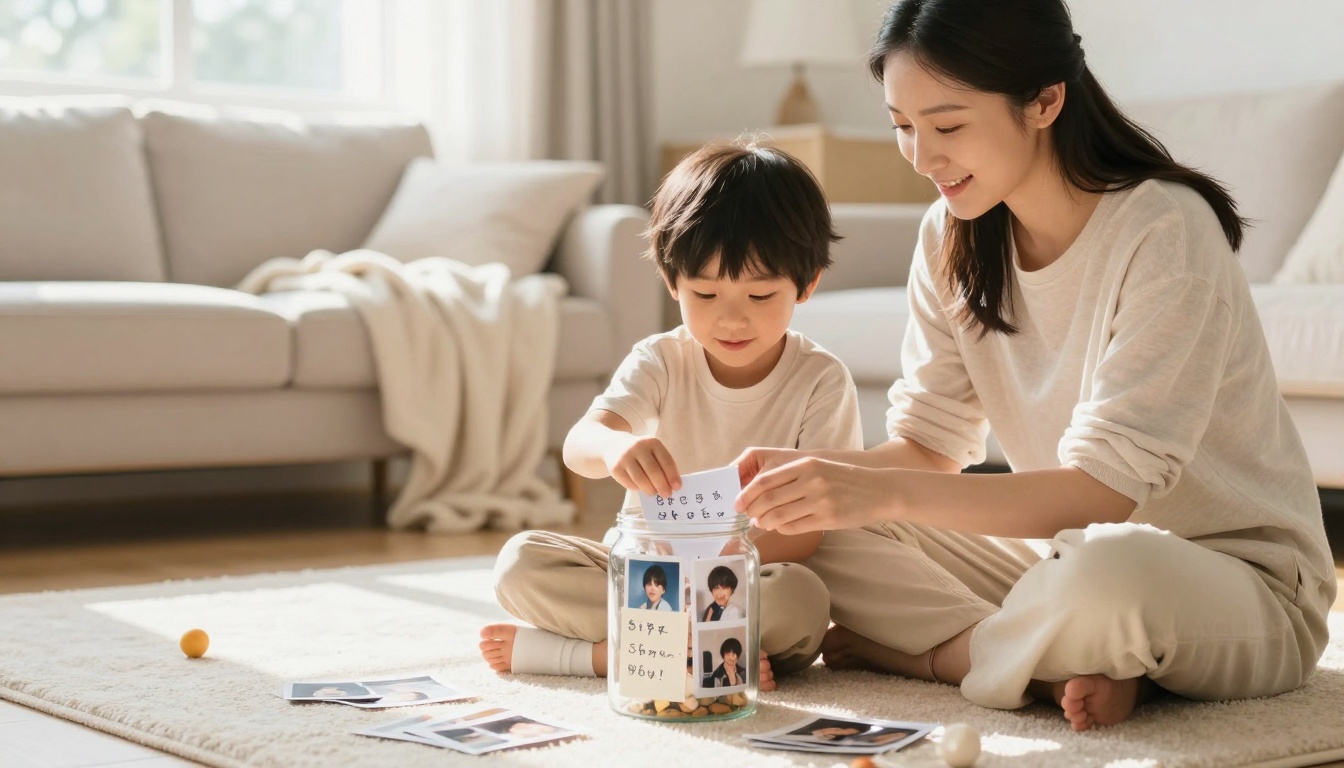
“Look back” jar opening (15 minutes): Add slips of paper through the month, then open on the last day. Read them aloud, laugh, keep the best few.
Print 10 photos once a month (15 minutes): Pick only 10. Write a date and a one-line caption on the back. Put them in an envelope labelled “March 2026”.
A tip that actually helps: set a recurring reminder and keep the tradition under 30 minutes, unless it’s clearly a joy for you.
For a simple, child-friendly way to make a shared book, the National Literacy Trust has a practical guide on how to make a memory keepsake.
Seasonal traditions that feel like your family’s signature
Children remember the feel of a season. They remember the smell of wet leaves, the crunch of frost, the first warm evening when you don’t need a coat. They rarely remember how much anything cost.
Seasonal traditions also fit the UK school rhythm, which makes them easier to repeat.
Back-to-school photo and hopes list (10 minutes): Take a photo in the same spot each year. Write three hopes, like “make a new friend” or “get better at spelling”.
Autumn leaf walk and collage (30 minutes): Collect leaves, bring them home, and glue them into a “September page” or a simple collage. Add one sentence: “We found a leaf bigger than your hand.”
Winter hot chocolate chat (15 minutes): One evening in December, sit with warm drinks and ask: “What made you feel cosy this year?” Save the answers as a voice note.
Spring kindness week notes (10 minutes a day): Write tiny notes like “Thank you for making me laugh” and hide them in lunch boxes or pockets.
Summer picnic and “funniest moment” recording (20 minutes): Record each person telling the funniest moment of the season, then name the clip by date.
If you’d like an example of a memory jar activity that’s gentle and structured, Rainbow Trust’s memory jar guide shows how to make one with meaning.
Capture family stories through conversation (the simplest way to keep memories)
Some parents hear “memory keeping” and picture hours of scrapbooking. In reality, the quickest way to keep a family story is to speak it out loud.
Spoken stories do three things at once:
- They help children process what happened.
- They teach kids where they come from, through shared family tales.
- They create a sense of being known, which is a kind of safety.
You can bring in grandparents, carers, aunties, and family friends without pressure. Ask them for one short story, not a life history. “Tell me about a game you played when you were eight.” That’s enough.
If you share stories digitally, keep privacy in mind. Avoid posting sensitive moments publicly, and be careful with location details. A private folder shared only with close family is often a better fit.
Use three simple prompts that unlock great stories
These prompts work for toddlers, teens, and adults. They also work when nobody feels chatty at first.
“What made you laugh this week?”
Laughter brings back detail. A child will often act it out, and you’ll hear the full story.
“What was hard, and what helped?”
This teaches your child that struggle is part of life, and support exists.
“What do you want to remember about today?”
This hands them the pen, even if you’re doing the writing.
Listen without rushing to fix. Let silences happen. Kids often need a few seconds to find the real answer.
Record it in under a minute (without making it awkward)
Recording can feel strange if you make it formal. Keep it casual, like snapping a photo.
A simple routine:
- Ask permission: “Can I record this story? It’s brilliant.”
- Record a 30 to 60-second voice note.
- Name it with the date and topic, like “2026-01-14, the lost PE kit”.
- Save it in a dedicated folder, labelled by year.
If you don’t want recordings, do a two-sentence summary together. One sentence for what happened, one for how it felt. That’s the whole job.
Make it last: keep traditions going when life gets busy
Traditions don’t fail because parents don’t care. They fail because everyone gets tired, the calendar fills up, and the home turns into a pile of coats and snack wrappers. Creating memorable family traditions can help anchor everyone amidst the chaos of daily life. When families set aside time to be together, they not only strengthen their bonds but also create lasting memories that can be cherished for generations. Making these traditions a priority can turn the tide and foster a sense of belonging and joy within the home.
A memory-keeping tradition has to survive:
- A rough week at work
- A child who’s in a mood
- Mixed ages who want different things
- Separated households and handovers
- A kitchen that looks like a storm hit it
The answer is not more effort. It’s a “good enough” system that protects the anchor moment, even in a smaller form.
The ‘good enough’ rules that stop traditions from fading out
Keep these rules where you can see them, maybe in a notes app or on the fridge.
Keep it short: five minutes counts.
Keep it kind: no turning it into a performance review.
Skip a week without quitting: missing once isn’t failure.
Do a mini version when busy: protect the habit, not the full plan.
Five-minute fallback plans, by format:
- Note: write one line, “Today we want to remember…”
- Photo: take one photo of whatever is real, coats on chairs and all.
- Voice: record ten seconds, “We laughed because…”
If a child resists, soften the approach. Let them be the photographer, or let them choose the prompt. Give them control, and the tradition stops feeling like a demand.
In separated households, keep the tradition simple and portable. A shared note in a private app, a small notebook that travels, or a monthly interview done on whichever day they’re with you can still build continuity.
Turn memories into keepsakes without piles of stuff
Keepsakes matter because children like to hold their history. The risk is clutter, where you keep everything and later can’t find anything.
Aim for one physical container per child:
- A small memory box for objects with a story (not every sticker).
- A yearly envelope for drawings, photos, and notes (labelled and dated).
- A single photo book per year, printed and finished.
A good rule: keep items that come with a sentence. If you can’t say why it matters, let it go.
Include your child in choosing what stays. Ask, “If you could only keep five things from this term, what would they be?” Their picks often have heart, and they learn how to value meaning over volume.
If you want a straightforward guide to build a child-friendly box, this step-by-step on how to build a memory box with children lays it out clearly.
Conclusion
One day, your child will be grown, turning over a small photo, or reading a crooked sentence you wrote on a tired Thursday, and they’ll feel it, the quiet proof that they were loved in ordinary days.
Memory-keeping traditions don’t need big budgets or perfect timing. Pick one anchor moment, choose one simple format, and repeat. Tonight, start with one prompt, save one small memory, and call it done.
The real tradition is attention, and it’s something your child can carry for life.