
Listen to this post: Nollywood vs Hollywood in 2026: where Nigerian actors are heading next
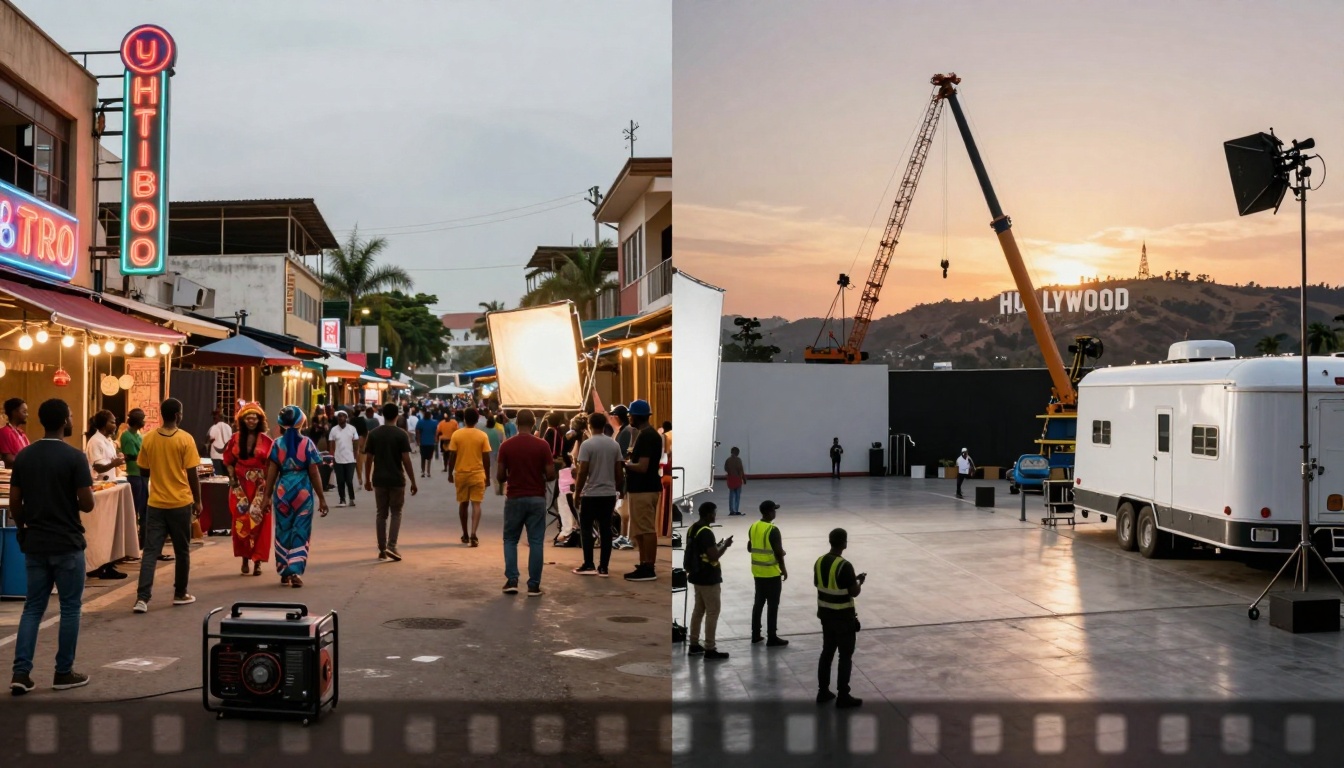
A Lagos film set can feel like a roadside mechanic’s shop. People move fast, tools change hands, and if rain threatens, someone finds a way. You might finish three scenes before lunch, with a generator humming and a wardrobe rail held up by hope.
A Hollywood backlot is different. It’s built for scale, time, and repeat takes. There are trailers, unions, call sheets, and a whole machine that exists to protect money and manage risk.
In 2026, comparing Nollywood vs Hollywood isn’t about who’s “better”. It’s about where Nigerian actors can grow next, and what kind of career they want. Nollywood is gaining real power at home, with rising cinema revenue and local films taking a bigger slice of West Africa’s box office. Hollywood still offers the widest global reach, the biggest budgets, and awards influence that can turn an actor into a household name.
Nollywood vs Hollywood in 2026: scale, money, and who controls the story
The easiest way to explain the difference is this: Nollywood often moves like a speedboat, Hollywood moves like a cargo ship. One turns quickly, the other carries more.
Budgets and schedules shape everything. Many Nollywood productions still shoot on tight timelines, sometimes in weeks rather than months. That speed can sharpen an actor’s instincts, but it can also limit rehearsal time, stunt prep, and multiple camera setups. Hollywood productions usually run longer, with more departments, more coverage, and more room to perfect small details.
Unions and contracts also change the feel of the work. Hollywood sets are heavily structured, with clear rules on hours, overtime, safety, and credits. In Nigeria, standards are improving, but they can vary widely from project to project. For actors, that means career planning isn’t only about the next role. It’s about the reliability of the process around the role.
Marketing and distribution is another fault line. Nollywood has strong local reach, especially through cinema runs, TV, and streaming. Hollywood, though, still owns the world’s biggest publicity machine. A mid-tier Hollywood film can travel through press circuits, red carpets, and global releases in a way most Nigerian films can’t, at least not yet.
And then there’s the most important question: who controls the story? Nollywood’s rise means more Nigerian-led narratives are being funded, produced, and marketed without asking anyone’s permission. Hollywood still offers scale, but it can come with pressures to “translate” culture for a global audience.
For a useful snapshot of the momentum behind Nigeria’s cinema market, see this report on West Africa’s record box office in 2025 from BusinessDay. The headline matters, but the details matter more for actors choosing their next steps.
The numbers that matter: Nigeria’s box office rise and West Africa market share
Cinema box office isn’t the whole Nollywood economy (home viewing and streaming are huge), but it’s one of the cleanest signals of audience demand.
Here’s what changed fast between 2023 and 2025:
- 2023 (Nigeria cinema box office): about ₦7.3bn
- 2024 (Nigeria cinema box office): about ₦11.6bn, roughly 60% growth year on year
- 2025 (West Africa cinema box office): about ₦15.6bn, around 34 to 35% growth on the prior year comparison
The share split is the headline moment. In 2025, local films took about 49.4% of West Africa’s cinema revenue, while Hollywood took about 48.8%. That’s not a symbolic win, it’s a commercial one. Nigerian-led stories are now competing head-to-head with the biggest film export machine on earth, in the same cinemas, in the same weeks.
A few more details show what’s really happening on the ground:
- 2.79 million cinema tickets were sold in West Africa in 2025
- Average ticket prices rose (about ₦5,596 per ticket), which pushes up revenue, but admissions also grew
- The region counted 122 cinemas and 248 new releases in the year
For actors, this means local popularity can translate into measurable box office value. When a producer can point to tickets sold, not just social media noise, an actor’s negotiating position changes.
What Hollywood still does best: global distribution, bigger budgets, and awards power
Hollywood’s strongest advantage is still reach. A successful Hollywood project can land in hundreds of territories, backed by marketing spend that can exceed the budget of some films.
Even when the US market is shaky, it remains huge. Box office tracking widely puts US and Canada ticket sales in 2024 at around $9bn, still below the pre-2019 peak, but far above the worst pandemic years. That matters because the ecosystem around Hollywood is built to make careers last: agents packaging projects, casting directors feeding studios, publicists shaping press, lawyers negotiating residuals, and guilds setting rules.
For actors, the practical benefits often look like this:
- International press that makes your name searchable everywhere
- Casting networks that open doors to film, TV, and voice work
- Long-tail income through residual structures (depending on deal type) and repeat licensing
- Awards visibility, which can shift the kinds of roles you get offered
This doesn’t mean Hollywood is “the top” and Nollywood is “the start”. It means Hollywood is a different kind of machine. For some actors it’s worth entering that machine, for others it’s smarter to build power at home and partner globally on their own terms.
How Nigerian actors are crossing over, and why ‘cross-over’ looks different now
“Cross-over” used to mean one thing: pack a bag, move to Los Angeles, and hope a casting director notices you. In 2026, it looks more like a set of lanes, not a single road.
One lane is the diaspora pipeline, where Nigerian-heritage actors build careers in the UK or US system from the start. Another lane is Nollywood-to-global, where stars become visible through streaming hits, festival premieres, or co-productions. A third lane is quieter but powerful: split-base careers, where an actor lives in one place, works in several markets, and follows the best script, not the loudest industry.
This shift is partly about money, but it’s also about control. When Nollywood proves it can sell tickets and create stars at home, Nigerian actors don’t have to treat Hollywood as a rescue boat. It becomes one option among many.
For a wider picture of how Nollywood formed its own creative universe, and why that matters for cultural power, the Financial Times feature on Nollywood is a useful read.
Nigerian-heritage stars in Hollywood, and what their paths teach
A lot of the most visible Nigerian names in Hollywood built their careers through the UK and US training routes.
Think of actors such as John Boyega, Chiwetel Ejiofor, David Oyelowo, Cynthia Erivo, Uzo Aduba, Damson Idris, and Yvonne Orji. Their backgrounds differ, but the lessons rhyme:
Training and craft still travel best. Many came up through theatre, drama school, British TV, or US stand-up and sitcom structures. That early grind taught them how to audition, how to hold a scene, and how to survive long shoots.
Representation is a strategy, not a badge. Agents and managers don’t just find work, they shape a narrative. They position actors for certain rooms and keep them in those rooms.
Producer credits add control. Acting alone can leave you waiting for permission. Producer and executive producer roles can help Nigerian-heritage talent influence casting, tone, and story choices. It’s not a shortcut, it’s a way of owning part of the pipeline.
The big takeaway is simple: Hollywood rewards actors who arrive with proof, not potential. Proof can be theatre acclaim, a breakout TV role, a festival performance, or a strong body of work from home that’s easy to point to.
From Nollywood to global screens: streaming, festivals, and co-productions
For Nigeria-based actors, streaming has changed the pace of discovery. A single series can jump borders in a weekend, reaching audiences who’ve never stepped into a Lagos cinema. That kind of exposure can’t replace craft, but it can compress the time it takes to become internationally known.
Festivals and official industry showcases also matter. They create “meeting places” where Nigerian films aren’t treated as side curiosities, but as serious works with market potential. In 2025, industry reporting around Nigeria’s presence at Cannes pointed to a more organised push for global positioning, including policy and funding conversations. Variety’s coverage of Screen Nigeria captures that sense of arrival.
Co-productions can be a bridge, but they also raise the bar. They tend to bring:
- Larger crews and more departments
- Tighter paperwork and clearer schedules
- Higher expectations on sound, lighting, continuity, and safety
- Mixed casting, which can create new kinds of roles for Nigerian actors
Movement from Nigeria-based Nollywood into Hollywood is growing, but it’s still slower than the diaspora route. The reason is simple: visas, reps, networks, and the sheer friction of entering a closed system. Streaming and co-productions reduce that friction, but they don’t erase it.
Where Nigerian actors are heading next: the roles, skills, and deals that will win
If you want a forecast for 2026 and beyond, look at what audiences reward and what producers can sell. Nollywood is proving it can generate cinema hits at home, while global platforms keep hunting for fresh stories that don’t feel copied and pasted.
That combination is pushing Nigerian actors towards three things at once: wider genres, stronger on-set standards, and smarter deal-making.
A useful business lens on why Nollywood is drawing attention, even as global box office patterns wobble, is this piece from Business Insider Africa. The key point isn’t hype, it’s that sustained demand builds bargaining power.
More than romance and comedy: action, sci-fi, historical epics, and animation
Romance and comedy will always sell because they’re cheap to make and easy to watch. But genres that travel best across borders often have a strong visual hook: action, crime thrillers, historical epics, animation, and even light sci-fi.
These genres tend to demand more from actors:
- Physical training and stamina for long takes
- Stunt awareness and safe screen combat habits
- Dialect control, especially for period stories or regional authenticity
- Patience for technical shooting, where you repeat a moment until it matches the camera’s needs
As budgets rise in Nigeria, more producers will take these swings. When they do, the actors who can credibly lead these films will become the new “bankable” faces, not only at home, but across African and diaspora audiences.
There’s also a storytelling upside. Bigger genres can carry local history and modern Nigerian life to audiences who might not sit down for a domestic drama. It’s like adding brighter paint to the same canvas.
The new ‘must-haves’ for actors: accent control, contracts, and on-set standards
Talent is not just emotional range. In 2026, it’s also readiness.
Accent control is now a career tool. That doesn’t mean sounding “less Nigerian”. It means being able to shift when a script demands it, and to keep your voice consistent across long shoots. Dialect coaching is becoming normal for actors with international aims.
Audition tapes are also a daily reality. Many casting decisions now happen from self-tapes, sometimes before you ever meet a director. Actors who can light a scene well, record clean audio, and take direction remotely have an edge.
On-set standards are rising too. More productions, especially co-productions, use intimacy coordinators, strict call sheets, and clear rules on stunts and minors. That structure can protect actors, but it also requires discipline. You can’t drift in and “find it on the day” when 80 crew members are waiting.
Then there are contracts. They don’t need to be scary, but they do need attention. Actors should understand:
- whether a fee is a flat buyout or includes future payments
- how credits are listed and where
- what exclusivity clauses can block you from other work
- why having legal support can save a career, not just a pay cheque
Bargaining power is moving: local hits, brand deals, and producer credits
When local films cross major box office milestones (including films that pass the billion-naira mark in Nigerian cinemas), it changes the conversation around value. A star attached to a proven hit isn’t only “popular”. They’re a measurable revenue driver.
That creates new options:
Brand deals that fit, not just pay. Nigerian actors are becoming faces of consumer brands across Africa and the diaspora. The smart money is on partnerships that match the actor’s image and don’t exhaust the audience.
Producer or executive producer roles. This is where power becomes durable. Acting careers can be unpredictable, but producer credits can keep someone in the room across decades. It’s also a way to protect story integrity, and to create space for new talent.
Not every actor needs to become a producer. But the ones who do, especially those who combine local box office pull with global distribution partners, can build a lane that doesn’t depend on any single market’s mood.
Conclusion
The Nollywood vs Hollywood debate misses the point in 2026. Hollywood is still the biggest stage, with the widest distribution and the loudest awards megaphone. Nollywood, though, is no longer “waiting to be discovered”. It’s building real power at home, measured in tickets sold, market share, and stars who can open a film.
The next wave of Nigerian actors won’t choose one industry and abandon the other. They’ll move between them, taking the best of each, and pushing for better terms as they go.
What to watch next:
- Co-productions that split shooting across Nigeria, the UK, and the US
- Genre expansion into action, animation, and historical stories
- Diaspora-led casting that normalises Nigerian talent in global roles
- More Nigerian-led deals, with actors taking producer credits and ownership stakes