
Listen to this post: Machine Learning vs Deep Learning vs Generative AI: Key Differences (Plain-English Guide)
People say “AI” when they mean three different things. In one meeting, machine learning is the model scoring fraud risk. In the next, deep learning is “the thing that recognises faces”. Then someone mentions generative AI and suddenly it’s writing emails, images, and code.
If those terms feel mashed together, you’re not alone. This guide breaks down what each one means, how they relate, and when each is the right fit. You’ll get quick examples, a simple comparison table, and a practical checklist you can use on real projects.
Quick definitions: machine learning, deep learning, and generative AI
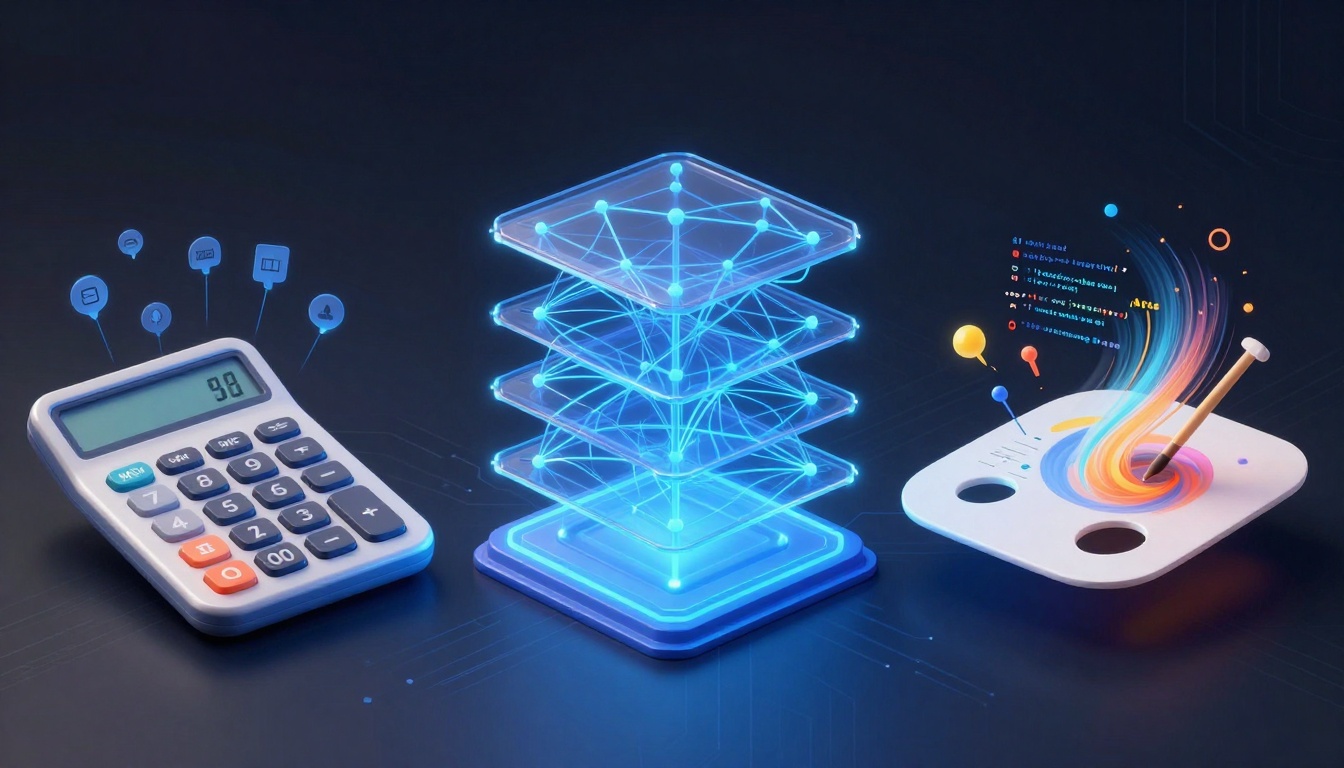
Machine learning (ML) is when a computer learns patterns from data to make a prediction or decision. Mental picture: a calculator that learns from past examples so it can guess the next answer.
Deep learning (DL) is a type of machine learning that uses neural networks with many layers. It’s great at messy, human-style data like images, audio, and text. Mental picture: a stack of filters that gradually turns raw input into meaning.
Generative AI (GenAI) is AI that creates new content (text, images, audio, video, or code) based on patterns it learned. It often uses deep learning models under the hood. Mental picture: an autocomplete engine that can write whole paragraphs, not just finish a word.
How they fit together is simple: deep learning sits inside machine learning, and generative AI often sits on top of deep learning. For a broader take on how GenAI differs from classic ML in practice, Coursera’s overview is a useful reference: https://www.coursera.org/articles/generative-ai-vs-machine-learning
Machine learning (ML): learning from data to predict or decide
Machine learning usually takes past data and tries to answer, “What’s most likely to happen next?” It tends to output a label, a score, or a decision, not brand-new content.
Most ML work falls into three common learning styles:
- Supervised learning: learn from examples with correct answers (a spam filter trained on emails labelled “spam” or “not spam”).
- Unsupervised learning: find natural groupings without labels (grouping customers by buying habits).
- Reinforcement learning: learn by trial and error using rewards (an agent learning to win a simple game).
A good way to think about ML is “predict the missing value”. Will this customer churn? Is this transaction fraudulent? What price is likely to sell?
ML also works best when your data looks like a spreadsheet: rows, columns, tidy numbers, and categories. That’s why it shows up everywhere in finance, ops, and analytics.
Deep learning (DL): neural networks that learn complex patterns
Deep learning is still machine learning, but it uses neural networks, which are layers of small “math helpers” working together. Each layer learns a slightly richer pattern than the one before.
If classic ML is like giving someone a checklist, deep learning is like teaching them by showing thousands of examples until the pattern sticks.
Deep learning shines when the “features” are hard to hand-pick, such as:
- Images (spotting a tumour on a scan, detecting objects in a photo)
- Audio (speech-to-text, speaker recognition)
- Language (understanding intent in a message, translating text)
The trade-off is cost and complexity. DL often needs:
- More data (because it learns lots of internal representations)
- More computing (GPUs are common)
- More tuning (training can be slower and less predictable)
It’s also harder to explain. With many layers, it can be difficult to give a simple “why” behind a prediction. That matters in regulated settings.
Key differences that matter in the real world (data, compute, output, explainability)
If you’re choosing an approach, the best question isn’t “What’s the newest?” It’s “What do I need the system to produce, and what do I have to work with?”
Here’s the comparison that usually decides it: output type, data type, cost to train and run, and how well you can explain results. TechTarget’s breakdown of how these terms relate is a solid extra read: https://www.techtarget.com/searchenterpriseai/tip/AI-vs-machine-learning-vs-deep-learning-Key-differences
A quick comparison table you can actually use
| What you care about | Machine learning (ML) | Deep learning (DL) | Generative AI (GenAI) |
|---|---|---|---|
| Typical output | Score, label, decision | Score, label, detection | New text, images, audio, video, or code |
| Best data fit | Structured tables (spreadsheets, transactions) | Unstructured data (images, audio, text) | Unstructured data, plus prompts and context |
| Data size (typical) | Small to medium | Large | Very large for training, smaller for use |
| Hardware needs | Often fine on CPUs | Often needs GPUs | Often needs GPUs, can be costly at scale |
| Explainability | Usually easier | Often harder (“black box”) | Hard, plus extra risks (hallucinations) |
| Common use | Forecasting, risk scoring, recommendations | Vision, speech, advanced language tasks | Drafting, summarising, content creation, code help |
The key point: DL doesn’t replace ML, it’s a stronger tool for certain inputs. And GenAI is not “all AI”, it’s specialised in producing new content.
What each one produces: predictions and classifications vs newly generated content
The fastest way to spot the difference is to look at the output:
- ML example: predict churn risk as 0.82, or label a transaction as “likely fraud”.
- DL example: detect a pedestrian in an image, or transcribe audio to text.
- GenAI example: write a product description in your brand tone, create a hero image, or draft a Python function from a prompt.
GenAI can help with prediction too, but that’s not its headline strength. Its standout skill is generation. It can produce content that looks human-made, which is powerful, and risky if you treat it as a facts engine.
If you want a practical “ML vs GenAI” angle from an enterprise lens, Bernard Marr’s piece is helpful context: https://www.forbes.com/sites/bernardmarr/2024/06/25/the-vital-difference-between-machine-learning-and-generative-ai/
What each one needs: data size, training time, and hardware
Think in plain terms:
Small to medium data is what a team can store, clean, and understand without huge infrastructure. Classic ML can do a lot here, especially when the target is clear (risk, demand, churn).
Huge data is when you’re dealing with millions of images, long audio files, or large text corpora. DL often needs this scale to beat simpler methods.
GenAI models can be the most expensive to train from scratch. That’s why many teams don’t train foundation models themselves. They use pre-trained models and adapt them with fine-tuning or careful prompting. That cuts time, cost, and compute.
In practice, “hardware needs” often means GPUs. Even when you’re not training, running GenAI at scale can be costly, especially with long prompts and large outputs.
Use cases and examples: where ML, DL, and GenAI fit best
A useful rule of thumb is to match the tool to the shape of the job:
- When the task is structured prediction, ML often wins on speed, cost, and clarity.
- When the task is perception (seeing, hearing, understanding messy signals), DL earns its keep.
- When the task is language or creative output, GenAI is usually the best first try (with checks in place).
Hybrid systems are also normal now. A GenAI assistant might draft an answer, while a classic ML model scores risk, routes the ticket, or decides when to ask for human help.
Common machine learning examples in business and news
Machine learning is everywhere because so much business data is structured. Common examples include:
- Fraud detection: flagging unusual card transactions based on patterns.
- Demand forecasting: predicting sales by week or region.
- Credit risk: estimating likelihood of default from customer history.
- Recommendation systems: suggesting products or content using past behaviour.
- Spam filtering: classifying messages as spam or safe.
- Dynamic pricing: adjusting prices based on demand, stock, and competition.
These problems usually don’t require an AI that can “talk”. They need a score you can act on, plus monitoring to keep performance stable.
Deep learning and generative AI examples people recognise (and how they differ)
Deep learning examples many people use without thinking about it:
- Face unlock on phones and devices
- Speech-to-text dictation and captions
- Medical imaging support that spots patterns clinicians may miss
Generative AI examples are more obvious because you see the content:
- Chatbots that answer questions and write drafts
- Summaries of long documents and articles
- Marketing images generated from prompts
- Code suggestions and debugging help
ChatGPT-style tools are generative AI, powered by deep learning models (often transformers). They’re great at language patterns, but they can still produce confident wrong answers, which is why verification matters.
Risks, limits, and how to choose the right approach
Choosing between ML, DL, and GenAI isn’t only about performance. It’s also about risk, control, and what happens when the system is wrong.
This matters more in 2026 because GenAI is shifting from “write me a paragraph” to tools that can plan and take steps. Many people describe this as agentic AI, where systems act more like assistants that can execute tasks, not just generate text. MIT Sloan’s January 2026 trends summary gives a good high-level view: https://sloanreview.mit.edu/article/five-trends-in-ai-and-data-science-for-2026/
What can go wrong: bias, hallucinations, privacy, and security
Here are the big risks, in plain language:
Bias: if the training data reflects unfair patterns, the system can repeat them. This can show up in lending, hiring, policing, and healthcare. The model doesn’t “intend” bias, it learns it.
Hallucinations (GenAI): the model can make up facts, names, or sources. It can sound sure while being wrong. Treat outputs as drafts unless you verify.
Privacy: if sensitive data goes into prompts or training sets without controls, it can leak. This includes customer info, internal documents, and trade secrets.
Security: prompts and uploaded files can become attack paths. A model can be tricked into ignoring rules, exposing data, or calling tools in unsafe ways.
Simple mitigations that work in real teams:
- Human review for high-impact decisions (especially early on).
- Data controls (don’t feed confidential data into tools without clear safeguards).
- Testing and monitoring (check for drift, bias, and failure modes, not just average accuracy).
- Limit tool access for GenAI agents (only trusted sources, least privilege).
IBM’s 2026 predictions also point to stronger governance as these systems spread across departments: https://www.ibm.com/think/news/ai-tech-trends-predictions-2026
A simple checklist to decide: ML vs DL vs GenAI for your problem
Use these questions to choose quickly:
- Do you need a prediction or new content?
If you need a score or label, start with ML. If you need text, images, or code, consider GenAI. - Is your data structured or unstructured?
Spreadsheets and transaction tables suit ML. Images, audio, and raw text often point to DL or GenAI. - How important is explainability?
If you must explain “why” to auditors or regulators, classic ML is often easier than DL or GenAI. - What’s your budget and time window?
ML can be quicker and cheaper. DL and GenAI can cost more to train and run, especially at scale. - Can you use a pre-trained model?
If yes, GenAI and DL become more realistic without huge training costs. - What happens when it’s wrong?
High-risk decisions need guardrails, fallbacks, and human checks, no matter the method.
A safe habit: start simple. Try ML first for structured prediction. Use DL when perception tasks demand it. Use GenAI for drafting and creation, then verify before you ship or act.
Conclusion
Machine learning predicts and decides, deep learning is machine learning with neural networks for complex data, and generative AI creates new content (often using deep learning). The practical choice comes down to output type, data shape, compute cost, explainability needs, and risk.
Pick one real task, run a small pilot, measure results, then add guardrails before scaling. The teams getting value in 2026 aren’t the ones chasing labels, they’re the ones building systems they can trust.