

Listen to this post: Local SEO basics for brick-and-mortar businesses (2026)
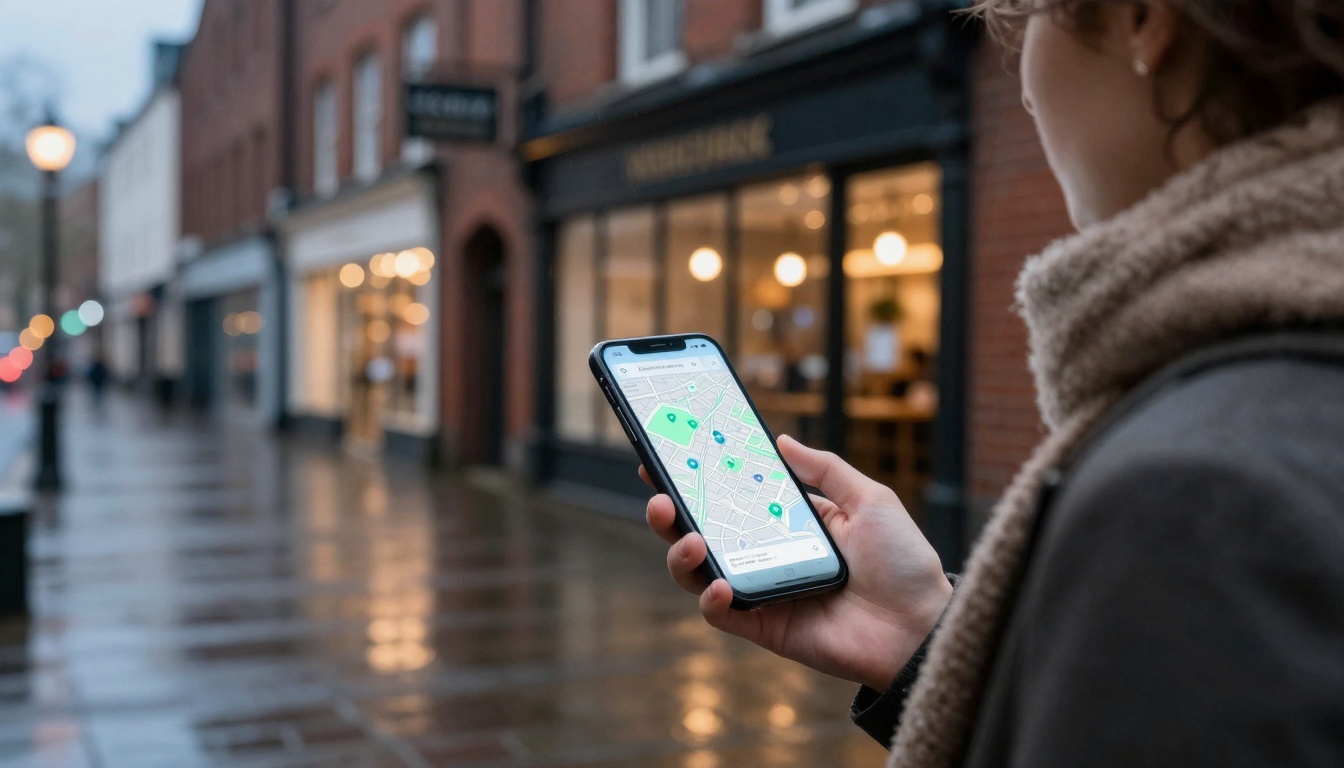
It’s raining. A person tucks their chin into a scarf, taps their phone, and types “coffee near me”. In seconds, Google shows a map with three places, a few star ratings, and an “Open now” label that feels like a small rescue.
They pick the top result, not because it has the prettiest website, but because Google seems to trust it. Local SEO is the set of signals that help Google trust, show, and recommend a real business nearby.
This guide gives you a short, clear checklist for 2026. It’s built for shops, clinics, salons, cafés, and anyone who needs calls, bookings, and footfall, not just page views.
Local SEO basics: what Google looks at when someone searches nearby
Local SEO starts with intent. The search isn’t “best coffee in the world”, it’s “coffee near me”, “open now”, “on the High Street”, “near the station”, or “in Shoreditch”. The person is already close, already hungry, already ready to buy.
When Google decides which businesses to show, the logic is simple (even if the system behind it is complex). Local rankings usually come down to three ideas:
- Relevance: do you match what they asked for?
- Distance: are you close enough to be a good option?
- Trust: do you look real, active, and liked by customers?
In 2026, local results pull heavily from three places: your Google Business Profile, your website, and your reviews. If one of those is messy or missing, the whole picture gets fuzzy.
For a useful UK-focused overview of how local search behaviour is shifting, see Four Search Trends Every Local Business Must Master in 2026. It’s a good reminder that people aren’t only typing short keywords anymore, they’re asking full questions.
The local pack, Google Maps, and why the top three spots win
The “local pack” is the little box with a map and three business listings. It often sits above the normal website results. Those three spots get a huge share of attention because they answer the question fast: where should I go, and can I go now?
This is different from standard SEO. A normal result is a blue link to a page. A local pack result is a ready-made decision: tap for directions, tap to call, tap to book.
A quick example:
A private physio clinic might rank for “physio in Manchester” with a well-written website page. But when someone searches “sports massage near me open now”, Google Maps results often win because they show distance, hours, and phone number without making the person think.
Your ‘trust signals’ in one sentence: details, activity, and happy customers
If you remember one line, make it this: accurate details, regular activity, and steady happy reviews.
Those signals are under your control:
- Your business name, address, phone, hours, and category are correct.
- Your profile has fresh photos and updates, not last year’s Christmas post.
- Your services are clear, priced or explained, and easy to book.
- Reviews arrive at a gentle, regular pace, and you reply like a human.
If that sounds basic, good. Local SEO rewards basics done properly.
Set up your Google Business Profile the right way (the fastest local SEO win)
If local SEO were a shop window, Google Business Profile (GBP) would be the glass, the lights, and the sign above the door. It’s often the first thing a customer sees, before they visit your website.
This matters even more in 2026 because Google can surface AI-style summaries based on what it understands from your profile, your site, and your reviews. Clarity helps both customers and search features.
If you want a practical primer written for small firms, Local SEO in 10: How Do I Get My Business Found Online? is a straightforward read, especially for first-time set-ups.
Complete every field that customers care about (and Google reads)
Treat your GBP like a mini-website. Fill it in as if a stranger is trying to find you in the dark with 4 percent battery.
Here’s what to complete and keep current:
- Business name: use the real name on your sign and invoices. Don’t add extra keywords.
- Address (or service area): be precise. If you have a shop, use the real address. If you travel to customers, set a service area and follow Google’s rules for service businesses.
- Phone number: use a local number that staff answer. Don’t swap it weekly.
- Website link: point to the most relevant page, often your homepage or a location page.
- Opening hours: update them, then add holiday hours early.
- Attributes: wheelchair access, parking, outdoor seating, dog-friendly, Wi-Fi. These can match “open now” and accessibility filters.
- Services or products: list what you actually do, using plain wording.
- Business description: write like you speak. Include your main service and town naturally (for example, “Independent bike repairs in Sheffield, with same-day service for punctures and brake checks.”).
One more detail people forget: if your entrance is hard to find, add a short note in the description, and upload a photo that shows the door and sign.
Choose the best primary category, then only a few accurate extras
Your primary category is one of the strongest signals you can set. It tells Google what you are. If it’s wrong, you’re asking to be matched with the wrong searches.
Good category choices are specific:
- “Italian restaurant” beats “Restaurant”.
- “Optician” beats “Health service”.
- “Emergency plumber” (if available) beats “Plumber” when that’s what you sell most.
Avoid picking categories just to appear in more searches. It can backfire by confusing Google and disappointing customers. If you show up for “nail salon” but you only do hair, you’ll get bounces, poor calls, and wasted visits.
A useful mindset is: pick the category that best describes what you’d want on your receipt.
Add fresh photos and simple posts so your profile looks alive
People trust what they can picture. Google also likes signs of life.
Aim for photos that answer real questions:
- The outside sign, taken from the pavement.
- The entrance, so nobody feels awkward hovering at the wrong door.
- The inside, showing seating, light, and vibe.
- Your team (one friendly group shot is enough).
- Best sellers (top dishes, best haircut style examples, popular treatments).
- “Before and after” shots for trades and beauty, if suitable.
- A menu photo, a price list, or a clear service board.
Keep a light routine:
- Monthly: add 5 to 10 photos.
- Weekly or fortnightly: add a short post (offer, event, new stock, seasonal service).
Posts don’t need poetry. Short text, one clear action. “Call to book”, “Order ahead”, “Walk-ins welcome”, “Free parking at rear”.
Make your website match your shop, so Google and customers don’t get confused
Your website backs up your GBP. Think of it like your shop’s back office. If your website says one thing and your profile says another, Google hesitates.
For brick-and-mortar businesses, you don’t need a huge site to win local search. You need a clear location, clear services, and clear contact routes.
If you’re curious about what’s changing and what still matters this year, Local SEO in 2026: What’s Changed & What Still Matters frames the basics well, with a 2026 lens.
Put your name, address, and phone on the site, and keep it identical everywhere
This is “NAP” consistency (Name, Address, Phone). It’s boring, and it works.
Small differences can cause real confusion, like:
- “12 King Street” vs “12 King St”
- “Suite 2” vs “Unit 2”
- A tracked phone number on the site but a different one on your profile
Put your NAP in the website footer so it appears on every page. Then create a strong Contact (or Visit Us) page with:
- Address written clearly
- Phone and email
- Opening hours
- A simple embedded map
- Directions and parking notes (people care more than you think)
If you serve multiple areas, list them on the contact page in plain English, not as a stuffed list.
Use plain local keywords where they fit (titles, headings, and key pages)
Local keywords are just the words people type when they’re trying to solve a nearby problem.
You don’t need to repeat them 20 times. You need to place them where they make sense:
- Page title and main heading
- A short intro paragraph on the page
- Service pages (one per core service)
- Your contact page
Natural phrases you can borrow:
- “Hairdresser in Bristol”
- “Boiler repair in Leeds”
- “Family dentist in Cardiff”
- “Same-day iPhone screen repair in Glasgow”
- “Sports massage near Clapham Junction”
A quick test: read your sentence out loud. If it sounds awkward, rewrite it. Google has seen every forced line under the sun.
For wider SEO context (and how search is getting tougher across the board), Pressing SEO Challenges of 2026 and How To Overcome Them is a useful reference point, even for businesses that sell face-to-face.
Add LocalBusiness schema so search engines ‘get’ your business details
Schema is a label system that helps search engines understand facts on your site, like your address, phone number, and opening hours. It doesn’t replace good content, but it reduces misunderstanding.
You don’t need to become a developer to benefit. Common routes:
- Ask your web developer to add LocalBusiness schema.
- Use an SEO plugin if your site runs on a platform like WordPress.
Keep it accurate. Wrong hours in schema can cause the same problems as wrong hours in GBP, customers arrive, doors are shut, reviews turn sour.
Reviews and listings: the proof that turns searches into walk-ins
Reviews are modern word of mouth, just louder and more permanent. They don’t only persuade people, they also shape what Google shows. A steady flow of good reviews, with real detail, can lift your visibility and your conversion rate at the same time.
Listings (often called citations) are the echoes of your business info across the web. When the echoes match, Google trusts the source.
For a deeper run-through of local SEO for smaller firms, The Ultimate Guide to Local SEO for Small Businesses (2025) is a solid companion, especially for citations and review habits.
How to get more reviews without breaking the rules
You don’t need to beg. You need timing and ease.
Safe ways to ask:
- Ask right after a good moment, when the customer is smiling, not rushing.
- Put a small QR code at the till that opens your Google review link.
- Add the review link to e-receipts or booking follow-ups.
- Train staff to use one short line: “If you’ve got a minute later, a Google review really helps local people find us.”
Avoid anything that risks trouble:
- Don’t pay for reviews.
- Don’t offer discounts or freebies in exchange for reviews.
- Don’t pressure customers to leave a five-star rating.
You’re aiming for honest feedback at a steady pace, not a suspicious spike.
Reply to every review, because people read your responses
Most people read responses, not just star ratings. A thoughtful reply signals that you’ll be decent in real life too.
Keep replies short and personal. Here are two templates you can adapt.
5-star template
“Thanks, [Name]. We’re glad you enjoyed [specific service or item]. Hope to see you again soon.”
1-star template
“Hi [Name], sorry you had a poor experience. That’s not the standard we aim for. If you can email or call with the date of your visit, we’ll look into it and try to put it right.”
Don’t argue in public. Don’t share private details. Keep it factual, calm, and focused on a fix.
Fix your business info on key directories and map apps (citations)
Citations are mentions of your business name, address, and phone number on directories and map apps. They help because they confirm you exist where you say you exist.
Common issues that hurt local visibility:
- Old addresses still live on an old listing
- Duplicate listings split your reviews and signals
- A wrong phone number sends calls into the void
- A slightly different business name creates a second identity
Start by cleaning up the places customers actually use (major map apps, large directories, and industry listings). Then work outward to local directories and trade bodies.
When in doubt, match your details to your Google Business Profile and your website footer, character for character.
Conclusion
Local SEO doesn’t need mystery. For most brick-and-mortar businesses, Google Business Profile, a website that matches it, and steady reviews are the basics that move the needle.
Here’s a compact 7-day starter plan you can finish without hiring anyone:
- Day 1: Claim or check your GBP, fix hours and contact details.
- Day 2: Make NAP identical on your website and profile.
- Day 3: Choose the best primary category, remove odd extras.
- Day 4: Add 10 strong photos (sign, entrance, inside, team, best sellers).
- Day 5: Add services or products, write a plain description with your town.
- Day 6: Ask five happy customers for a review (with a QR code or link).
- Day 7: Check GBP Insights and note what people searched for.
Pick one action today that helps Google trust you more. Tomorrow, it can be the reason a real person steps off the pavement and through your door.