
Listen to this post: AI in Manufacturing and Supply Chain Optimisation: Practical Wins Without the Hype
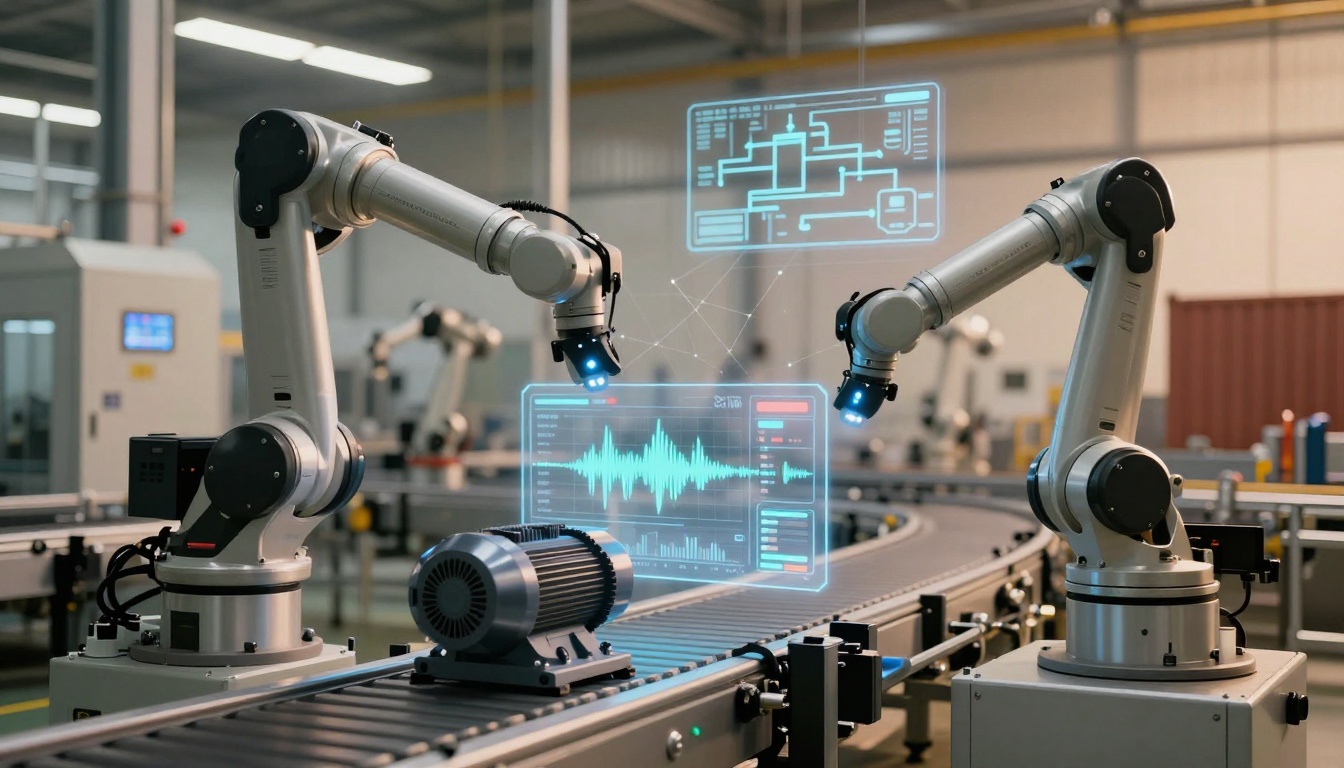
Picture a factory floor that can listen. Motors hum, pumps thrum, conveyors rattle, and sensors turn all that noise into clues. Now picture a supply chain that can see, spotting a late shipment before it turns into a missed customer promise.
That’s what AI in manufacturing and supply chain optimisation looks like when it’s done well. In plain terms, AI is software that learns from data and helps people make better decisions. It doesn’t replace the shop floor, the planner, or the forklift driver. It gives them earlier warnings, clearer options, and fewer nasty surprises.
You’ll see where AI fits, what it needs to work, and where it still falls over (bad data, skills gaps, and messy handovers). To keep it grounded, hold this one example in your head: a sensor flags a motor’s vibration pattern changing, and the system warns maintenance days before it seizes.
What AI really does in manufacturing and supply chains
At its core, AI is pattern-spotting at scale. It takes streams of data that humans can’t watch all day, then highlights what’s unusual, what’s likely next, and what choice might cost less.
It helps to separate two ideas:
- Rules-based automation: “If temperature exceeds X, shut down.” Fast and useful, but it only does what you pre-write.
- AI models that learn: “This mix of temperature, vibration, and power draw usually appears before failure.” It improves as it sees more examples.
Where does the data come from? Usually from three places:
- Machines and sensors (often called IIoT, the Industrial Internet of Things)
- Business systems like ERP (orders, stock, suppliers), plus MES and WMS (production and warehouse records)
- People, entering quality checks, reason codes, shipment notes, and exceptions
Common AI “types” show up again and again:
- Forecasting: predicting demand, lead times, or usage
- Anomaly detection: spotting behaviour that doesn’t match the normal pattern
- Optimisation: choosing the best plan under constraints (time, labour, capacity, cost)
- Computer vision: using cameras to check parts, labels, and finishes
- AI assistants: chat-style tools that summarise issues, draft reports, or help query data
Generative AI is also moving into this space, mostly as a helper layer for people. If you want context on how organisations are using it across operations, this overview from McKinsey is a useful starting point: Harnessing generative AI in manufacturing and supply chains.
From raw data to a decision workers can trust
AI doesn’t start with magic. It starts with plumbing and patience.
Most successful projects follow a simple flow:
- Collect data (sensors, logs, orders, scans, quality checks)
- Clean it (fix missing values, wrong units, duplicate IDs, and broken timestamps)
- Train a model (teach it what “normal” and “bad” look like)
- Test it (measure errors, false alarms, and edge cases)
- Monitor it (models drift as products, suppliers, and processes change)
Data quality matters because AI will follow the numbers, even when the numbers lie. A mis-calibrated sensor can look like a failing bearing. A wrong lead time in the ERP can cause silly reorder plans.
Trust grows in steps. Many teams begin with AI as an alert system. Then it becomes a recommendation tool. Only later does it earn permission for pre-approved auto-actions, with a clear audit trail and an easy “stop” button.
Where AI sits in the real world, shop floor to shipping lane
AI can run in a few places, and each has a reason:
- On-machine (edge): fast reactions for safety, control, and high-speed checks. This is the “don’t wait for the internet” zone.
- On-site servers: good for plants with strict latency needs or data limits.
- Cloud tools: best for heavier planning, network-wide views, and supplier collaboration.
The biggest practical issue is not the model, it’s the mess of disconnected tools. If AI becomes “yet another dashboard”, people ignore it. The aim is to push insights into the systems teams already use, like maintenance work orders, planning boards, and warehouse task lists.
High-impact use cases that cut downtime, waste, and delays
AI works best when it’s tied to a plain business pain. A squealing conveyor. A quality queue. A warehouse that always seems to run out of one item and drown in another.
Below are the use cases that tend to pay back first, with what they need and what they change.
Predictive maintenance, fixing problems before a breakdown
Predictive maintenance uses condition data to spot early warning signs. Think vibration, heat, sound, and power draw. A pump that’s slowly grinding itself to dust has a signature. AI can learn that signature and flag it before it becomes a stoppage.
What it fixes: unplanned downtime, rushed call-outs, and “we didn’t know it was that bad” failures.
What data it needs: sensor readings, maintenance history, failure codes, run hours, and parts usage.
What it changes day to day: maintenance can prioritise the right work orders, order parts before the panic, and schedule jobs around production. The win isn’t only fewer breakdowns, it’s calmer maintenance planning.
Smarter production planning and scheduling when reality changes
A schedule looks perfect until reality turns up. Materials arrive late. A key operator is off sick. A machine goes down. AI-based scheduling helps planners re-plan faster, using rules that reflect the shop floor.
In simple terms, it weighs constraints such as:
- Which lines can run which products
- Changeover times and cleaning windows
- Labour and skills available per shift
- Material availability and expiry dates
A strong feature here is “what-if” simulation. It lets planners test options without gambling the day’s output. Harvard Business Review has a clear view of how generative AI can speed decisions in this area, including scenario work: How Generative AI Improves Supply Chain Management.
Quality inspection with computer vision, catching defects at speed
Computer vision uses cameras plus AI to spot defects and errors at production speed. It can catch scratches, dents, missing components, wrong labels, skewed barcodes, and uneven fills.
What it fixes: slow manual checks, inconsistent inspection, rework, and scrap.
What data it needs: labelled images of good and bad parts, clear defect definitions, and stable camera placement.
This use case lives and dies on basics. Good lighting matters. Clean lenses matter. Clear standards matter. When it works, it also helps with root cause. A spike in defects might link back to a worn tool, a drifting setting, or a new batch of raw material.
Demand forecasting and inventory optimisation, fewer stockouts and less dead stock
Forecasting isn’t just guessing next month’s sales. It’s building a picture using signals that often move demand before your order book does: seasonality, promotions, weather, price changes, and shifting lead times.
AI forecasting can feed into inventory decisions:
- Reorder points: when to buy again
- Safety stock: how much buffer you keep for uncertainty
In multi-site operations, it can also help balance stock across more than one warehouse (sometimes called multi-echelon inventory). The goal is simple: keep the right items close to demand, without hoarding everything everywhere.
To see how supply chain leaders talk about this shift, including how generative AI supports planning work, Accenture’s perspective gives helpful framing: Supply Chain Networks in the Age of Generative AI.
Warehouse and transport optimisation, faster picking and fewer empty miles
Warehouses are full of small wasted moments: extra steps, wrong slots, missed scans, and bottlenecks at the dock. AI can help tune the system without turning it into a science project.
Common wins include:
- Slotting: deciding where items should live, based on pick rate, size, and constraints
- Pick-path optimisation: reducing walking and travel time
- Labour planning: matching headcount to expected workload by hour or shift
Robotics can play a role, such as AMRs moving totes or cobots assisting repetitive lifts. The best set-ups stay human-centred: machines handle heavy repeat work, people handle exceptions and judgement calls.
Transport optimisation often starts with better routing and carrier choice. AI can combine delivery windows, traffic patterns, load constraints, and carrier performance, cutting late drops and empty miles.
Risk sensing and exception management, spotting trouble early
Risk rarely arrives with a siren. It arrives as a small delay, a supplier email, a port backlog, or a demand spike that looks like a blip until it’s too late.
AI can help by:
- Flagging risk signals (late ASN, quality escapes, supplier lead-time creep)
- Ranking exceptions by impact (what will stop production first)
- Suggesting actions (expedite, substitute materials, re-allocate stock)
Some teams are now testing “agentic” AI. That means systems that can plan actions and carry out safe, pre-approved steps, such as drafting supplier messages, raising a reorder request, or proposing a reroute. Guardrails are non-negotiable: permissions, approvals, and logs must be clear.
For a readable industry view of how AI is being used for faster response, this article gives practical examples: The AI Advantage: Supply Chains Evolve for Rapid Response.
How to adopt AI without breaking the plant or the plan
AI projects fail in boring ways. Not because the maths was wrong, but because the data was patchy, the process wasn’t stable, or nobody owned the day-two reality.
A practical approach keeps risk low and learning high.
Pick the right first project, look for pain you can measure
Start where the pain is loud and measurable. Good first projects often look like:
- A bottleneck line with frequent downtime
- A high-scrap process with clear defect types
- A high-value spare parts group with erratic usage
- A delivery lane with repeated late shipments
A simple scoring method helps you choose without politics:
| Scoring factor | What “good” looks like |
|---|---|
| Impact | Clear cost, delay, or waste reduction |
| Data availability | Data exists, is accessible, and has history |
| Speed to pilot | You can test in weeks, not quarters |
| Ease of rollout | One site, one line, one flow to start |
Data and integration basics, make the numbers reliable
Think of AI as a hungry engine. If you feed it mixed fuel, it will splutter.
Priorities that pay off fast:
- Master data: parts, suppliers, units of measure, locations, pack sizes
- Sensor quality: calibration, sampling rate, and consistent naming
- Timestamps: aligned clocks across machines, scanners, and systems
A single source of truth matters, even if it’s built in stages. The other key is integration. If AI insights don’t reach ERP, MES, WMS, or CMMS workflows, they won’t change decisions.
Models also need monitoring. Products change, tooling changes, supplier behaviour changes. When the world shifts, model accuracy drifts.
People, safety, and trust, keep humans in control
AI lands best when it respects the people who keep the place running. Operators and planners know the “why” behind the numbers. Maintenance teams know which fixes last and which ones don’t.
Practical steps that build trust:
- Train people in short, job-fit sessions (alerts, thresholds, and actions)
- Keep approvals clear, with human sign-off for high-risk moves
- Add easy ways to report false alarms and missed issues
- Show simple explanations, like which sensor signals triggered the alert
If robotics is involved, safety rules need to be visible and enforced: geofencing, speed limits, and obvious emergency stops.
Cybersecurity, supplier data, and AI governance in plain English
Connected factories increase the attack surface. More portals and integrations mean more doors to lock.
Common risks include exposed machine networks, over-shared supplier access, and tampering with model inputs. Sensible protections are not exotic:
- Least-privilege access (people only see what they need)
- Network segmentation for operational tech
- Logging and alerting for unusual activity
- Regular patching and asset inventories
Governance matters too. Someone must own the model and its changes. Someone must approve new data sources. Someone must audit decisions after incidents.
If you want a vendor-led overview of how AI fits across manufacturing and supply chain operations, including planning and execution layers, this page from Dassault Systèmes DELMIA provides useful context: Artificial Intelligence in Manufacturing & Supply Chain.
What to track, ROI metrics that matter on the floor and in the warehouse
AI value should show up in operational metrics people already respect. Track a baseline, then review at 30, 60, and 90 days so gains don’t fade.
Strong metrics include:
- OEE
- Unplanned downtime hours
- Scrap rate
- Rework time
- Schedule adherence
- Forecast error
- OTIF (on-time in-full)
- Inventory turns
- Cost per shipment
Pick a short list for the pilot. If you measure everything, you’ll manage nothing.
Conclusion
A well-run AI programme leads to fewer silent breakdowns, fewer “where is it?” calls, and calmer planning meetings. The main takeaway is simple: AI works best when the data is clean, the goal is clear, and people stay in the loop. Start with one painful process you can measure, run a small pilot, and scale what proves itself. The factory that can listen and the supply chain that can see are built one solid improvement at a time.