


Listen to this post: Why the Hour After Work Rarely Feels Like Time Off

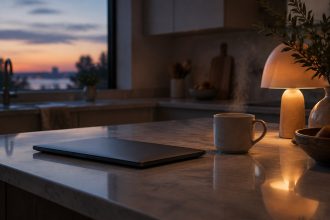
You close the laptop at six, or whenever it actually happens, and for about ninety seconds it works. Then you’re standing in the kitchen trying to decide what to eat and a Slack message replies itself in your head, unprompted, in your own voice, about a thing nobody asked you to think about again until tomorrow. Twenty minutes later you’re half-watching something and still mentally drafting the email you’ll send in the morning. Your body left the job. The rest of you is running fifteen minutes behind.
Most people assume this is just what being busy feels like, and sometimes it is. But the specific flavor of it — work that keeps running in the background long after there’s nothing left to do about it — has a name in the research on recovery, and it isn’t about workload at all. It’s about whether anything ever actually told your brain the day was finished.
Your Brain Doesn’t Get the Memo When the Laptop Closes
There’s an old, slightly spooky finding in psychology called the Zeigarnik effect, after a Lithuanian psychologist who noticed that waiters remembered unpaid orders far better than ones they’d already settled. An unfinished task stays active in memory in a way a finished one doesn’t. Your mind treats it like a tab it hasn’t closed, and it keeps a small amount of attention parked on it, just in case.
A normal workday ends with dozens of these tabs still open — the reply you meant to send, the decision you tabled until Thursday, the slightly tense exchange you’re still turning over. None of that gets resolved by shutting a laptop. The laptop closing is a location change, not a cognitive one, and your attention doesn’t actually know the difference between “the workday is over” and “I’ve simply stopped looking at the thing that was stressing me.”
Researchers who study recovery from work have a more formal term for the thing that’s actually missing here: psychological detachment, meaning the mental sense of being away from work, not just physically but in attention and mood. Studies on it keep finding the same pattern — people who detach well in the evening report less exhaustion, better sleep, and more energy the next day, and it’s a genuinely separate skill from simply working fewer hours. You can have a short day and a bad detachment. You can also have a long one and still switch off cleanly, if something marks the end clearly enough.
Scrolling Feels Like Decompressing, But Rarely Is
The default move, once the laptop’s shut, is the phone. It feels like the opposite of work, which is exactly why it’s so appealing at 6:05 — bright, undemanding, nothing due. But most of what fills a phone in that window is still asking something of you: a half-read headline, a stranger’s opinion, a group chat mid-argument. None of it is effortful the way a spreadsheet is effortful, but none of it is actually restful either. It just swaps one open tab for several smaller ones.
This is part of why twenty minutes of scrolling after work can leave you feeling more scattered rather than less, even though nothing about it was stressful on its own. You never got the clean signal that says “that part of the day is done now.” You got a continuous feed with no edge to it, layered directly on top of a mind that was already mid-sentence with itself about something from 4pm.
What Actually Marks the Shift
The thing that seems to work isn’t willpower, and it isn’t an elaborate ritual either — it’s something with a genuine beginning and a genuine end, short enough that you actually finish it, specific enough that it fully occupies the part of your attention still replaying the day. A short walk around the block does this for a lot of people. So does five minutes of a crossword, or cooking something that needs actual attention for ten minutes. The common thread isn’t the activity itself. It’s that it has an edge — a moment where it is simply, unambiguously over — which a feed, by design, never gives you.
A few people use a small, finite game for exactly that gap instead of a feed, for the same reason: it starts, it has a shape, and then it stops on its own rather than asking you to decide when enough is enough. Nestled, a small bird-themed logic puzzle, gets used this way by a few friends of mine specifically in the gap between closing the laptop and actually being home — not because it’s more virtuous than checking a phone, but because a round of it ends, and that ending is doing more work than it looks like. It hands the moment back to you instead of quietly extending it.
None of this is really about the fifteen minutes themselves, which were never the expensive part. It’s about whether anything in that stretch tells your attention, clearly enough to believe it, that the thing it’s still chewing on can wait until tomorrow. Once something does, the rest of the evening tends to arrive on time — instead of fifteen minutes behind you, the way it usually is.